L-Thyroxine and L-thyroxine-based antimicrobials against Streptococcus pneumoniae and other Gram-positive bacteria
Galano-Frutos, Juan José (Universidad de Zaragoza) ; Maity, Ritwik ; Iguarbe, Verónica (Universidad de Zaragoza) ; Aínsa, José Antonio (Universidad de Zaragoza) ; Velázquez-Campoy, Adrián (Universidad de Zaragoza) ; Schaible, Ulrich E. ; Mamat, Uwe ; Sancho, Javier (Universidad de Zaragoza)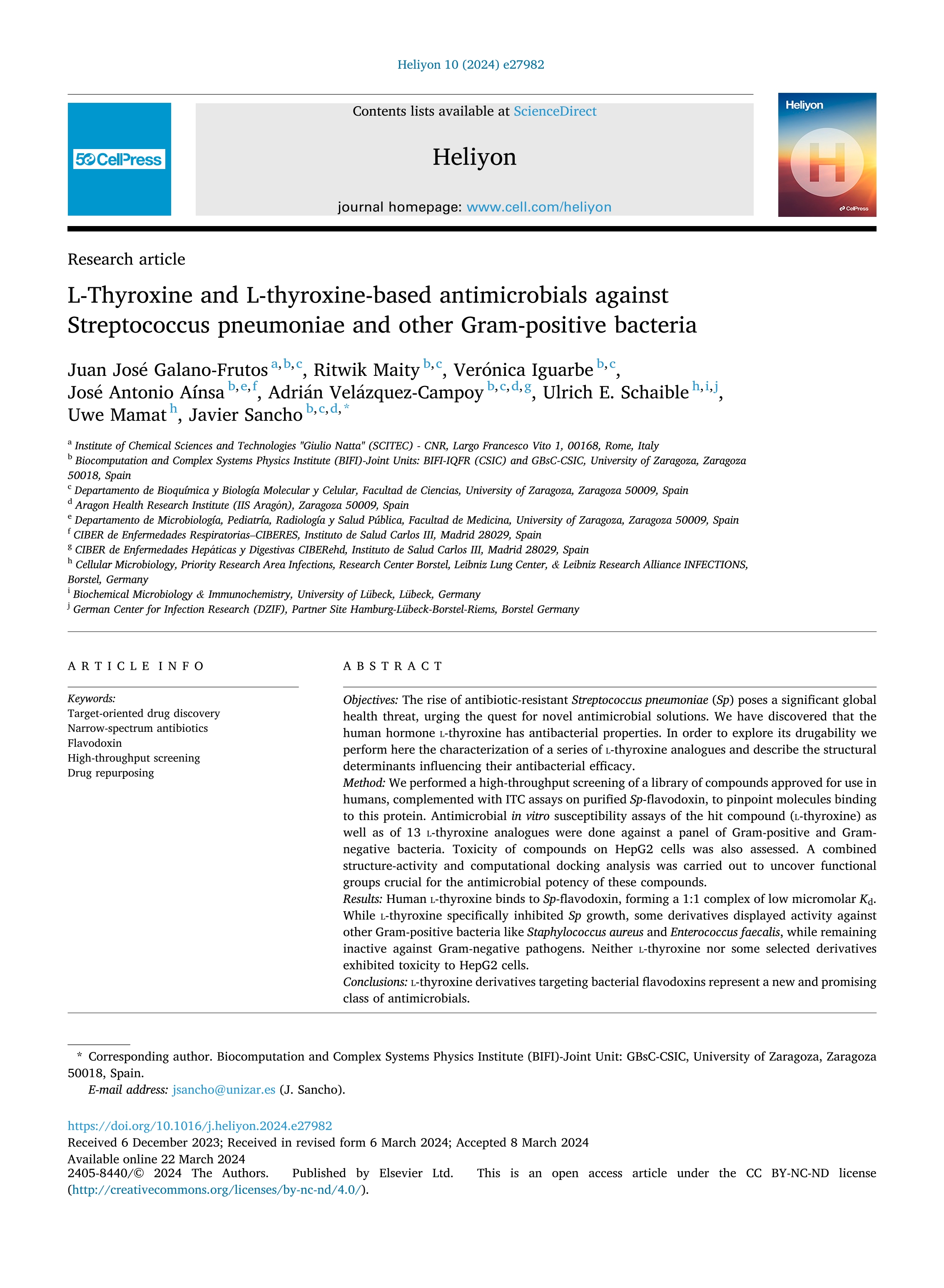
Resumen: Objectives: The rise of antibiotic-resistant Streptococcus pneumoniae (Sp) poses a significant global health threat, urging the quest for novel antimicrobial solutions. We have discovered that the human hormone l-thyroxine has antibacterial properties. In order to explore its drugability we perform here the characterization of a series of l-thyroxine analogues and describe the structural determinants influencing their antibacterial efficacy. Method: We performed a high-throughput screening of a library of compounds approved for use in humans, complemented with ITC assays on purified Sp-flavodoxin, to pinpoint molecules binding to this protein. Antimicrobial in vitro susceptibility assays of the hit compound (l-thyroxine) as well as of 13 l-thyroxine analogues were done against a panel of Gram-positive and Gram-negative bacteria. Toxicity of compounds on HepG2 cells was also assessed. A combined structure-activity and computational docking analysis was carried out to uncover functional groups crucial for the antimicrobial potency of these compounds. Results: Human l-thyroxine binds to Sp-flavodoxin, forming a 1:1 complex of low micromolar Kd. While l-thyroxine specifically inhibited Sp growth, some derivatives displayed activity against other Gram-positive bacteria like Staphylococcus aureus and Enterococcus faecalis, while remaining inactive against Gram-negative pathogens. Neither l-thyroxine nor some selected derivatives exhibited toxicity to HepG2 cells. Conclusions: l-thyroxine derivatives targeting bacterial flavodoxins represent a new and promising class of antimicrobials.
Idioma: Inglés
DOI: 10.1016/j.heliyon.2024.e27982
Año: 2024
Publicado en: Heliyon 10, 7 (2024), e27982 [11 pp.]
ISSN: 2405-8440
Factor impacto JCR: 3.6 (2024)
Categ. JCR: MULTIDISCIPLINARY SCIENCES rank: 29 / 136 = 0.213 (2024) - Q1 - T1
Factor impacto CITESCORE: 4.1 - Multidisciplinary (Q1)
Factor impacto SCIMAGO: 0.644 - Multidisciplinary (Q1)
Financiación: info:eu-repo/grantAgreement/ES/DGA/E45-23R
Financiación: info:eu-repo/grantAgreement/ES/MICINN/PID2019-107293GB-I00
Financiación: info:eu-repo/grantAgreement/ES/MICINN/PID2022-141068NB-I00
Tipo y forma: Article (Published version)
Área (Departamento): Área Microbiología (Dpto. Microb.Ped.Radio.Sal.Pú.)
Área (Departamento): Área Química Orgánica (Dpto. Química Orgánica)
Área (Departamento): Área Bioquímica y Biolog.Mole. (Dpto. Bioq.Biolog.Mol. Celular)
 You must give appropriate credit, provide a link to the license, and indicate if changes were made. You may do so in any reasonable manner, but not in any way that suggests the licensor endorses you or your use. You may not use the material for commercial purposes. If you remix, transform, or build upon the material, you may not distribute the modified material.
Exportado de SIDERAL (2026-02-17-20:23:02)
Visitas y descargas
Idioma: Inglés
DOI: 10.1016/j.heliyon.2024.e27982
Año: 2024
Publicado en: Heliyon 10, 7 (2024), e27982 [11 pp.]
ISSN: 2405-8440
Factor impacto JCR: 3.6 (2024)
Categ. JCR: MULTIDISCIPLINARY SCIENCES rank: 29 / 136 = 0.213 (2024) - Q1 - T1
Factor impacto CITESCORE: 4.1 - Multidisciplinary (Q1)
Factor impacto SCIMAGO: 0.644 - Multidisciplinary (Q1)
Financiación: info:eu-repo/grantAgreement/ES/DGA/E45-23R
Financiación: info:eu-repo/grantAgreement/ES/MICINN/PID2019-107293GB-I00
Financiación: info:eu-repo/grantAgreement/ES/MICINN/PID2022-141068NB-I00
Tipo y forma: Article (Published version)
Área (Departamento): Área Microbiología (Dpto. Microb.Ped.Radio.Sal.Pú.)
Área (Departamento): Área Química Orgánica (Dpto. Química Orgánica)
Área (Departamento): Área Bioquímica y Biolog.Mole. (Dpto. Bioq.Biolog.Mol. Celular)
You must give appropriate credit, provide a link to the license, and indicate if changes were made. You may do so in any reasonable manner, but not in any way that suggests the licensor endorses you or your use. You may not use the material for commercial purposes. If you remix, transform, or build upon the material, you may not distribute the modified material. Exportado de SIDERAL (2026-02-17-20:23:02)
Permalink:
Visitas y descargas
Este artículo se encuentra en las siguientes colecciones:
Articles > Artículos por área > Bioquímica y Biología Molecular
Articles > Artículos por área > Química Orgánica
Articles > Artículos por área > Microbiología
Record created 2024-04-12, last modified 2026-02-17