NIR-II Emission from Cyclometalated Dinuclear Pt(III) Complexes
Melendo, Irene ; Fuertes, Sara ; Martín, Antonio ; Sicilia, Violeta (Universidad de Zaragoza)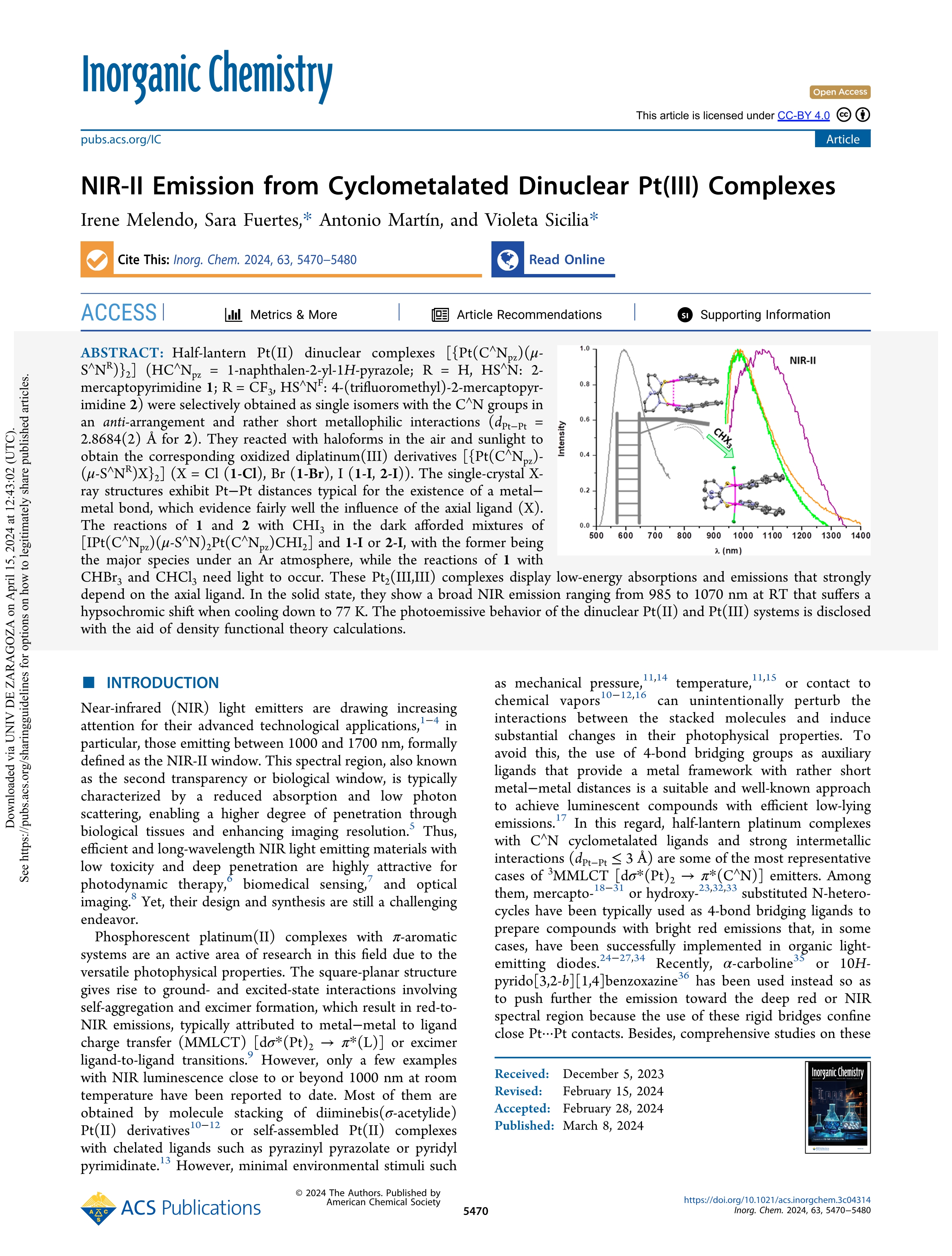
Resumen: Half-lantern Pt(II) dinuclear complexes [{Pt(C∧Npz)(μ-S∧NR)}2] (HC∧Npz = 1-naphthalen-2-yl-1H-pyrazole; R = H, HS∧N: 2-mercaptopyrimidine 1; R = CF3, HS∧NF: 4-(trifluoromethyl)-2-mercaptopyrimidine 2) were selectively obtained as single isomers with the C∧N groups in an anti-arrangement and rather short metallophilic interactions (dPt–Pt = 2.8684(2) Å for 2). They reacted with haloforms in the air and sunlight to obtain the corresponding oxidized diplatinum(III) derivatives [{Pt(C∧Npz)(μ-S∧NR)X}2] (X = Cl (1-Cl), Br (1-Br), I (1-I, 2-I)). The single-crystal X-ray structures exhibit Pt–Pt distances typical for the existence of a metal–metal bond, which evidence fairly well the influence of the axial ligand (X). The reactions of 1 and 2 with CHI3 in the dark afforded mixtures of [IPt(C∧Npz)(μ-S∧N)2Pt(C∧Npz)CHI2] and 1-I or 2-I, with the former being the major species under an Ar atmosphere, while the reactions of 1 with CHBr3 and CHCl3 need light to occur. These Pt2(III,III) complexes display low-energy absorptions and emissions that strongly depend on the axial ligand. In the solid state, they show a broad NIR emission ranging from 985 to 1070 nm at RT that suffers a hypsochromic shift when cooling down to 77 K. The photoemissive behavior of the dinuclear Pt(II) and Pt(III) systems is disclosed with the aid of density functional theory calculations.
Idioma: Inglés
DOI: 10.1021/acs.inorgchem.3c04314
Año: 2024
Publicado en: Inorganic Chemistry 63, 12 (2024), 5470-5480
ISSN: 0020-1669
Factor impacto JCR: 4.7 (2024)
Categ. JCR: CHEMISTRY, INORGANIC & NUCLEAR rank: 6 / 43 = 0.14 (2024) - Q1 - T1
Factor impacto CITESCORE: 7.4 - Inorganic Chemistry (Q1) - Physical and Theoretical Chemistry (Q1)
Factor impacto SCIMAGO: 0.958 - Chemistry (miscellaneous) (Q1) - Physical and Theoretical Chemistry (Q1) - Inorganic Chemistry (Q1)
Financiación: info:eu-repo/grantAgreement/ES/DGA/E17-23R
Financiación: info:eu-repo/grantAgreement/ES/MICINN/PID2021-122869NB-I00
Tipo y forma: Artículo (Versión definitiva)
Área (Departamento): Área Química Inorgánica (Dpto. Química Inorgánica)
 Debe reconocer adecuadamente la autoría, proporcionar un enlace a la licencia e indicar si se han realizado cambios. Puede hacerlo de cualquier manera razonable, pero no de una manera que sugiera que tiene el apoyo del licenciador o lo recibe por el uso que hace.
Exportado de SIDERAL (2026-02-17-20:21:55)
Visitas y descargas
Idioma: Inglés
DOI: 10.1021/acs.inorgchem.3c04314
Año: 2024
Publicado en: Inorganic Chemistry 63, 12 (2024), 5470-5480
ISSN: 0020-1669
Factor impacto JCR: 4.7 (2024)
Categ. JCR: CHEMISTRY, INORGANIC & NUCLEAR rank: 6 / 43 = 0.14 (2024) - Q1 - T1
Factor impacto CITESCORE: 7.4 - Inorganic Chemistry (Q1) - Physical and Theoretical Chemistry (Q1)
Factor impacto SCIMAGO: 0.958 - Chemistry (miscellaneous) (Q1) - Physical and Theoretical Chemistry (Q1) - Inorganic Chemistry (Q1)
Financiación: info:eu-repo/grantAgreement/ES/DGA/E17-23R
Financiación: info:eu-repo/grantAgreement/ES/MICINN/PID2021-122869NB-I00
Tipo y forma: Artículo (Versión definitiva)
Área (Departamento): Área Química Inorgánica (Dpto. Química Inorgánica)
Debe reconocer adecuadamente la autoría, proporcionar un enlace a la licencia e indicar si se han realizado cambios. Puede hacerlo de cualquier manera razonable, pero no de una manera que sugiera que tiene el apoyo del licenciador o lo recibe por el uso que hace. Exportado de SIDERAL (2026-02-17-20:21:55)
Enlace permanente:
Visitas y descargas
Este artículo se encuentra en las siguientes colecciones:
Artículos > Artículos por área > Química Inorgánica
Registro creado el 2024-04-16, última modificación el 2026-02-17