Association Between Pain Coping and Symptoms of Anxiety and Depression, and work absenteeism in people with upper limb musculoskeletal disorders: a systematic review and meta-analysis
Núñez-Cortés, Rodrigo ; Espin, Ander ; Pérez-Alenda, Sofía ; López-Bueno, Rubén (Universidad de Zaragoza) ; Cruz-Montecinos, Carlos ; Vincents-Seeberg, Karina Glies ; Püschel, Thomas A. ; Calatayud, Joaquín ; Andersen, Lars Louis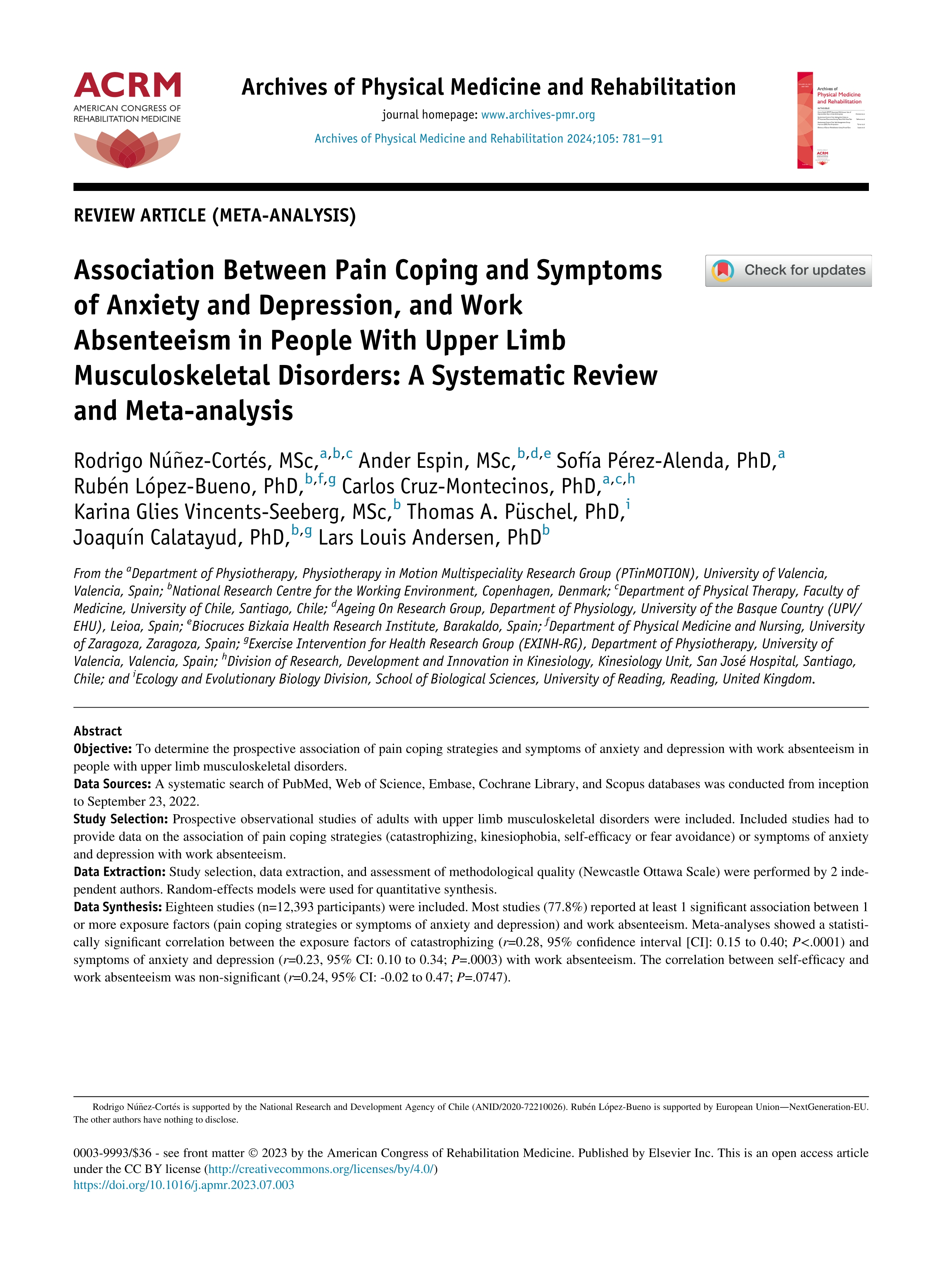
Resumen: Objective:
To determine the prospective association of pain coping strategies and symptoms of anxiety and depression with work absenteeism in people with upper limb musculoskeletal disorders.
Data Sources:
A systematic search of PubMed, Web of Science, Embase, Cochrane Library, and Scopus databases was conducted from inception to September 23, 2022.
Study Selection:
Prospective observational studies of adults with upper limb musculoskeletal disorders were included. Included studies had to provide data on the association of pain coping strategies (catastrophizing, kinesiophobia, self-efficacy or fear avoidance) or symptoms of anxiety and depression with work absenteeism.
Data Extraction:
Study selection, data extraction, and assessment of methodological quality (Newcastle Ottawa Scale) were performed by 2 independent authors. Random-effects models were used for quantitative synthesis.
Data Synthesis:
Eighteen studies (n=12,393 participants) were included. Most studies (77.8%) reported at least 1 significant association between 1 or more exposure factors (pain coping strategies or symptoms of anxiety and depression) and work absenteeism. Meta-analyses showed a statistically significant correlation between the exposure factors of catastrophizing (r=0.28, 95% confidence interval [CI]: 0.15 to 0.40; P<.0001) and symptoms of anxiety and depression (r=0.23, 95% CI: 0.10 to 0.34; P=.0003) with work absenteeism. The correlation between self-efficacy and work absenteeism was non-significant (r=0.24, 95% CI: -0.02 to 0.47; P=.0747).
Conclusions:
Rehabilitation teams should consider assessing catastrophizing and symptoms of anxiety and depression to identify patients at risk for work absenteeism. Addressing these variables may also be considered in return-to-work programs for individuals with upper limb disorders.
Idioma: Inglés
DOI: 10.1016/j.apmr.2023.07.003
Año: 2024
Publicado en: ARCHIVES OF PHYSICAL MEDICINE AND REHABILITATION 105, 4 (2024), 781-791
ISSN: 0003-9993
Factor impacto JCR: 3.7 (2024)
Categ. JCR: SPORT SCIENCES rank: 16 / 133 = 0.12 (2024) - Q1 - T1
Categ. JCR: REHABILITATION rank: 9 / 173 = 0.052 (2024) - Q1 - T1
Factor impacto SCIMAGO: 1.136 - Physical Therapy, Sports Therapy and Rehabilitation (Q1) - Rehabilitation (Q1) - Sports Science (Q2)
Tipo y forma: Article (Published version)
Área (Departamento): Área Didáctica Expres.Corporal (Dpto. Expres.Music.Plást.Corp.)
 You must give appropriate credit, provide a link to the license, and indicate if changes were made. You may do so in any reasonable manner, but not in any way that suggests the licensor endorses you or your use.
Exportado de SIDERAL (2025-09-22-14:35:06)
Visitas y descargas
To determine the prospective association of pain coping strategies and symptoms of anxiety and depression with work absenteeism in people with upper limb musculoskeletal disorders.
Data Sources:
A systematic search of PubMed, Web of Science, Embase, Cochrane Library, and Scopus databases was conducted from inception to September 23, 2022.
Study Selection:
Prospective observational studies of adults with upper limb musculoskeletal disorders were included. Included studies had to provide data on the association of pain coping strategies (catastrophizing, kinesiophobia, self-efficacy or fear avoidance) or symptoms of anxiety and depression with work absenteeism.
Data Extraction:
Study selection, data extraction, and assessment of methodological quality (Newcastle Ottawa Scale) were performed by 2 independent authors. Random-effects models were used for quantitative synthesis.
Data Synthesis:
Eighteen studies (n=12,393 participants) were included. Most studies (77.8%) reported at least 1 significant association between 1 or more exposure factors (pain coping strategies or symptoms of anxiety and depression) and work absenteeism. Meta-analyses showed a statistically significant correlation between the exposure factors of catastrophizing (r=0.28, 95% confidence interval [CI]: 0.15 to 0.40; P<.0001) and symptoms of anxiety and depression (r=0.23, 95% CI: 0.10 to 0.34; P=.0003) with work absenteeism. The correlation between self-efficacy and work absenteeism was non-significant (r=0.24, 95% CI: -0.02 to 0.47; P=.0747).
Conclusions:
Rehabilitation teams should consider assessing catastrophizing and symptoms of anxiety and depression to identify patients at risk for work absenteeism. Addressing these variables may also be considered in return-to-work programs for individuals with upper limb disorders.
Idioma: Inglés
DOI: 10.1016/j.apmr.2023.07.003
Año: 2024
Publicado en: ARCHIVES OF PHYSICAL MEDICINE AND REHABILITATION 105, 4 (2024), 781-791
ISSN: 0003-9993
Factor impacto JCR: 3.7 (2024)
Categ. JCR: SPORT SCIENCES rank: 16 / 133 = 0.12 (2024) - Q1 - T1
Categ. JCR: REHABILITATION rank: 9 / 173 = 0.052 (2024) - Q1 - T1
Factor impacto SCIMAGO: 1.136 - Physical Therapy, Sports Therapy and Rehabilitation (Q1) - Rehabilitation (Q1) - Sports Science (Q2)
Tipo y forma: Article (Published version)
Área (Departamento): Área Didáctica Expres.Corporal (Dpto. Expres.Music.Plást.Corp.)
You must give appropriate credit, provide a link to the license, and indicate if changes were made. You may do so in any reasonable manner, but not in any way that suggests the licensor endorses you or your use. Exportado de SIDERAL (2025-09-22-14:35:06)
Permalink:
Visitas y descargas
Este artículo se encuentra en las siguientes colecciones:
Articles > Artículos por área > Didáctica de la Expresión Corporal
Record created 2024-04-24, last modified 2025-09-23