Developing a scale to explore self-regulatory approaches to assessment and feedback with academics in higher education
Evans, Carol ; Kay, William ; Amici-Dargan, Sheila ; Miguel González, Rafael Pablo (Universidad de Zaragoza) ; Donert, Karl ; Rutherford, Stephen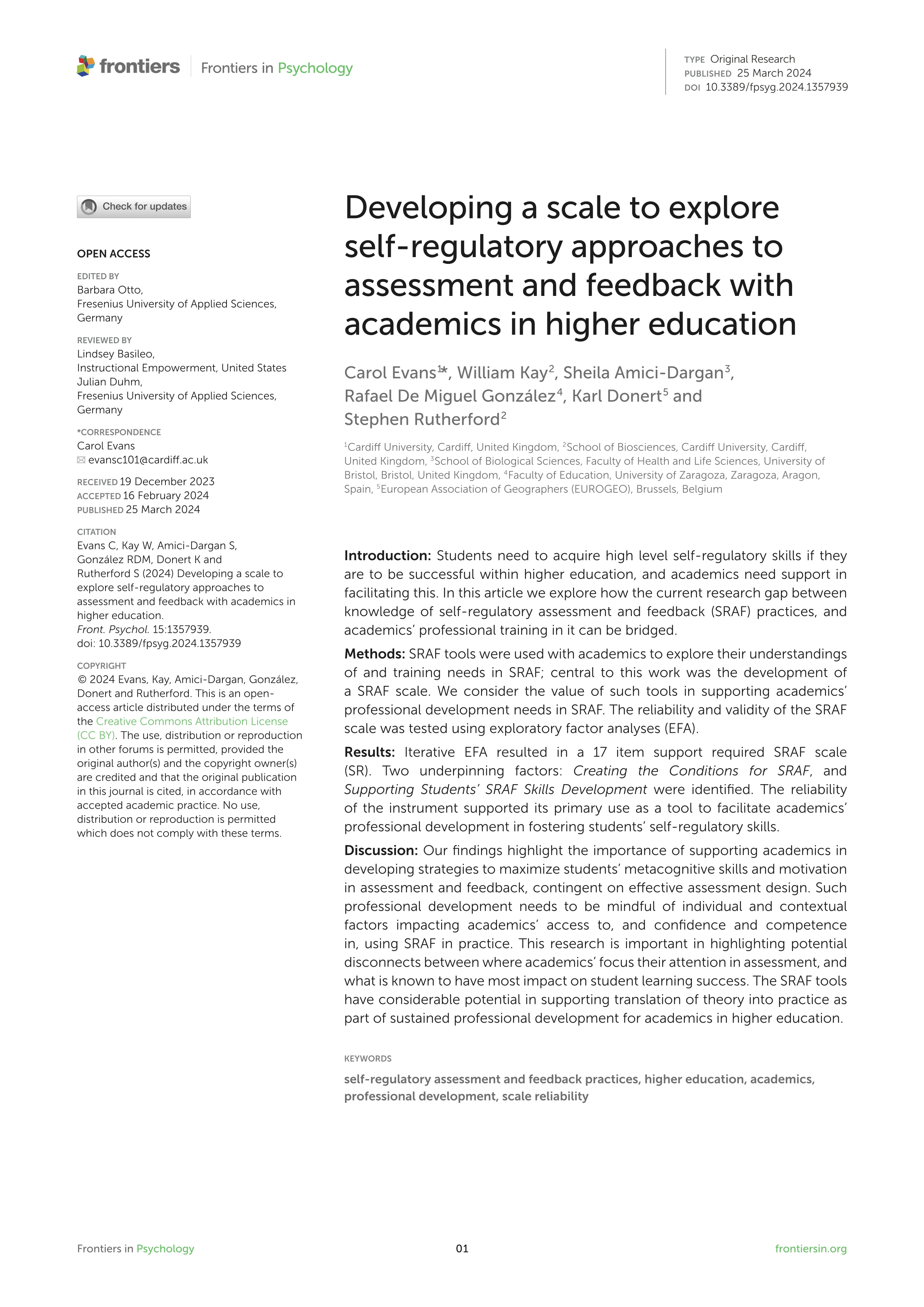
Resumen: Introduction: Students need to acquire high level self-regulatory skills if they are to be successful within higher education, and academics need support in facilitating this. In this article we explore how the current research gap between knowledge of self-regulatory assessment and feedback (SRAF) practices, and academics’ professional training in it can be bridged.
Methods: SRAF tools were used with academics to explore their understandings of and training needs in SRAF; central to this work was the development of a SRAF scale. We consider the value of such tools in supporting academics’ professional development needs in SRAF. The reliability and validity of the SRAF scale was tested using exploratory factor analyses (EFA).
Results: Iterative EFA resulted in a 17 item support required SRAF scale (SR). Two underpinning factors: Creating the Conditions for SRAF, and Supporting Students’ SRAF Skills Development were identified. The reliability of the instrument supported its primary use as a tool to facilitate academics’ professional development in fostering students’ self-regulatory skills.
Discussion: Our findings highlight the importance of supporting academics in developing strategies to maximize students’ metacognitive skills and motivation in assessment and feedback, contingent on effective assessment design. Such professional development needs to be mindful of individual and contextual factors impacting academics’ access to, and confidence and competence in, using SRAF in practice. This research is important in highlighting potential disconnects between where academics’ focus their attention in assessment, and what is known to have most impact on student learning success. The SRAF tools have considerable potential in supporting translation of theory into practice as part of sustained professional development for academics in higher education.
Idioma: Inglés
DOI: 10.3389/fpsyg.2024.1357939
Año: 2024
Publicado en: Frontiers in Psychology 15 (2024), [20 pp.]
ISSN: 1664-1078
Factor impacto JCR: 2.9 (2024)
Categ. JCR: PSYCHOLOGY, MULTIDISCIPLINARY rank: 45 / 223 = 0.202 (2024) - Q1 - T1
Factor impacto CITESCORE: 6.3 - Psychology (all) (Q1)
Factor impacto SCIMAGO: 0.872 - Psychology (miscellaneous) (Q2)
Tipo y forma: Artículo (Versión definitiva)
Área (Departamento): Área Didáctica Ciencias Socia. (Dpto. Didácticas Específicas)
 Debe reconocer adecuadamente la autoría, proporcionar un enlace a la licencia e indicar si se han realizado cambios. Puede hacerlo de cualquier manera razonable, pero no de una manera que sugiera que tiene el apoyo del licenciador o lo recibe por el uso que hace.
Exportado de SIDERAL (2026-02-17-20:26:58)
Visitas y descargas
Methods: SRAF tools were used with academics to explore their understandings of and training needs in SRAF; central to this work was the development of a SRAF scale. We consider the value of such tools in supporting academics’ professional development needs in SRAF. The reliability and validity of the SRAF scale was tested using exploratory factor analyses (EFA).
Results: Iterative EFA resulted in a 17 item support required SRAF scale (SR). Two underpinning factors: Creating the Conditions for SRAF, and Supporting Students’ SRAF Skills Development were identified. The reliability of the instrument supported its primary use as a tool to facilitate academics’ professional development in fostering students’ self-regulatory skills.
Discussion: Our findings highlight the importance of supporting academics in developing strategies to maximize students’ metacognitive skills and motivation in assessment and feedback, contingent on effective assessment design. Such professional development needs to be mindful of individual and contextual factors impacting academics’ access to, and confidence and competence in, using SRAF in practice. This research is important in highlighting potential disconnects between where academics’ focus their attention in assessment, and what is known to have most impact on student learning success. The SRAF tools have considerable potential in supporting translation of theory into practice as part of sustained professional development for academics in higher education.
Idioma: Inglés
DOI: 10.3389/fpsyg.2024.1357939
Año: 2024
Publicado en: Frontiers in Psychology 15 (2024), [20 pp.]
ISSN: 1664-1078
Factor impacto JCR: 2.9 (2024)
Categ. JCR: PSYCHOLOGY, MULTIDISCIPLINARY rank: 45 / 223 = 0.202 (2024) - Q1 - T1
Factor impacto CITESCORE: 6.3 - Psychology (all) (Q1)
Factor impacto SCIMAGO: 0.872 - Psychology (miscellaneous) (Q2)
Tipo y forma: Artículo (Versión definitiva)
Área (Departamento): Área Didáctica Ciencias Socia. (Dpto. Didácticas Específicas)
Debe reconocer adecuadamente la autoría, proporcionar un enlace a la licencia e indicar si se han realizado cambios. Puede hacerlo de cualquier manera razonable, pero no de una manera que sugiera que tiene el apoyo del licenciador o lo recibe por el uso que hace. Exportado de SIDERAL (2026-02-17-20:26:58)
Enlace permanente:
Visitas y descargas
Este artículo se encuentra en las siguientes colecciones:
Artículos > Artículos por área > Didáctica de las Ciencias Sociales
Registro creado el 2024-05-03, última modificación el 2026-02-17