Responsible consumption trend in Generation Z and millennials its impact on SDG 12. A Peruvian case study
Ramirez Lozano, Julianna Paola ; Peñaflor Guerra, Renato ; Sanagustín-Fons, M. Victoria (Universidad de Zaragoza)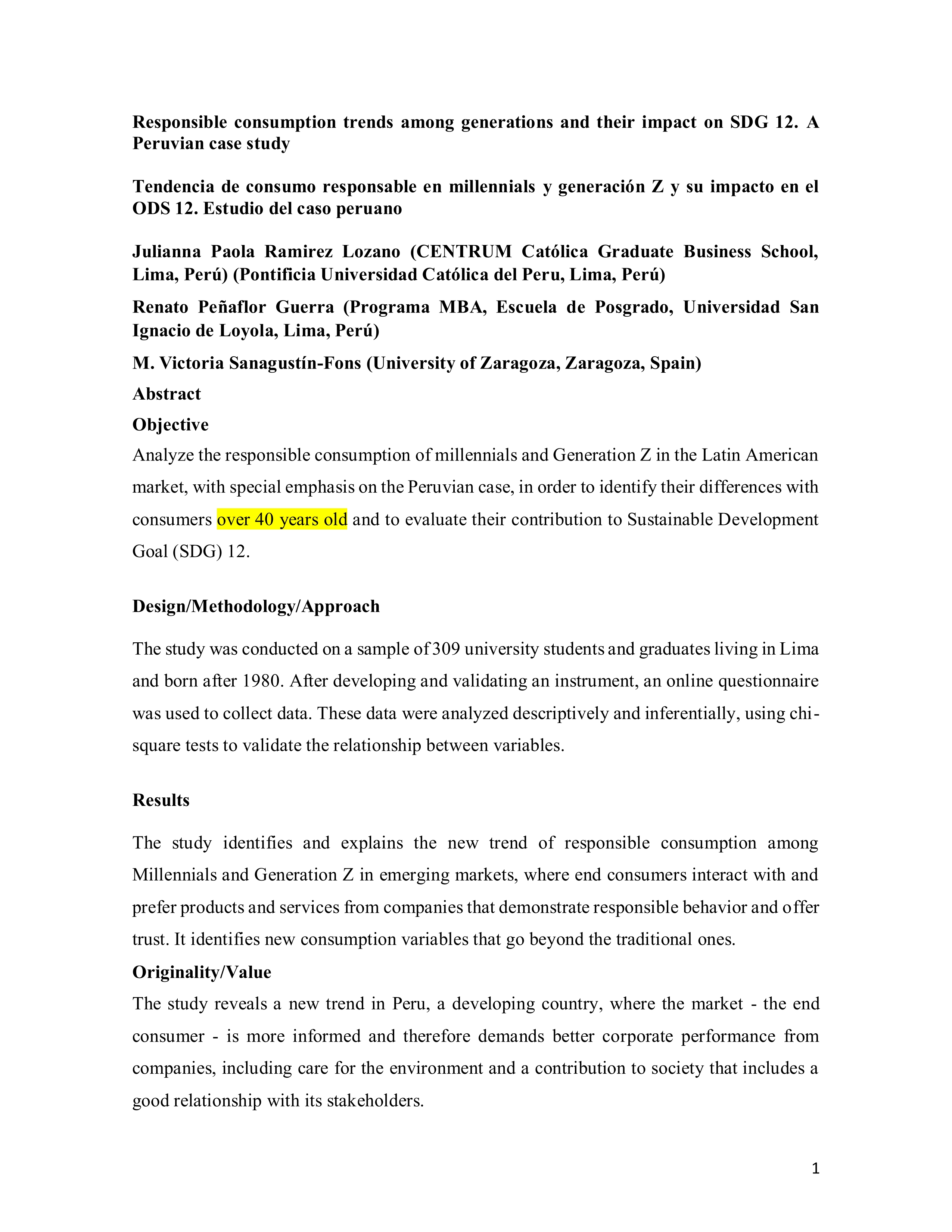
Resumen: Purpose: This study aims to analyze the responsible consumption of Generation Z and millennials in the Latin American market, with special emphasis on the Peruvian case, to identify their differences with consumers born in 1980 and earlier and to evaluate their contribution to Sustainable Development Goal 12.
Design/methodology/approach: The study was conducted on a sample of 309 persons living in Lima. After developing and validating an instrument, an online questionnaire was used to collect data. These data were analyzed descriptively and inferentially, using chi-square tests to validate the relationship between variables.
Findings: The study identifies and explains the new trend of responsible consumption among Generation Z and millennials in emerging markets, where end consumers interact with and prefer products and services from companies that demonstrate responsible behavior and offer trust. It identifies new consumption variables that go beyond the traditional ones.
Research limitations/implications: The study reveals a trend in the responsible consumption of Generation Z and millennials in Peru. However, it is necessary to complement the study in other countries in the region, as well as to study the new generations, such as the alpha generation and their consumption patterns.
Practical implications: The new trend of responsible consumption among Generation Z and millennials is forcing companies to implement strategies and develop corporate social responsibility programs. These companies must demonstrate ethical, environmental, socially responsible and sustainable behaviors in their daily operations to satisfy their stakeholders.
Originality/value: The study reveals a new trend in Peru, a developing country, where the market – the end consumer – is more informed and therefore demands better corporate performance from companies, including care for the environment and a contribution to society that includes a good relationship with its stakeholders.
Idioma: Inglés
DOI: 10.1108/ARLA-07-2022-0142
Año: 2024
Publicado en: Academia-Revista Latinoamericana de Administracion 37, 3 (2024), 483-508
ISSN: 1012-8255
Factor impacto JCR: 1.4 (2024)
Categ. JCR: MANAGEMENT rank: 310 / 420 = 0.738 (2024) - Q3 - T3
Categ. JCR: BUSINESS rank: 224 / 316 = 0.709 (2024) - Q3 - T3
Factor impacto CITESCORE: 3.5 - Strategy and Management (Q2) - Management Science and Operations Research (Q2) - Organizational Behavior and Human Resource Management (Q2) - Business and International Management (Q2)
Factor impacto SCIMAGO: 0.405 - Public Administration (Q2) - Education (Q2) - Economics, Econometrics and Finance (miscellaneous) (Q2) - Organizational Behavior and Human Resource Management (Q3) - Strategy and Management (Q3) - Business and International Management (Q3) - Management Science and Operations Research (Q3)
Tipo y forma: Article (PostPrint)
Área (Departamento): Área Sociología (Dpto. Psicología y Sociología)
 You must give appropriate credit, provide a link to the license, and indicate if changes were made. You may do so in any reasonable manner, but not in any way that suggests the licensor endorses you or your use. You may not use the material for commercial purposes.
Exportado de SIDERAL (2026-02-17-20:30:47)
Visitas y descargas
Design/methodology/approach: The study was conducted on a sample of 309 persons living in Lima. After developing and validating an instrument, an online questionnaire was used to collect data. These data were analyzed descriptively and inferentially, using chi-square tests to validate the relationship between variables.
Findings: The study identifies and explains the new trend of responsible consumption among Generation Z and millennials in emerging markets, where end consumers interact with and prefer products and services from companies that demonstrate responsible behavior and offer trust. It identifies new consumption variables that go beyond the traditional ones.
Research limitations/implications: The study reveals a trend in the responsible consumption of Generation Z and millennials in Peru. However, it is necessary to complement the study in other countries in the region, as well as to study the new generations, such as the alpha generation and their consumption patterns.
Practical implications: The new trend of responsible consumption among Generation Z and millennials is forcing companies to implement strategies and develop corporate social responsibility programs. These companies must demonstrate ethical, environmental, socially responsible and sustainable behaviors in their daily operations to satisfy their stakeholders.
Originality/value: The study reveals a new trend in Peru, a developing country, where the market – the end consumer – is more informed and therefore demands better corporate performance from companies, including care for the environment and a contribution to society that includes a good relationship with its stakeholders.
Idioma: Inglés
DOI: 10.1108/ARLA-07-2022-0142
Año: 2024
Publicado en: Academia-Revista Latinoamericana de Administracion 37, 3 (2024), 483-508
ISSN: 1012-8255
Factor impacto JCR: 1.4 (2024)
Categ. JCR: MANAGEMENT rank: 310 / 420 = 0.738 (2024) - Q3 - T3
Categ. JCR: BUSINESS rank: 224 / 316 = 0.709 (2024) - Q3 - T3
Factor impacto CITESCORE: 3.5 - Strategy and Management (Q2) - Management Science and Operations Research (Q2) - Organizational Behavior and Human Resource Management (Q2) - Business and International Management (Q2)
Factor impacto SCIMAGO: 0.405 - Public Administration (Q2) - Education (Q2) - Economics, Econometrics and Finance (miscellaneous) (Q2) - Organizational Behavior and Human Resource Management (Q3) - Strategy and Management (Q3) - Business and International Management (Q3) - Management Science and Operations Research (Q3)
Tipo y forma: Article (PostPrint)
Área (Departamento): Área Sociología (Dpto. Psicología y Sociología)
You must give appropriate credit, provide a link to the license, and indicate if changes were made. You may do so in any reasonable manner, but not in any way that suggests the licensor endorses you or your use. You may not use the material for commercial purposes. Exportado de SIDERAL (2026-02-17-20:30:47)
Permalink:
Visitas y descargas
Este artículo se encuentra en las siguientes colecciones:
Articles > Artículos por área > Sociología
Record created 2024-07-31, last modified 2026-02-17