Unveiling the Potential of Haloalkenes as Electron Density Acceptors
Velasquez, Juan D. ; Keshtkar, Noushin ; Polo, Víctor (Universidad de Zaragoza) ; Munárriz, Julen (Universidad de Zaragoza) ; Echeverría, Jorge (Universidad de Zaragoza)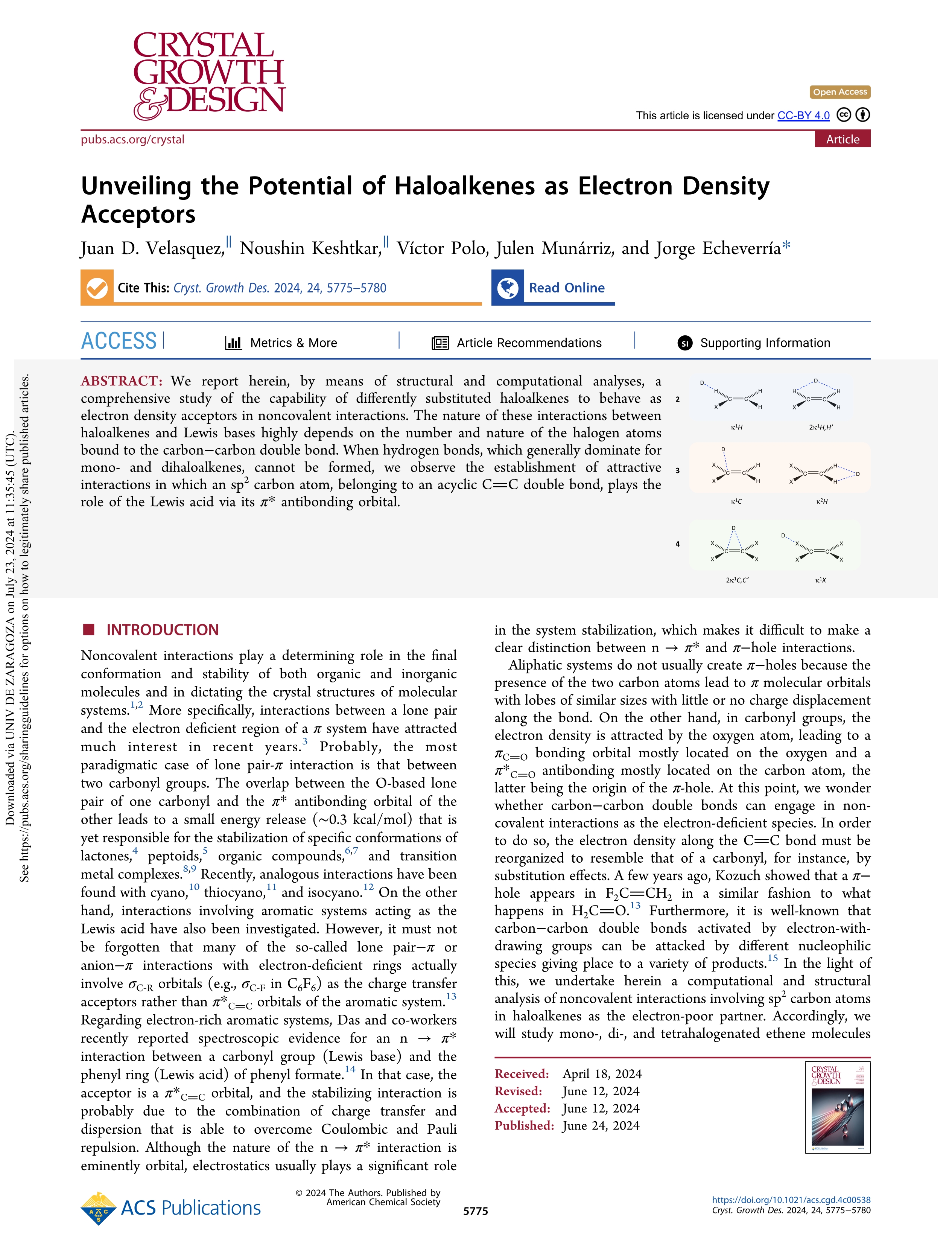
Resumen: We report herein, by means of structural and computational analyses, a comprehensive study of the capability of differently substituted haloalkenes to behave as electron density acceptors in noncovalent interactions. The nature of these interactions between haloalkenes and Lewis bases highly depends on the number and nature of the halogen atoms bound to the carbon–carbon double bond. When hydrogen bonds, which generally dominate for mono- and dihaloalkenes, cannot be formed, we observe the establishment of attractive interactions in which an sp2 carbon atom, belonging to an acyclic C═C double bond, plays the role of the Lewis acid via its π* antibonding orbital.
Idioma: Inglés
DOI: 10.1021/acs.cgd.4c00538
Año: 2024
Publicado en: CRYSTAL GROWTH & DESIGN 24, 13 (2024), 5775-5780
ISSN: 1528-7483
Factor impacto JCR: 3.4 (2024)
Categ. JCR: CRYSTALLOGRAPHY rank: 5 / 31 = 0.161 (2024) - Q1 - T1
Categ. JCR: CHEMISTRY, MULTIDISCIPLINARY rank: 100 / 239 = 0.418 (2024) - Q2 - T2
Categ. JCR: MATERIALS SCIENCE, MULTIDISCIPLINARY rank: 224 / 461 = 0.486 (2024) - Q2 - T2
Factor impacto CITESCORE: 5.6 - Materials Science (all) (Q2) - Condensed Matter Physics (Q2) - Chemistry (all) (Q2)
Factor impacto SCIMAGO: 0.633 - Chemistry (miscellaneous) (Q2) - Materials Science (miscellaneous) (Q2) - Condensed Matter Physics (Q2)
Financiación: info:eu-repo/grantAgreement/ES/AEI/PID2022-140244NB-I00
Financiación: info:eu-repo/grantAgreement/ES/DGA/E07-23R
Financiación: info:eu-repo/grantAgreement/ES/MICINN/PID2021-122763NB-I00
Financiación: info:eu-repo/grantAgreement/ES/MICINN/RYC-2017-22853
Tipo y forma: Article (Published version)
Área (Departamento): Área Química Inorgánica (Dpto. Química Inorgánica)
Área (Departamento): Área Química Física (Dpto. Química Física)
Exportado de SIDERAL (2026-02-17-20:40:53)
Visitas y descargas
Idioma: Inglés
DOI: 10.1021/acs.cgd.4c00538
Año: 2024
Publicado en: CRYSTAL GROWTH & DESIGN 24, 13 (2024), 5775-5780
ISSN: 1528-7483
Factor impacto JCR: 3.4 (2024)
Categ. JCR: CRYSTALLOGRAPHY rank: 5 / 31 = 0.161 (2024) - Q1 - T1
Categ. JCR: CHEMISTRY, MULTIDISCIPLINARY rank: 100 / 239 = 0.418 (2024) - Q2 - T2
Categ. JCR: MATERIALS SCIENCE, MULTIDISCIPLINARY rank: 224 / 461 = 0.486 (2024) - Q2 - T2
Factor impacto CITESCORE: 5.6 - Materials Science (all) (Q2) - Condensed Matter Physics (Q2) - Chemistry (all) (Q2)
Factor impacto SCIMAGO: 0.633 - Chemistry (miscellaneous) (Q2) - Materials Science (miscellaneous) (Q2) - Condensed Matter Physics (Q2)
Financiación: info:eu-repo/grantAgreement/ES/AEI/PID2022-140244NB-I00
Financiación: info:eu-repo/grantAgreement/ES/DGA/E07-23R
Financiación: info:eu-repo/grantAgreement/ES/MICINN/PID2021-122763NB-I00
Financiación: info:eu-repo/grantAgreement/ES/MICINN/RYC-2017-22853
Tipo y forma: Article (Published version)
Área (Departamento): Área Química Inorgánica (Dpto. Química Inorgánica)
Área (Departamento): Área Química Física (Dpto. Química Física)
Exportado de SIDERAL (2026-02-17-20:40:53)
Permalink:
Visitas y descargas
Este artículo se encuentra en las siguientes colecciones:
articulos > articulos-por-area > quimica_inorganica
articulos > articulos-por-area > quimica_fisica
Notice créée le 2024-07-31, modifiée le 2026-02-17