Effects of a dual intervention (motor and virtual reality-based cognitive) on cognition in patients with mild cognitive impairment: a single-blind, randomized controlled trial
Buele, Jorge ; Avilés-Castillo, Fátima ; Del-Valle-Soto, Carolina ; Varela-Aldás, José ; Palacios-Navarro, Guillermo (Universidad de Zaragoza)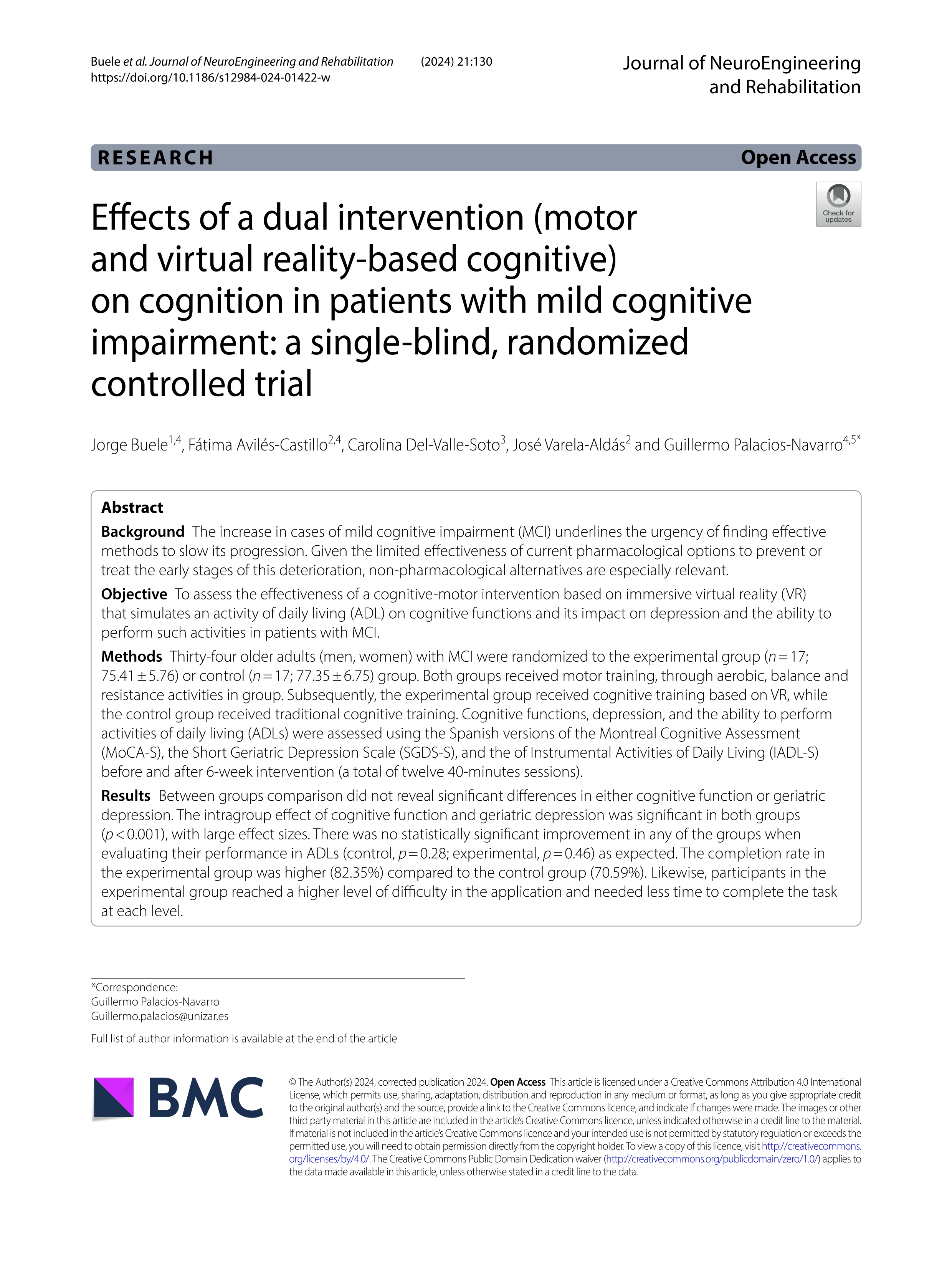
Resumen: Background: The increase in cases of mild cognitive impairment (MCI) underlines the urgency of finding effective methods to slow its progression. Given the limited effectiveness of current pharmacological options to prevent or treat the early stages of this deterioration, non-pharmacological alternatives are especially relevant.
Objective: To assess the effectiveness of a cognitive-motor intervention based on immersive virtual reality (VR) that simulates an activity of daily living (ADL) on cognitive functions and its impact on depression and the ability to perform such activities in patients with MCI.
Methods: Thirty-four older adults (men, women) with MCI were randomized to the experimental group (n = 17; 75.41 ± 5.76) or control (n = 17; 77.35 ± 6.75) group. Both groups received motor training, through aerobic, balance and resistance activities in group. Subsequently, the experimental group received cognitive training based on VR, while the control group received traditional cognitive training. Cognitive functions, depression, and the ability to perform activities of daily living (ADLs) were assessed using the Spanish versions of the Montreal Cognitive Assessment (MoCA-S), the Short Geriatric Depression Scale (SGDS-S), and the of Instrumental Activities of Daily Living (IADL-S) before and after 6-week intervention (a total of twelve 40-minutes sessions).
Results: Between groups comparison did not reveal significant differences in either cognitive function or geriatric depression. The intragroup effect of cognitive function and geriatric depression was significant in both groups (p < 0.001), with large effect sizes. There was no statistically significant improvement in any of the groups when evaluating their performance in ADLs (control, p = 0.28; experimental, p = 0.46) as expected. The completion rate in the experimental group was higher (82.35%) compared to the control group (70.59%). Likewise, participants in the experimental group reached a higher level of difficulty in the application and needed less time to complete the task at each level.
Conclusions: The application of a dual intervention, through motor training prior to a cognitive task based on Immersive VR was shown to be a beneficial non-pharmacological strategy to improve cognitive functions and reduce depression in patients with MCI. Similarly, the control group benefited from such dual intervention with statistically significant improvements.
Idioma: Inglés
DOI: 10.1186/s12984-024-01422-w
Año: 2024
Publicado en: Journal of NeuroEngineering and Rehabilitation 21, 1 (2024), 130 [17 pp.]
ISSN: 1743-0003
Factor impacto JCR: 5.2 (2024)
Categ. JCR: ENGINEERING, BIOMEDICAL rank: 28 / 124 = 0.226 (2024) - Q1 - T1
Categ. JCR: REHABILITATION rank: 4 / 175 = 0.023 (2024) - Q1 - T1
Categ. JCR: NEUROSCIENCES rank: 47 / 314 = 0.15 (2024) - Q1 - T1
Factor impacto CITESCORE: 9.4 - Health Informatics (Q1) - Rehabilitation (Q1)
Factor impacto SCIMAGO: 1.287 - Rehabilitation (Q1) - Health Informatics (Q1)
Tipo y forma: Article (Published version)
Área (Departamento): Área Tecnología Electrónica (Dpto. Ingeniería Electrón.Com.)
 You must give appropriate credit, provide a link to the license, and indicate if changes were made. You may do so in any reasonable manner, but not in any way that suggests the licensor endorses you or your use.
Exportado de SIDERAL (2026-02-17-20:32:58)
Visitas y descargas
Objective: To assess the effectiveness of a cognitive-motor intervention based on immersive virtual reality (VR) that simulates an activity of daily living (ADL) on cognitive functions and its impact on depression and the ability to perform such activities in patients with MCI.
Methods: Thirty-four older adults (men, women) with MCI were randomized to the experimental group (n = 17; 75.41 ± 5.76) or control (n = 17; 77.35 ± 6.75) group. Both groups received motor training, through aerobic, balance and resistance activities in group. Subsequently, the experimental group received cognitive training based on VR, while the control group received traditional cognitive training. Cognitive functions, depression, and the ability to perform activities of daily living (ADLs) were assessed using the Spanish versions of the Montreal Cognitive Assessment (MoCA-S), the Short Geriatric Depression Scale (SGDS-S), and the of Instrumental Activities of Daily Living (IADL-S) before and after 6-week intervention (a total of twelve 40-minutes sessions).
Results: Between groups comparison did not reveal significant differences in either cognitive function or geriatric depression. The intragroup effect of cognitive function and geriatric depression was significant in both groups (p < 0.001), with large effect sizes. There was no statistically significant improvement in any of the groups when evaluating their performance in ADLs (control, p = 0.28; experimental, p = 0.46) as expected. The completion rate in the experimental group was higher (82.35%) compared to the control group (70.59%). Likewise, participants in the experimental group reached a higher level of difficulty in the application and needed less time to complete the task at each level.
Conclusions: The application of a dual intervention, through motor training prior to a cognitive task based on Immersive VR was shown to be a beneficial non-pharmacological strategy to improve cognitive functions and reduce depression in patients with MCI. Similarly, the control group benefited from such dual intervention with statistically significant improvements.
Idioma: Inglés
DOI: 10.1186/s12984-024-01422-w
Año: 2024
Publicado en: Journal of NeuroEngineering and Rehabilitation 21, 1 (2024), 130 [17 pp.]
ISSN: 1743-0003
Factor impacto JCR: 5.2 (2024)
Categ. JCR: ENGINEERING, BIOMEDICAL rank: 28 / 124 = 0.226 (2024) - Q1 - T1
Categ. JCR: REHABILITATION rank: 4 / 175 = 0.023 (2024) - Q1 - T1
Categ. JCR: NEUROSCIENCES rank: 47 / 314 = 0.15 (2024) - Q1 - T1
Factor impacto CITESCORE: 9.4 - Health Informatics (Q1) - Rehabilitation (Q1)
Factor impacto SCIMAGO: 1.287 - Rehabilitation (Q1) - Health Informatics (Q1)
Tipo y forma: Article (Published version)
Área (Departamento): Área Tecnología Electrónica (Dpto. Ingeniería Electrón.Com.)
You must give appropriate credit, provide a link to the license, and indicate if changes were made. You may do so in any reasonable manner, but not in any way that suggests the licensor endorses you or your use. Exportado de SIDERAL (2026-02-17-20:32:58)
Permalink:
Visitas y descargas
Este artículo se encuentra en las siguientes colecciones:
Articles > Artículos por área > Tecnología Electrónica
Record created 2024-08-29, last modified 2026-02-17