Intersectional analysis of social determinants of health and their association with mortality in patients with multimorbidity
Moreno-Juste, Aida ; Laguna-Berna, Clara ; Poblador-Plou, Beatriz ; Calderón-Larrañaga, Amaia ; Librero, Julián ; Lozano-Hernández, Cristina ; Santos-Mejías, Alejandro ; Castillo-Jimena, Marcos ; Gimeno-Miguel, Antonio ; Gimeno-Feliú, Luis A (Universidad de Zaragoza)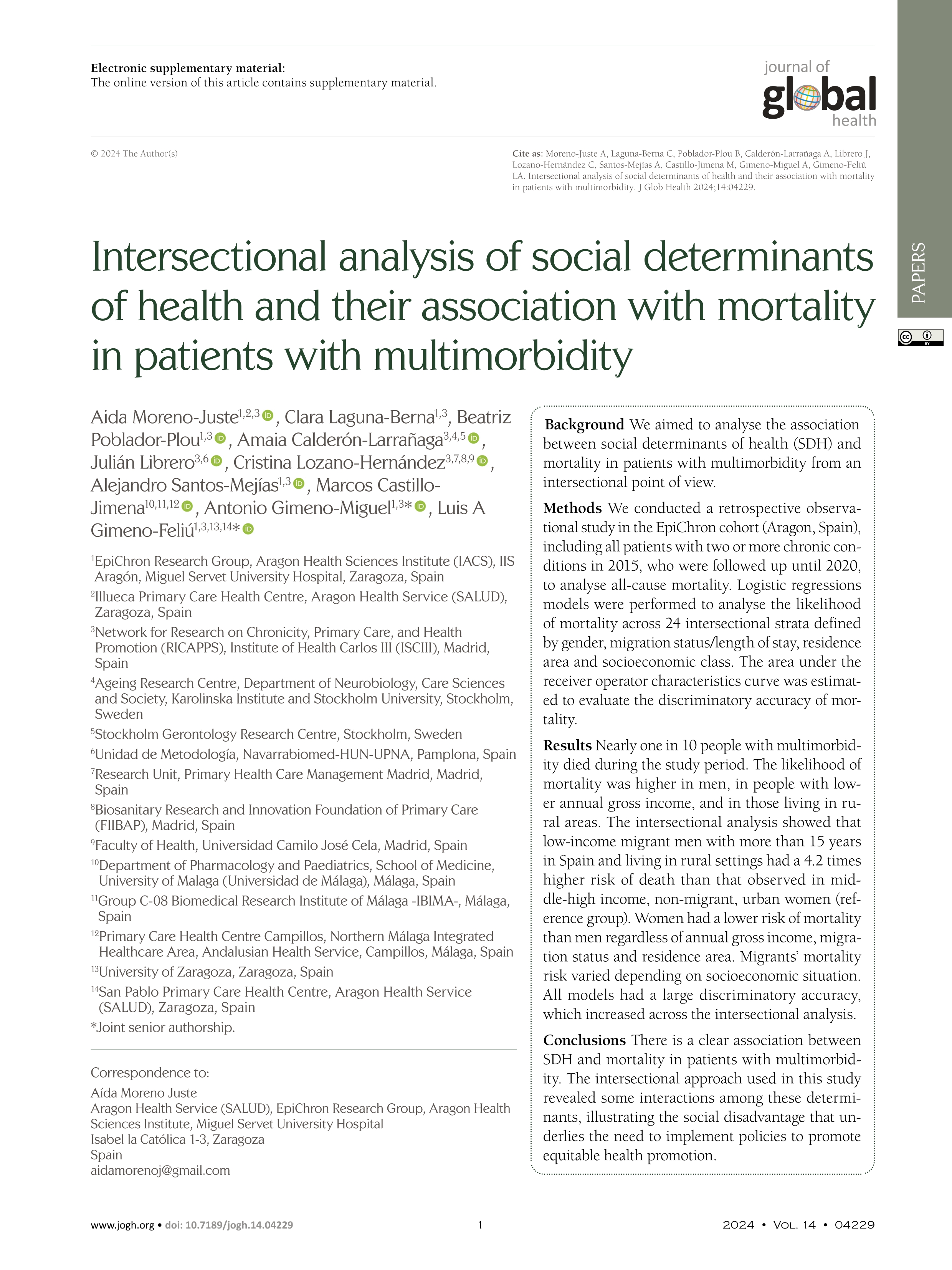
Resumen: Background
We aimed to analyse the association between social determinants of health (SDH) and mortality in patients with multimorbidity from an intersectional point of view.
Methods
We conducted a retrospective observational study in the EpiChron cohort (Aragon, Spain), including all patients with two or more chronic conditions in 2015, who were followed up until 2020, to analyse all-cause mortality. Logistic regressions models were performed to analyse the likelihood of mortality across 24 intersectional strata defined by gender, migration status/length of stay, residence area and socioeconomic class. The area under the receiver operator characteristics curve was estimated to evaluate the discriminatory accuracy of mortality.
Results
Nearly one in 10 people with multimorbidity died during the study period. The likelihood of mortality was higher in men, in people with lower annual gross income, and in those living in rural areas. The intersectional analysis showed that low-income migrant men with more than 15 years in Spain and living in rural settings had a 4.2 times higher risk of death than that observed in middle-high income, non-migrant, urban women (reference group). Women had a lower risk of mortality than men regardless of annual gross income, migration status and residence area. Migrants’ mortality risk varied depending on socioeconomic situation. All models had a large discriminatory accuracy, which increased across the intersectional analysis.
Conclusions
There is a clear association between SDH and mortality in patients with multimorbidity. The intersectional approach used in this study revealed some interactions among these determinants, illustrating the social disadvantage that underlies the need to implement policies to promote equitable health promotion.
Idioma: Inglés
DOI: 10.7189/jogh.14.04229
Año: 2024
Publicado en: Journal of Global Health 14 (2024), 4229 [9 pp.]
ISSN: 2047-2978
Factor impacto JCR: 4.3 (2024)
Categ. JCR: PUBLIC, ENVIRONMENTAL & OCCUPATIONAL HEALTH rank: 47 / 421 = 0.112 (2024) - Q1 - T1
Categ. JCR: PUBLIC, ENVIRONMENTAL & OCCUPATIONAL HEALTH rank: 47 / 421 = 0.112 (2024) - Q1 - T1
Factor impacto CITESCORE: 5.7 - Public Health, Environmental and Occupational Health (Q1) - Health Policy (Q1)
Factor impacto SCIMAGO: 1.172 - Public Health, Environmental and Occupational Health (Q1) - Health Policy (Q1)
Financiación: info:eu-repo/grantAgreement/ES/DGA-FEDER/B01-23R
Financiación: info:eu-repo/grantAgreement/ES/ISCIII/PI22-00701
Financiación: info:eu-repo/grantAgreement/ES/ISCIII/PI22-00768
Financiación: info:eu-repo/grantAgreement/ES/ISCIII/PI22-01651
Financiación: info:eu-repo/grantAgreement/ES/ISCIII/PI22-01665
Financiación: info:eu-repo/grantAgreement/ES/ISCIII-RICAPPS/RD21-0016-0019
Tipo y forma: Article (Published version)
Área (Departamento): Area Medicina (Dpto. Medicina, Psiqu. y Derm.)
Exportado de SIDERAL (2026-02-17-20:44:13)
Visitas y descargas
We aimed to analyse the association between social determinants of health (SDH) and mortality in patients with multimorbidity from an intersectional point of view.
Methods
We conducted a retrospective observational study in the EpiChron cohort (Aragon, Spain), including all patients with two or more chronic conditions in 2015, who were followed up until 2020, to analyse all-cause mortality. Logistic regressions models were performed to analyse the likelihood of mortality across 24 intersectional strata defined by gender, migration status/length of stay, residence area and socioeconomic class. The area under the receiver operator characteristics curve was estimated to evaluate the discriminatory accuracy of mortality.
Results
Nearly one in 10 people with multimorbidity died during the study period. The likelihood of mortality was higher in men, in people with lower annual gross income, and in those living in rural areas. The intersectional analysis showed that low-income migrant men with more than 15 years in Spain and living in rural settings had a 4.2 times higher risk of death than that observed in middle-high income, non-migrant, urban women (reference group). Women had a lower risk of mortality than men regardless of annual gross income, migration status and residence area. Migrants’ mortality risk varied depending on socioeconomic situation. All models had a large discriminatory accuracy, which increased across the intersectional analysis.
Conclusions
There is a clear association between SDH and mortality in patients with multimorbidity. The intersectional approach used in this study revealed some interactions among these determinants, illustrating the social disadvantage that underlies the need to implement policies to promote equitable health promotion.
Idioma: Inglés
DOI: 10.7189/jogh.14.04229
Año: 2024
Publicado en: Journal of Global Health 14 (2024), 4229 [9 pp.]
ISSN: 2047-2978
Factor impacto JCR: 4.3 (2024)
Categ. JCR: PUBLIC, ENVIRONMENTAL & OCCUPATIONAL HEALTH rank: 47 / 421 = 0.112 (2024) - Q1 - T1
Categ. JCR: PUBLIC, ENVIRONMENTAL & OCCUPATIONAL HEALTH rank: 47 / 421 = 0.112 (2024) - Q1 - T1
Factor impacto CITESCORE: 5.7 - Public Health, Environmental and Occupational Health (Q1) - Health Policy (Q1)
Factor impacto SCIMAGO: 1.172 - Public Health, Environmental and Occupational Health (Q1) - Health Policy (Q1)
Financiación: info:eu-repo/grantAgreement/ES/DGA-FEDER/B01-23R
Financiación: info:eu-repo/grantAgreement/ES/ISCIII/PI22-00701
Financiación: info:eu-repo/grantAgreement/ES/ISCIII/PI22-00768
Financiación: info:eu-repo/grantAgreement/ES/ISCIII/PI22-01651
Financiación: info:eu-repo/grantAgreement/ES/ISCIII/PI22-01665
Financiación: info:eu-repo/grantAgreement/ES/ISCIII-RICAPPS/RD21-0016-0019
Tipo y forma: Article (Published version)
Área (Departamento): Area Medicina (Dpto. Medicina, Psiqu. y Derm.)
Exportado de SIDERAL (2026-02-17-20:44:13)
Permalink:
Visitas y descargas
Este artículo se encuentra en las siguientes colecciones:
articulos > articulos-por-area > medicina
Notice créée le 2024-11-08, modifiée le 2026-02-17