Trajectory of Cognitive Decline Before and After Stroke in 14 Population Cohorts
Lo, Jessica W. ; Crawford, John D. ; Lipnicki, Darren M. ; Lipton, Richard B. ; Katz, Mindy J. ; Preux, Pierre-Marie ; Guerchet, Maëlenn ; d’Orsi, Eleonora ; Quialheiro, Anna ; Rech, Cassiano Ricardo ; Ritchie, Karen ; Skoog, Ingmar ; Najar, Jenna ; Sterner, Therese Rydberg ; Rolandi, Elena ; Davin, Annalisa ; Rossi, Michele ; Riedel-Heller, Steffi G. ; Pabst, Alexander ; Röhr, Susanne ; Ganguli, Mary ; Jacobsen, Erin ; Snitz, Beth E. ; Anstey, Kaarin J. ; Aiello, Allison E. ; Brodaty, Henry ; Kochan, Nicole A. ; Chen, Yen-Ching ; Chen, Jen-Hau ; Sanchez-Juan, Pascual ; del Ser, Teodoro ; Valentí, Meritxell ; Lobo, Antonio (Universidad de Zaragoza) ; Cámara Izquierdo, Concepción de la (Universidad de Zaragoza) ; Lobo, Elena (Universidad de Zaragoza) ; Sachdev, Perminder S.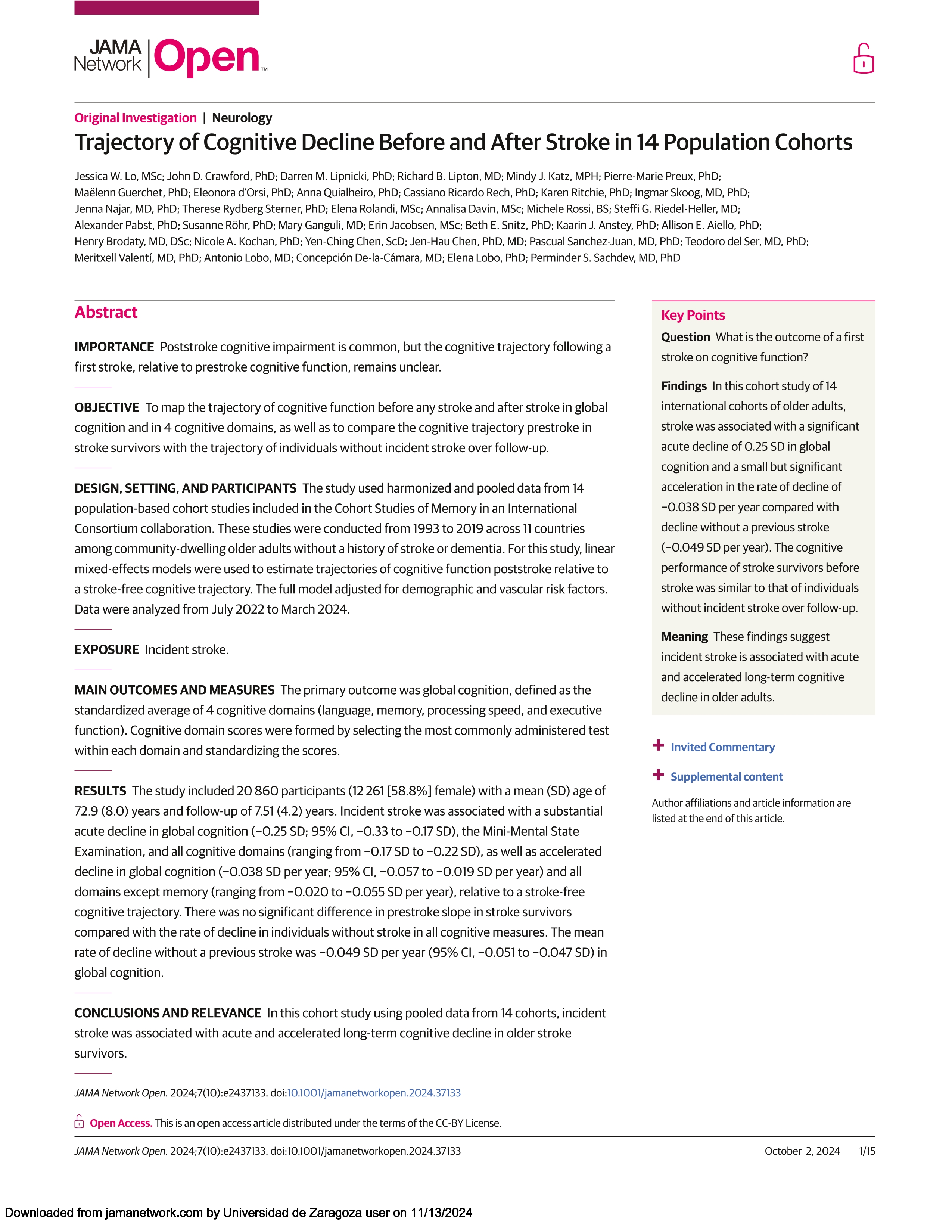
Resumen: ImportancePoststroke cognitive impairment is common, but the cognitive trajectory following a first stroke, relative to prestroke cognitive function, remains unclear.ObjectiveTo map the trajectory of cognitive function before any stroke and after stroke in global cognition and in 4 cognitive domains, as well as to compare the cognitive trajectory prestroke in stroke survivors with the trajectory of individuals without incident stroke over follow-up.Design, Setting, and ParticipantsThe study used harmonized and pooled data from 14 population-based cohort studies included in the Cohort Studies of Memory in an International Consortium collaboration. These studies were conducted from 1993 to 2019 across 11 countries among community-dwelling older adults without a history of stroke or dementia. For this study, linear mixed-effects models were used to estimate trajectories of cognitive function poststroke relative to a stroke-free cognitive trajectory. The full model adjusted for demographic and vascular risk factors. Data were analyzed from July 2022 to March 2024.ExposureIncident stroke.Main outcomes and measuresThe primary outcome was global cognition, defined as the standardized average of 4 cognitive domains (language, memory, processing speed, and executive function). Cognitive domain scores were formed by selecting the most commonly administered test within each domain and standardizing the scores.ResultsThe study included 20 860 participants (12 261 [58.8%] female) with a mean (SD) age of 72.9 (8.0) years and follow-up of 7.51 (4.2) years. Incident stroke was associated with a substantial acute decline in global cognition (−0.25 SD; 95% CI, −0.33 to −0.17 SD), the Mini-Mental State Examination, and all cognitive domains (ranging from −0.17 SD to −0.22 SD), as well as accelerated decline in global cognition (−0.038 SD per year; 95% CI, −0.057 to −0.019 SD per year) and all domains except memory (ranging from −0.020 to −0.055 SD per year), relative to a stroke-free cognitive trajectory. There was no significant difference in prestroke slope in stroke survivors compared with the rate of decline in individuals without stroke in all cognitive measures. The mean rate of decline without a previous stroke was −0.049 SD per year (95% CI, −0.051 to −0.047 SD) in global cognition.Conclusions and relevanceIn this cohort study using pooled data from 14 cohorts, incident stroke was associated with acute and accelerated long-term cognitive decline in older stroke survivors.
Idioma: Inglés
DOI: 10.1001/jamanetworkopen.2024.37133
Año: 2024
Publicado en: JAMA network open 7, 10 (2024), e2437133
ISSN: 2574-3805
Factor impacto JCR: 9.7 (2024)
Categ. JCR: MEDICINE, GENERAL & INTERNAL rank: 16 / 332 = 0.048 (2024) - Q1 - T1
Factor impacto CITESCORE: 13.8 - Medicine (all) (Q1)
Factor impacto SCIMAGO: 3.546 - Medicine (miscellaneous) (Q1)
Financiación: info:eu-repo/grantAgreement/ES/DGA-FEDER/B15-17R
Financiación: info:eu-repo/grantAgreement/ES/MINECO-ISCIII/FIS/G03-128
Financiación: info:eu-repo/grantAgreement/ES/MINECO-ISCIII/FIS/01-0255
Financiación: info:eu-repo/grantAgreement/ES/MINECO-ISCIII/FIS/03-0815
Financiación: info:eu-repo/grantAgreement/ES/MINECO-ISCIII/FIS/06-0617
Financiación: info:eu-repo/grantAgreement/ES/MINECO-ISCIII/FIS/12-02254
Financiación: info:eu-repo/grantAgreement/ES/MINECO-ISCIII/FIS/16-00896
Financiación: info:eu-repo/grantAgreement/ES/MINECO-ISCIII/FIS/19-01874
Financiación: info:eu-repo/grantAgreement/ES/MINECO-ISCIII/FIS/94-1562
Financiación: info:eu-repo/grantAgreement/ES/MINECO-ISCIII/FIS/97-1321E
Financiación: info:eu-repo/grantAgreement/ES/MINECO-ISCIII/FIS/98-0103
Tipo y forma: Artículo (Versión definitiva)
Área (Departamento): Area Anatom.Embriol.Humana (Dpto. Anatom.Histolog.Humanas)
Área (Departamento): Area Psiquiatría (Dpto. Medicina, Psiqu. y Derm.)
Área (Departamento): Área Medic.Prevent.Salud Públ. (Dpto. Microb.Ped.Radio.Sal.Pú.)
 Debe reconocer adecuadamente la autoría, proporcionar un enlace a la licencia e indicar si se han realizado cambios. Puede hacerlo de cualquier manera razonable, pero no de una manera que sugiera que tiene el apoyo del licenciador o lo recibe por el uso que hace.
Exportado de SIDERAL (2026-02-17-20:46:15)
Visitas y descargas
Idioma: Inglés
DOI: 10.1001/jamanetworkopen.2024.37133
Año: 2024
Publicado en: JAMA network open 7, 10 (2024), e2437133
ISSN: 2574-3805
Factor impacto JCR: 9.7 (2024)
Categ. JCR: MEDICINE, GENERAL & INTERNAL rank: 16 / 332 = 0.048 (2024) - Q1 - T1
Factor impacto CITESCORE: 13.8 - Medicine (all) (Q1)
Factor impacto SCIMAGO: 3.546 - Medicine (miscellaneous) (Q1)
Financiación: info:eu-repo/grantAgreement/ES/DGA-FEDER/B15-17R
Financiación: info:eu-repo/grantAgreement/ES/MINECO-ISCIII/FIS/G03-128
Financiación: info:eu-repo/grantAgreement/ES/MINECO-ISCIII/FIS/01-0255
Financiación: info:eu-repo/grantAgreement/ES/MINECO-ISCIII/FIS/03-0815
Financiación: info:eu-repo/grantAgreement/ES/MINECO-ISCIII/FIS/06-0617
Financiación: info:eu-repo/grantAgreement/ES/MINECO-ISCIII/FIS/12-02254
Financiación: info:eu-repo/grantAgreement/ES/MINECO-ISCIII/FIS/16-00896
Financiación: info:eu-repo/grantAgreement/ES/MINECO-ISCIII/FIS/19-01874
Financiación: info:eu-repo/grantAgreement/ES/MINECO-ISCIII/FIS/94-1562
Financiación: info:eu-repo/grantAgreement/ES/MINECO-ISCIII/FIS/97-1321E
Financiación: info:eu-repo/grantAgreement/ES/MINECO-ISCIII/FIS/98-0103
Tipo y forma: Artículo (Versión definitiva)
Área (Departamento): Area Anatom.Embriol.Humana (Dpto. Anatom.Histolog.Humanas)
Área (Departamento): Area Psiquiatría (Dpto. Medicina, Psiqu. y Derm.)
Área (Departamento): Área Medic.Prevent.Salud Públ. (Dpto. Microb.Ped.Radio.Sal.Pú.)
Debe reconocer adecuadamente la autoría, proporcionar un enlace a la licencia e indicar si se han realizado cambios. Puede hacerlo de cualquier manera razonable, pero no de una manera que sugiera que tiene el apoyo del licenciador o lo recibe por el uso que hace. Exportado de SIDERAL (2026-02-17-20:46:15)
Enlace permanente:
Visitas y descargas
Este artículo se encuentra en las siguientes colecciones:
Artículos > Artículos por área > Medicina Preventiva y Salud Pública
Artículos > Artículos por área > Anatomía y Embriología Humana
Artículos > Artículos por área > Psiquiatría
Registro creado el 2024-11-14, última modificación el 2026-02-17