Parent–child microbiota relationships involved in childhood obesity: A CORALS ancillary study
de Cuevillas, Begoña ; Riezu-Boj, Jose I. ; Milagro, Fermín I. ; Galera Alquegui, Sergio ; Babio, Nancy ; Pastor-Villaescusa, Belén ; Gil-Campos, Mercedes ; Leis, Rosaura ; De Miguel-Etayo, Pilar (Universidad de Zaragoza) ; Moreno, Luis A. (Universidad de Zaragoza) ; Salas-Salvadó, Jordi ; Martínez, J. Alfredo ; Navas-Carretero, Santiago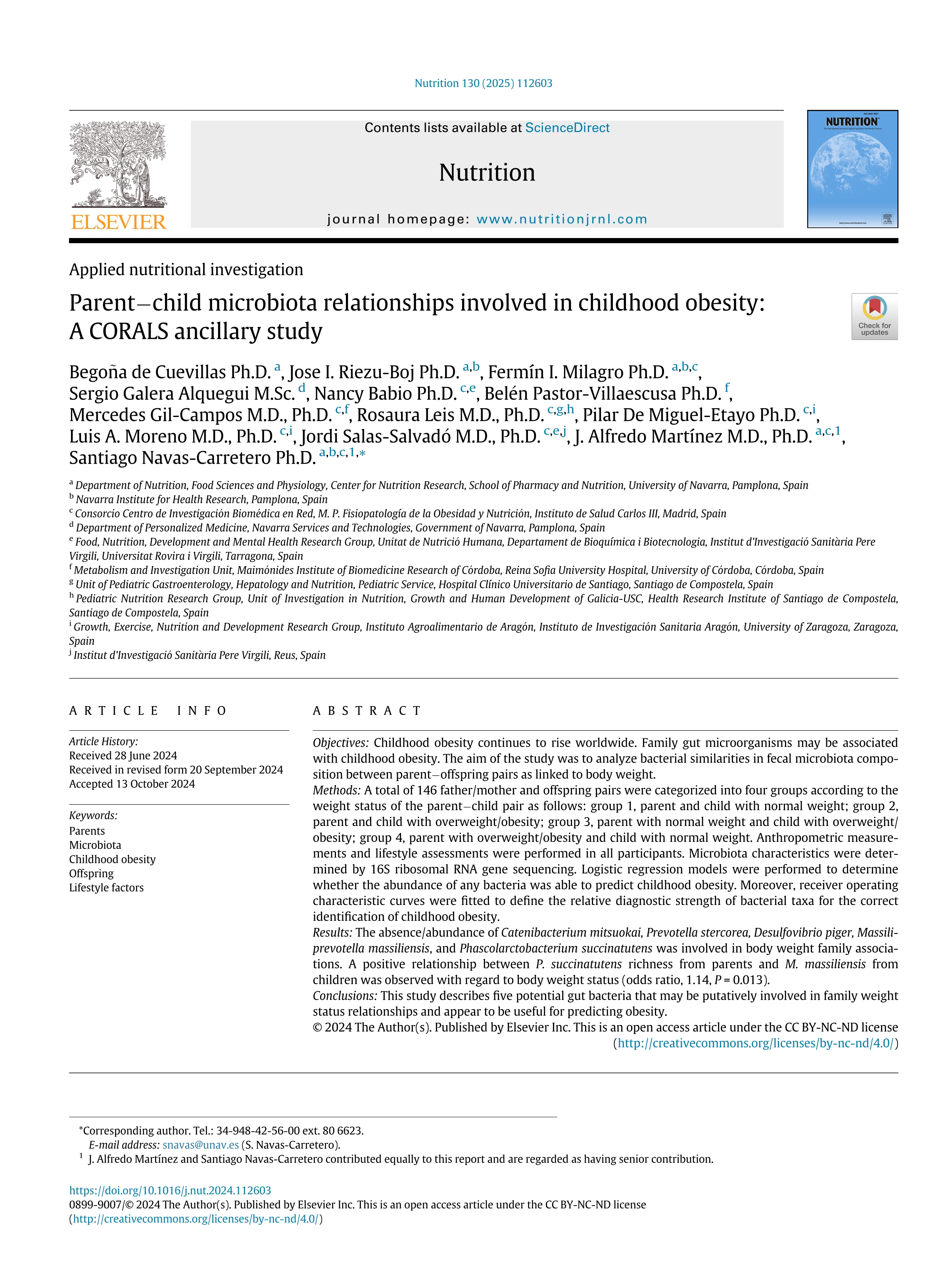
Resumen: Objectives
Childhood obesity continues to rise worldwide. Family gut microorganisms may be associated with childhood obesity. The aim of the study was to analyze bacterial similarities in fecal microbiota composition between parent–offspring pairs as linked to body weight.
Methods
A total of 146 father/mother and offspring pairs were categorized into four groups according to the weight status of the parent–child pair as follows: group 1, parent and child with normal weight; group 2, parent and child with overweight/obesity; group 3, parent with normal weight and child with overweight/obesity; group 4, parent with overweight/obesity and child with normal weight. Anthropometric measurements and lifestyle assessments were performed in all participants. Microbiota characteristics were determined by 16S ribosomal RNA gene sequencing. Logistic regression models were performed to determine whether the abundance of any bacteria was able to predict childhood obesity. Moreover, receiver operating characteristic curves were fitted to define the relative diagnostic strength of bacterial taxa for the correct identification of childhood obesity.
Results
The absence/abundance of Catenibacterium mitsuokai, Prevotella stercorea, Desulfovibrio piger, Massiliprevotella massiliensis, and Phascolarctobacterium succinatutens was involved in body weight family associations. A positive relationship between P. succinatutens richness from parents and M. massiliensis from children was observed with regard to body weight status (odds ratio, 1.14, P = 0.013).
Conclusions
This study describes five potential gut bacteria that may be putatively involved in family weight status relationships and appear to be useful for predicting obesity.
Idioma: Inglés
DOI: 10.1016/j.nut.2024.112603
Año: 2024
Publicado en: NUTRITION 130 (2024), 112603 [9 pp.]
ISSN: 0899-9007
Factor impacto JCR: 3.0 (2024)
Categ. JCR: NUTRITION & DIETETICS rank: 54 / 112 = 0.482 (2024) - Q2 - T2
Factor impacto SCIMAGO: 0.961 - Nutrition and Dietetics (Q2) - Endocrinology, Diabetes and Metabolism (Q2)
Tipo y forma: Artículo (Versión definitiva)
Área (Departamento): Área Enfermería (Dpto. Fisiatría y Enfermería)
Área (Departamento): Área Medic.Prevent.Salud Públ. (Dpto. Microb.Ped.Radio.Sal.Pú.)
 Debe reconocer adecuadamente la autoría, proporcionar un enlace a la licencia e indicar si se han realizado cambios. Puede hacerlo de cualquier manera razonable, pero no de una manera que sugiera que tiene el apoyo del licenciador o lo recibe por el uso que hace. No puede utilizar el material para una finalidad comercial. Si remezcla, transforma o crea a partir del material, no puede difundir el material modificado.
Exportado de SIDERAL (2025-09-22-14:53:50)
Visitas y descargas
Childhood obesity continues to rise worldwide. Family gut microorganisms may be associated with childhood obesity. The aim of the study was to analyze bacterial similarities in fecal microbiota composition between parent–offspring pairs as linked to body weight.
Methods
A total of 146 father/mother and offspring pairs were categorized into four groups according to the weight status of the parent–child pair as follows: group 1, parent and child with normal weight; group 2, parent and child with overweight/obesity; group 3, parent with normal weight and child with overweight/obesity; group 4, parent with overweight/obesity and child with normal weight. Anthropometric measurements and lifestyle assessments were performed in all participants. Microbiota characteristics were determined by 16S ribosomal RNA gene sequencing. Logistic regression models were performed to determine whether the abundance of any bacteria was able to predict childhood obesity. Moreover, receiver operating characteristic curves were fitted to define the relative diagnostic strength of bacterial taxa for the correct identification of childhood obesity.
Results
The absence/abundance of Catenibacterium mitsuokai, Prevotella stercorea, Desulfovibrio piger, Massiliprevotella massiliensis, and Phascolarctobacterium succinatutens was involved in body weight family associations. A positive relationship between P. succinatutens richness from parents and M. massiliensis from children was observed with regard to body weight status (odds ratio, 1.14, P = 0.013).
Conclusions
This study describes five potential gut bacteria that may be putatively involved in family weight status relationships and appear to be useful for predicting obesity.
Idioma: Inglés
DOI: 10.1016/j.nut.2024.112603
Año: 2024
Publicado en: NUTRITION 130 (2024), 112603 [9 pp.]
ISSN: 0899-9007
Factor impacto JCR: 3.0 (2024)
Categ. JCR: NUTRITION & DIETETICS rank: 54 / 112 = 0.482 (2024) - Q2 - T2
Factor impacto SCIMAGO: 0.961 - Nutrition and Dietetics (Q2) - Endocrinology, Diabetes and Metabolism (Q2)
Tipo y forma: Artículo (Versión definitiva)
Área (Departamento): Área Enfermería (Dpto. Fisiatría y Enfermería)
Área (Departamento): Área Medic.Prevent.Salud Públ. (Dpto. Microb.Ped.Radio.Sal.Pú.)
Debe reconocer adecuadamente la autoría, proporcionar un enlace a la licencia e indicar si se han realizado cambios. Puede hacerlo de cualquier manera razonable, pero no de una manera que sugiera que tiene el apoyo del licenciador o lo recibe por el uso que hace. No puede utilizar el material para una finalidad comercial. Si remezcla, transforma o crea a partir del material, no puede difundir el material modificado.Exportado de SIDERAL (2025-09-22-14:53:50)
Enlace permanente:
Visitas y descargas
Este artículo se encuentra en las siguientes colecciones:
Artículos > Artículos por área > Medicina Preventiva y Salud Pública
Artículos > Artículos por área > Enfermería
Registro creado el 2024-12-05, última modificación el 2025-09-23