Recontextualizing knowledge in academic video publications
Velilla Sánchez, María Ángeles (Universidad de Zaragoza)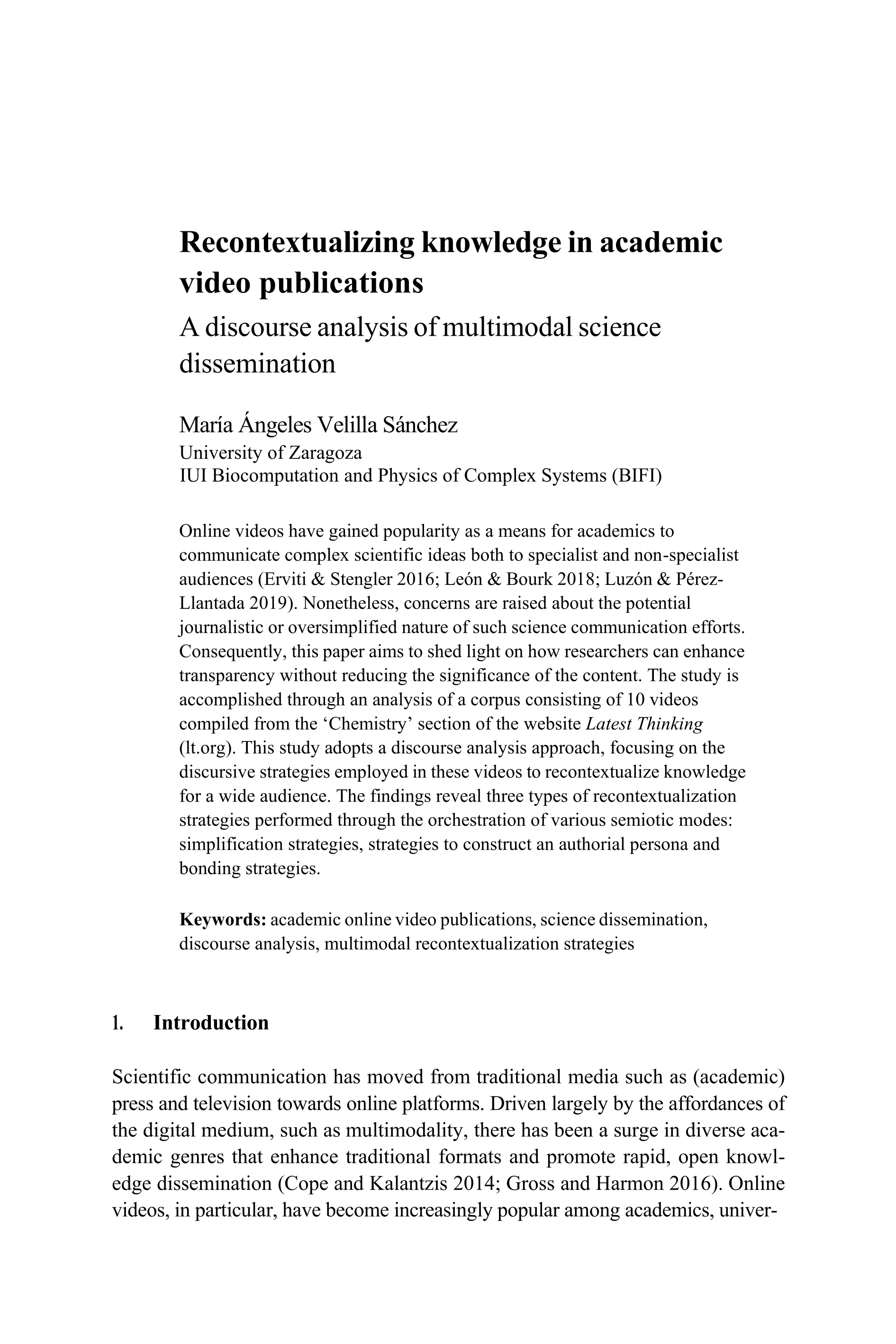
Resumen: Online videos have gained popularity as a means for academics to communicate complex scientific ideas both to specialist and non-specialist audiences (Erviti ; Stengler 2016; León ; Bourk 2018; Luzón ; Pérez-Llantada 2019). Nonetheless, concerns are raised about the potential journalistic or oversimplified nature of such science communication efforts. Consequently, this paper aims to shed light on how researchers can enhance transparency without reducing the significance of the content. The study is accomplished through an analysis of a corpus consisting of 10 videos compiled from the ‘Chemistry’ section of the website Latest Thinking (lt.org). This study adopts a discourse analysis approach, focusing on the discursive strategies employed in these videos to recontextualize knowledge for a wide audience. The findings reveal three types of recontextualization strategies performed through the orchestration of various semiotic modes: simplification strategies, strategies to construct an authorial persona and bonding strategies.
Idioma: Inglés
DOI: 10.1075/ps.23124.vel
Año: 2025
Publicado en: Pragmatics and society 16, 5 (2025), 676-700
ISSN: 1878-9714
Factor impacto JCR: 0.7 (2024)
Categ. JCR: LINGUISTICS rank: 187 / 306 = 0.611 (2024) - Q3 - T2
Factor impacto CITESCORE: 1.8 - Linguistics and Language (Q1) - Language and Linguistics (Q1)
Factor impacto SCIMAGO: 0.687 - Linguistics and Language (Q1)
Tipo y forma: Article (PostPrint)
Área (Departamento): Área Filología Inglesa (Dpto. Filolog.Inglesa y Alema.)
 You must give appropriate credit, provide a link to the license, and indicate if changes were made. You may do so in any reasonable manner, but not in any way that suggests the licensor endorses you or your use.
Exportado de SIDERAL (2026-04-18-11:05:06)
Visitas y descargas
Idioma: Inglés
DOI: 10.1075/ps.23124.vel
Año: 2025
Publicado en: Pragmatics and society 16, 5 (2025), 676-700
ISSN: 1878-9714
Factor impacto JCR: 0.7 (2024)
Categ. JCR: LINGUISTICS rank: 187 / 306 = 0.611 (2024) - Q3 - T2
Factor impacto CITESCORE: 1.8 - Linguistics and Language (Q1) - Language and Linguistics (Q1)
Factor impacto SCIMAGO: 0.687 - Linguistics and Language (Q1)
Tipo y forma: Article (PostPrint)
Área (Departamento): Área Filología Inglesa (Dpto. Filolog.Inglesa y Alema.)
You must give appropriate credit, provide a link to the license, and indicate if changes were made. You may do so in any reasonable manner, but not in any way that suggests the licensor endorses you or your use. Exportado de SIDERAL (2026-04-18-11:05:06)
Permalink:
Visitas y descargas
Este artículo se encuentra en las siguientes colecciones:
Articles > Artículos por área > Filología Inglesa
Record created 2025-01-07, last modified 2026-04-18