Differentiating healthy orthorexia from orthorexia nervosa: sociodemographic, psychological and dietary characteristics in a French sample
Hanras, Eva ; Boujut, Emilie ; Barrada, Juan Ramón (Universidad de Zaragoza) ; Dorard, Géraldine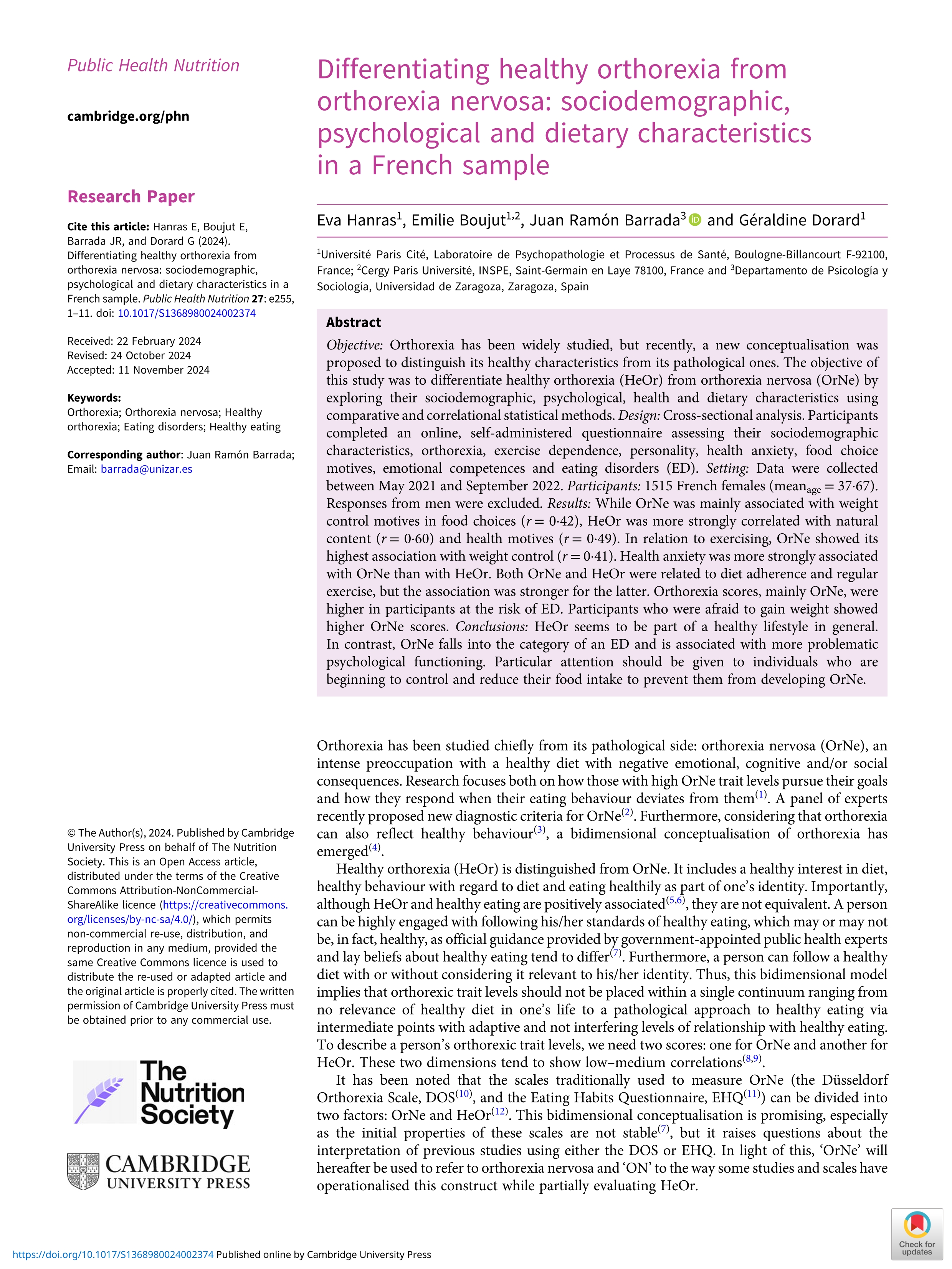
Resumen: Objective: Orthorexia has been widely studied, but recently, a new conceptualisation was proposed to distinguish its healthy characteristics from its pathological ones. The objective of this study was to differentiate healthy orthorexia (HeOr) from orthorexia nervosa (OrNe) by exploring their sociodemographic, psychological, health and dietary characteristics using comparative and correlational statistical methods. Design: Cross-sectional analysis. Participants completed an online, self-administered questionnaire assessing their sociodemographic characteristics, orthorexia, exercise dependence, personality, health anxiety, food choice motives, emotional competences and eating disorders (ED). Setting:Data were collected between May 2021 and September 2022. Participants:1515 French females (meanage = 37·67). Responses from men were excluded. Results:While OrNe was mainly associated with weight control motives in food choices (r = 0·42), HeOr was more strongly correlated with natural content (r = 0·60) and health motives (r = 0·49). In relation to exercising, OrNe showed its highest association with weight control (r = 0·41). Health anxiety was more strongly associated with OrNe than with HeOr. Both OrNe and HeOr were related to diet adherence and regular exercise, but the association was stronger for the latter. Orthorexia scores, mainly OrNe, were higher in participants at the risk of ED. Participants who were afraid to gain weight showed higher OrNe scores. Conclusions: HeOr seems to be part of a healthy lifestyle in general. In contrast, OrNe falls into the category of an ED and is associated with more problematic psychological functioning. Particular attention should be given to individuals who are beginning to control and reduce their food intake to prevent them from developing OrNe.
Idioma: Inglés
DOI: 10.1017/S1368980024002374
Año: 2024
Publicado en: Public Health Nutrition 27 (2024), e255 [11 pp.]
ISSN: 1368-9800
Factor impacto JCR: 3.0 (2024)
Categ. JCR: PUBLIC, ENVIRONMENTAL & OCCUPATIONAL HEALTH rank: 111 / 421 = 0.264 (2024) - Q2 - T1
Categ. JCR: NUTRITION & DIETETICS rank: 54 / 113 = 0.478 (2024) - Q2 - T2
Factor impacto CITESCORE: 6.6 - Medicine (miscellaneous) (Q1) - Public Health, Environmental and Occupational Health (Q1) - Nutrition and Dietetics (Q2)
Factor impacto SCIMAGO: 0.987 - Medicine (miscellaneous) (Q1) - Public Health, Environmental and Occupational Health (Q1) - Nutrition and Dietetics (Q2)
Tipo y forma: Article (Published version)
Área (Departamento): Área Psicolog.Evolut.Educac (Dpto. Psicología y Sociología)
 You must give appropriate credit, provide a link to the license, and indicate if changes were made. You may do so in any reasonable manner, but not in any way that suggests the licensor endorses you or your use. You may not use the material for commercial purposes. If you remix, transform, or build upon the material, you must distribute your contributions under the same license as the original.
Exportado de SIDERAL (2026-02-17-20:35:46)
Visitas y descargas
Idioma: Inglés
DOI: 10.1017/S1368980024002374
Año: 2024
Publicado en: Public Health Nutrition 27 (2024), e255 [11 pp.]
ISSN: 1368-9800
Factor impacto JCR: 3.0 (2024)
Categ. JCR: PUBLIC, ENVIRONMENTAL & OCCUPATIONAL HEALTH rank: 111 / 421 = 0.264 (2024) - Q2 - T1
Categ. JCR: NUTRITION & DIETETICS rank: 54 / 113 = 0.478 (2024) - Q2 - T2
Factor impacto CITESCORE: 6.6 - Medicine (miscellaneous) (Q1) - Public Health, Environmental and Occupational Health (Q1) - Nutrition and Dietetics (Q2)
Factor impacto SCIMAGO: 0.987 - Medicine (miscellaneous) (Q1) - Public Health, Environmental and Occupational Health (Q1) - Nutrition and Dietetics (Q2)
Tipo y forma: Article (Published version)
Área (Departamento): Área Psicolog.Evolut.Educac (Dpto. Psicología y Sociología)
You must give appropriate credit, provide a link to the license, and indicate if changes were made. You may do so in any reasonable manner, but not in any way that suggests the licensor endorses you or your use. You may not use the material for commercial purposes. If you remix, transform, or build upon the material, you must distribute your contributions under the same license as the original. Exportado de SIDERAL (2026-02-17-20:35:46)
Permalink:
Visitas y descargas
Este artículo se encuentra en las siguientes colecciones:
Articles > Artículos por área > Psicología Evolutiva y de la Educación
Record created 2025-01-14, last modified 2026-02-17