Gender Differences in Outcomes of Ambulatory and Hospitalized Patients With Obesity Hypoventilation Syndrome
Nowalk, Nathan C. ; Mokhlesi, Babak ; Neborak, Julie M. ; Masa Jimenez, Juan Fernando ; Benitez, Ivan ; Gomez de Terreros, Francisco J. ; Romero, Auxiliadora ; Caballero-Eraso, Candela ; Troncoso, Maria F. ; González, Mónica ; López-Martín, Soledad ; Marin, José M. (Universidad de Zaragoza) ; Martí, Sergi ; Díaz-Cambriles, Trinidad ; Chiner, Eusebi ; Egea, Carlos ; Utrabo, Isabel ; Barbe, Ferran ; Sánchez-Quiroga, Maria Ángeles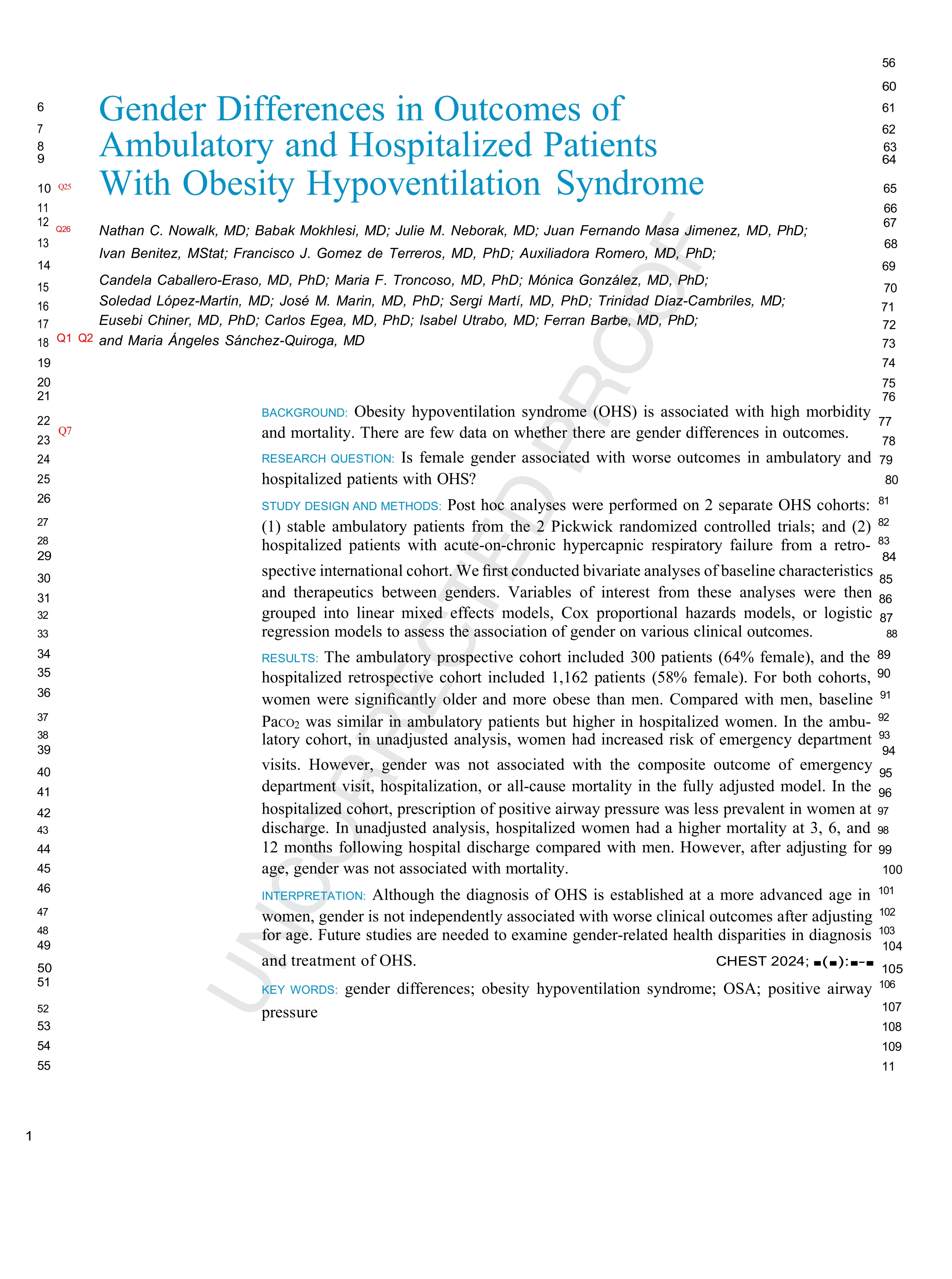
Resumen: Background
Obesity hypoventilation syndrome (OHS) is associated with high morbidity and mortality. There are few data on whether there are gender differences in outcomes.
Research Question
Do women with OHS experience worse outcomes in ambulatory and hospitalized settings compared to men?
Study Design and Methods
Post hoc analyses were performed on two separate OHS cohorts: (1) stable ambulatory patients from the two Pickwick randomized controlled trials; and (2) hospitalized patients with acute-on-chronic hypercapnic respiratory failure from a retrospective international cohort. We first conducted bivariate analyses of baseline characteristics and therapeutics between genders. Variables of interest from these analyses were then grouped into linear mixed effects models, Cox proportional hazards models, or logistic regression models to assess the association of gender on various clinical outcomes.
Results
The ambulatory prospective cohort included 300 patients (64% self-identified as women), and the hospitalized retrospective cohort included 1,162 patients (58% self-identified as women). For both cohorts, women were significantly older and more obese than men. Compared with men, baseline Paco2 was similar in ambulatory patients but higher in hospitalized women. In the ambulatory cohort, in unadjusted analysis, women had increased risk of emergency department visits. However, gender was not associated with the composite outcome of emergency department visit, hospitalization, or all-cause mortality in the fully adjusted model. In the hospitalized cohort, prescription of positive airway pressure was less prevalent in women at discharge. In unadjusted analysis, hospitalized women had a higher mortality at 3, 6, and 12 months following hospital discharge compared with men. However, after adjusting for age, gender was not associated with mortality.
Interpretation
Our findings indicate that although the diagnosis of OHS is established at a more advanced age in women, gender is not independently associated with worse clinical outcomes after adjusting for age. Future studies are needed to examine gender-related health disparities in diagnosis and treatment of OHS.
Idioma: Inglés
DOI: 10.1016/j.chest.2024.10.002
Año: 2024
Publicado en: Chest 167, 1 (2024), 245-248
ISSN: 0012-3692
Factor impacto JCR: 8.6 (2024)
Categ. JCR: CRITICAL CARE MEDICINE rank: 5 / 62 = 0.081 (2024) - Q1 - T1
Categ. JCR: RESPIRATORY SYSTEM rank: 7 / 108 = 0.065 (2024) - Q1 - T1
Factor impacto SCIMAGO: 1.834 - Cardiology and Cardiovascular Medicine (Q1) - Pulmonary and Respiratory Medicine (Q1) - Critical Care and Intensive Care Medicine (Q1)
Financiación: info:eu-repo/grantAgreement/ES/ISCIII PI0540402
Tipo y forma: Article (PostPrint)
Área (Departamento): Area Medicina (Dpto. Medicina, Psiqu. y Derm.)
 You must give appropriate credit, provide a link to the license, and indicate if changes were made. You may do so in any reasonable manner, but not in any way that suggests the licensor endorses you or your use. You may not use the material for commercial purposes. If you remix, transform, or build upon the material, you may not distribute the modified material.
Exportado de SIDERAL (2025-09-22-14:44:45)
Visitas y descargas
Obesity hypoventilation syndrome (OHS) is associated with high morbidity and mortality. There are few data on whether there are gender differences in outcomes.
Research Question
Do women with OHS experience worse outcomes in ambulatory and hospitalized settings compared to men?
Study Design and Methods
Post hoc analyses were performed on two separate OHS cohorts: (1) stable ambulatory patients from the two Pickwick randomized controlled trials; and (2) hospitalized patients with acute-on-chronic hypercapnic respiratory failure from a retrospective international cohort. We first conducted bivariate analyses of baseline characteristics and therapeutics between genders. Variables of interest from these analyses were then grouped into linear mixed effects models, Cox proportional hazards models, or logistic regression models to assess the association of gender on various clinical outcomes.
Results
The ambulatory prospective cohort included 300 patients (64% self-identified as women), and the hospitalized retrospective cohort included 1,162 patients (58% self-identified as women). For both cohorts, women were significantly older and more obese than men. Compared with men, baseline Paco2 was similar in ambulatory patients but higher in hospitalized women. In the ambulatory cohort, in unadjusted analysis, women had increased risk of emergency department visits. However, gender was not associated with the composite outcome of emergency department visit, hospitalization, or all-cause mortality in the fully adjusted model. In the hospitalized cohort, prescription of positive airway pressure was less prevalent in women at discharge. In unadjusted analysis, hospitalized women had a higher mortality at 3, 6, and 12 months following hospital discharge compared with men. However, after adjusting for age, gender was not associated with mortality.
Interpretation
Our findings indicate that although the diagnosis of OHS is established at a more advanced age in women, gender is not independently associated with worse clinical outcomes after adjusting for age. Future studies are needed to examine gender-related health disparities in diagnosis and treatment of OHS.
Idioma: Inglés
DOI: 10.1016/j.chest.2024.10.002
Año: 2024
Publicado en: Chest 167, 1 (2024), 245-248
ISSN: 0012-3692
Factor impacto JCR: 8.6 (2024)
Categ. JCR: CRITICAL CARE MEDICINE rank: 5 / 62 = 0.081 (2024) - Q1 - T1
Categ. JCR: RESPIRATORY SYSTEM rank: 7 / 108 = 0.065 (2024) - Q1 - T1
Factor impacto SCIMAGO: 1.834 - Cardiology and Cardiovascular Medicine (Q1) - Pulmonary and Respiratory Medicine (Q1) - Critical Care and Intensive Care Medicine (Q1)
Financiación: info:eu-repo/grantAgreement/ES/ISCIII PI0540402
Tipo y forma: Article (PostPrint)
Área (Departamento): Area Medicina (Dpto. Medicina, Psiqu. y Derm.)
You must give appropriate credit, provide a link to the license, and indicate if changes were made. You may do so in any reasonable manner, but not in any way that suggests the licensor endorses you or your use. You may not use the material for commercial purposes. If you remix, transform, or build upon the material, you may not distribute the modified material. Exportado de SIDERAL (2025-09-22-14:44:45)
Permalink:
Visitas y descargas
Este artículo se encuentra en las siguientes colecciones:
Articles > Artículos por área > Medicina
Record created 2025-01-16, last modified 2025-09-23