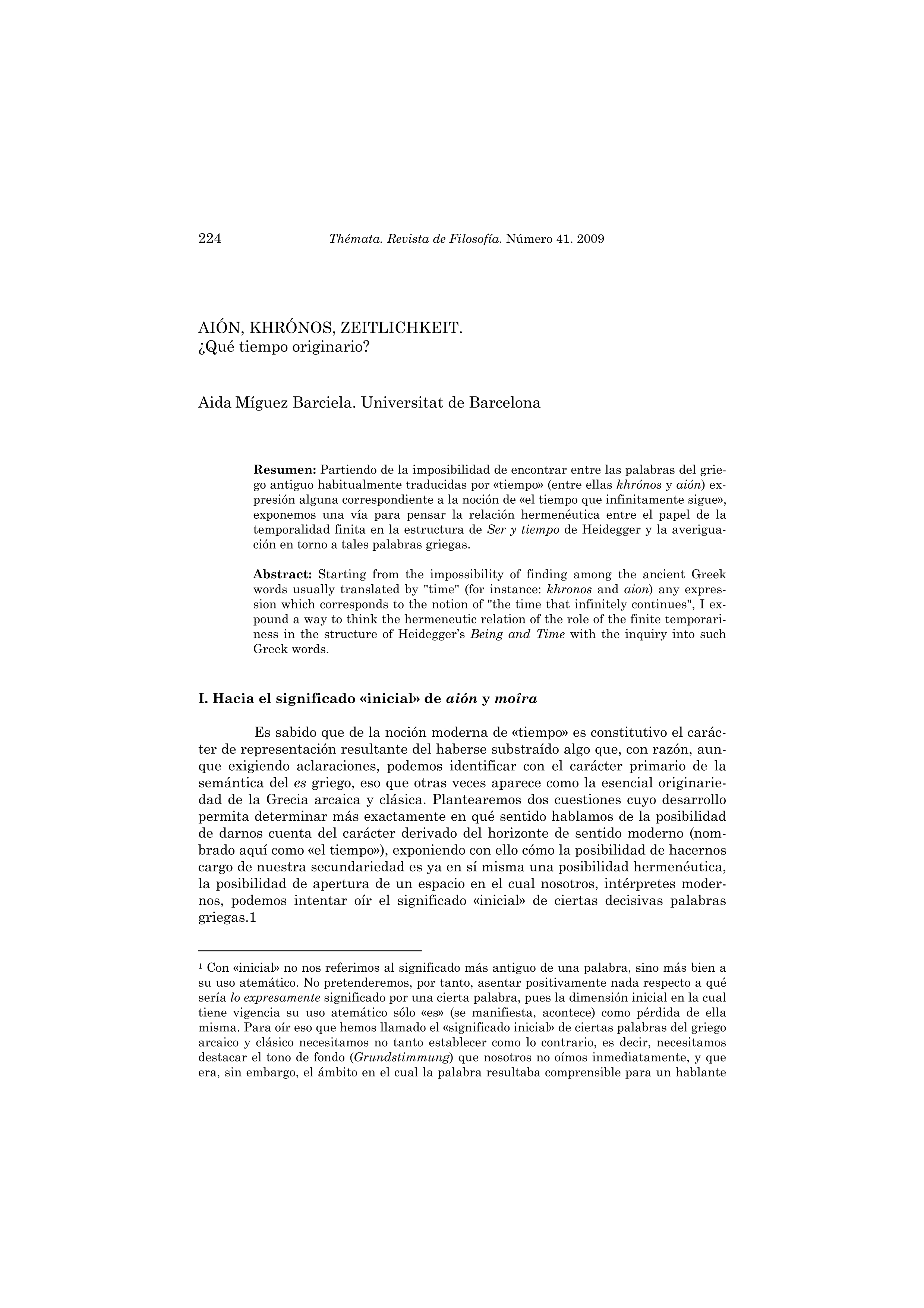
Resumen: Partiendo de la imposibilidad de encontrar entre las palabras del griego antiguo habitualmente traducidas por «tiempo» (entre ellas khrónos y aión) expresión alguna correspondiente a la noción de «el tiempo que infinitamente sigue», exponemos una vía para pensar la relación hermenéutica entre el papel de la temporalidad finita en la estructura de Ser y tiempo de Heidegger y la averiguación en torno a tales palabras griegas.
Starting from the impossibility of finding among the ancient Greek words usually translated by "time" (for instance: khronos and aion) any expression which corresponds to the notion of "the time that infinitely continues", I expound a way to think the hermeneutic relation of the role of the finite temporariness in the structure of Heidegger’s Being and Time with the inquiry into such Greek words.
Idioma: Español
Año: 2009
Publicado en: Thémata (Sevilla) 41 (2009), 224-238
ISSN: 0212-8365
Originalmente disponible en: Texto completo de la revista
Tipo y forma: Article (Published version)
 You must give appropriate credit, provide a link to the license, and indicate if changes were made. You may do so in any reasonable manner, but not in any way that suggests the licensor endorses you or your use. You may not use the material for commercial purposes. If you remix, transform, or build upon the material, you must distribute your contributions under the same license as the original.
Exportado de SIDERAL (2025-01-21-14:44:36)
Visitas y descargas
Starting from the impossibility of finding among the ancient Greek words usually translated by "time" (for instance: khronos and aion) any expression which corresponds to the notion of "the time that infinitely continues", I expound a way to think the hermeneutic relation of the role of the finite temporariness in the structure of Heidegger’s Being and Time with the inquiry into such Greek words.
Idioma: Español
Año: 2009
Publicado en: Thémata (Sevilla) 41 (2009), 224-238
ISSN: 0212-8365
Originalmente disponible en: Texto completo de la revista
Tipo y forma: Article (Published version)
You must give appropriate credit, provide a link to the license, and indicate if changes were made. You may do so in any reasonable manner, but not in any way that suggests the licensor endorses you or your use. You may not use the material for commercial purposes. If you remix, transform, or build upon the material, you must distribute your contributions under the same license as the original. Exportado de SIDERAL (2025-01-21-14:44:36)
Permalink:
Visitas y descargas
Este artículo se encuentra en las siguientes colecciones:
Articles
Record created 2025-01-21, last modified 2025-01-21