Iron Electrodes Based on Sulfur-Modified Iron Oxides with Enhanced Stability for Iron–Air Batteries
Villanueva, Nicolás ; Alegre, Cinthia ; Rubin, Javier (Universidad de Zaragoza) ; Figueredo-Rodríguez, Horacio A. ; McKerracher, Rachel D. ; de León, Carlos Ponce ; Lázaro, María Jesús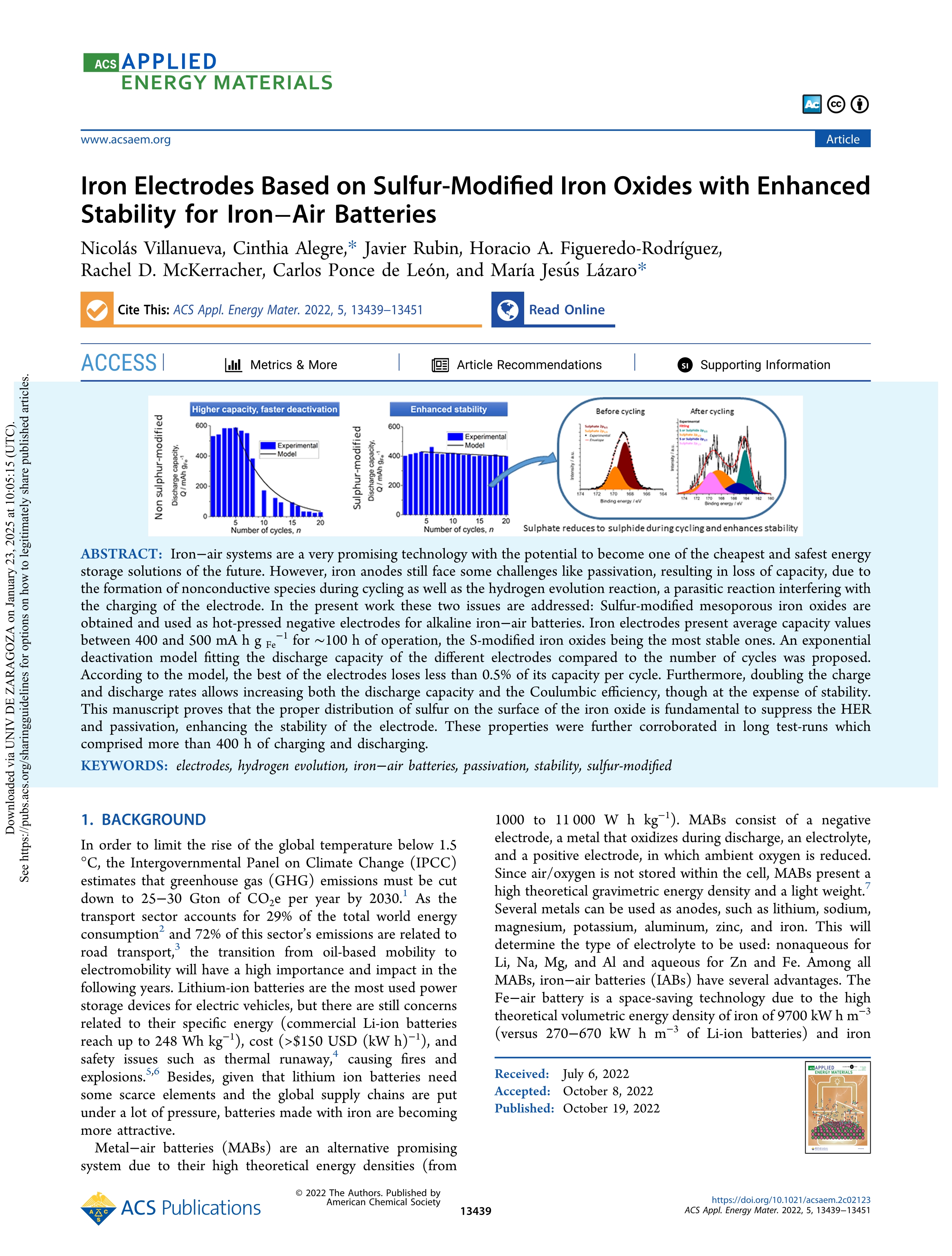
Resumen: Iron–air systems are a very promising technology with the potential to become one of the cheapest and safest energy storage solutions of the future. However, iron anodes still face some challenges like passivation, resulting in loss of capacity, due to the formation of nonconductive species during cycling as well as the hydrogen evolution reaction, a parasitic reaction interfering with the charging of the electrode. In the present work these two issues are addressed: Sulfur-modified mesoporous iron oxides are obtained and used as hot-pressed negative electrodes for alkaline iron–air batteries. Iron electrodes present average capacity values between 400 and 500 mA h g Fe–1 for ∼100 h of operation, the S-modified iron oxides being the most stable ones. An exponential deactivation model fitting the discharge capacity of the different electrodes compared to the number of cycles was proposed. According to the model, the best of the electrodes loses less than 0.5% of its capacity per cycle. Furthermore, doubling the charge and discharge rates allows increasing both the discharge capacity and the Coulumbic efficiency, though at the expense of stability. This manuscript proves that the proper distribution of sulfur on the surface of the iron oxide is fundamental to suppress the HER and passivation, enhancing the stability of the electrode. These properties were further corroborated in long test-runs which comprised more than 400 h of charging and discharging.
Idioma: Inglés
DOI: 10.1021/acsaem.2c02123
Año: 2022
Publicado en: ACS applied energy materials 5, 11 (2022), 13439-13451
ISSN: 2574-0962
Factor impacto JCR: 6.4 (2022)
Categ. JCR: MATERIALS SCIENCE, MULTIDISCIPLINARY rank: 86 / 343 = 0.251 (2022) - Q2 - T1
Categ. JCR: CHEMISTRY, PHYSICAL rank: 43 / 161 = 0.267 (2022) - Q2 - T1
Categ. JCR: ENERGY & FUELS rank: 40 / 119 = 0.336 (2022) - Q2 - T2
Factor impacto CITESCORE: 9.5 - Engineering (Q1) - Materials Science (Q1) - Chemistry (Q1) - Chemical Engineering (Q1) - Energy (Q1)
Factor impacto SCIMAGO: 1.588 - Chemical Engineering (miscellaneous) (Q1) - Electrical and Electronic Engineering (Q1) - Materials Chemistry (Q1) - Energy Engineering and Power Technology (Q1) - Electrochemistry (Q1)
Financiación: info:eu-repo/grantAgreement/ES/DGA/T06-20R Grupo de Conversión de Combustibles
Financiación: info:eu-repo/grantAgreement/ES/AEI/IJCI-2017-32354
Tipo y forma: Article (Published version)
Área (Departamento): Área Cienc.Mater. Ingen.Metal. (Dpto. Ciencia Tecnol.Mater.Fl.)
 You must give appropriate credit, provide a link to the license, and indicate if changes were made. You may do so in any reasonable manner, but not in any way that suggests the licensor endorses you or your use.
Exportado de SIDERAL (2025-11-13-15:00:48)
Visitas y descargas
Idioma: Inglés
DOI: 10.1021/acsaem.2c02123
Año: 2022
Publicado en: ACS applied energy materials 5, 11 (2022), 13439-13451
ISSN: 2574-0962
Factor impacto JCR: 6.4 (2022)
Categ. JCR: MATERIALS SCIENCE, MULTIDISCIPLINARY rank: 86 / 343 = 0.251 (2022) - Q2 - T1
Categ. JCR: CHEMISTRY, PHYSICAL rank: 43 / 161 = 0.267 (2022) - Q2 - T1
Categ. JCR: ENERGY & FUELS rank: 40 / 119 = 0.336 (2022) - Q2 - T2
Factor impacto CITESCORE: 9.5 - Engineering (Q1) - Materials Science (Q1) - Chemistry (Q1) - Chemical Engineering (Q1) - Energy (Q1)
Factor impacto SCIMAGO: 1.588 - Chemical Engineering (miscellaneous) (Q1) - Electrical and Electronic Engineering (Q1) - Materials Chemistry (Q1) - Energy Engineering and Power Technology (Q1) - Electrochemistry (Q1)
Financiación: info:eu-repo/grantAgreement/ES/DGA/T06-20R Grupo de Conversión de Combustibles
Financiación: info:eu-repo/grantAgreement/ES/AEI/IJCI-2017-32354
Tipo y forma: Article (Published version)
Área (Departamento): Área Cienc.Mater. Ingen.Metal. (Dpto. Ciencia Tecnol.Mater.Fl.)
You must give appropriate credit, provide a link to the license, and indicate if changes were made. You may do so in any reasonable manner, but not in any way that suggests the licensor endorses you or your use. Exportado de SIDERAL (2025-11-13-15:00:48)
Permalink:
Visitas y descargas
Este artículo se encuentra en las siguientes colecciones:
Articles > Artículos por área > Ciencia de los Materiales e Ingeniería Metalúrgica
Record created 2025-01-23, last modified 2025-11-13