Primary adrenal insufficiency: case study IN 5 tertiary hospitals
Ovejero García, María Teresa ; Sáez Gallego, Blanca ; Barreda Bonís, Ana Coral ; Domínguez Riscart, Jesús ; Garnier Rodríguez, María Beatriz ; Molina Suárez, Ruth ; Arriba Muñoz, Antonio De (Universidad de Zaragoza)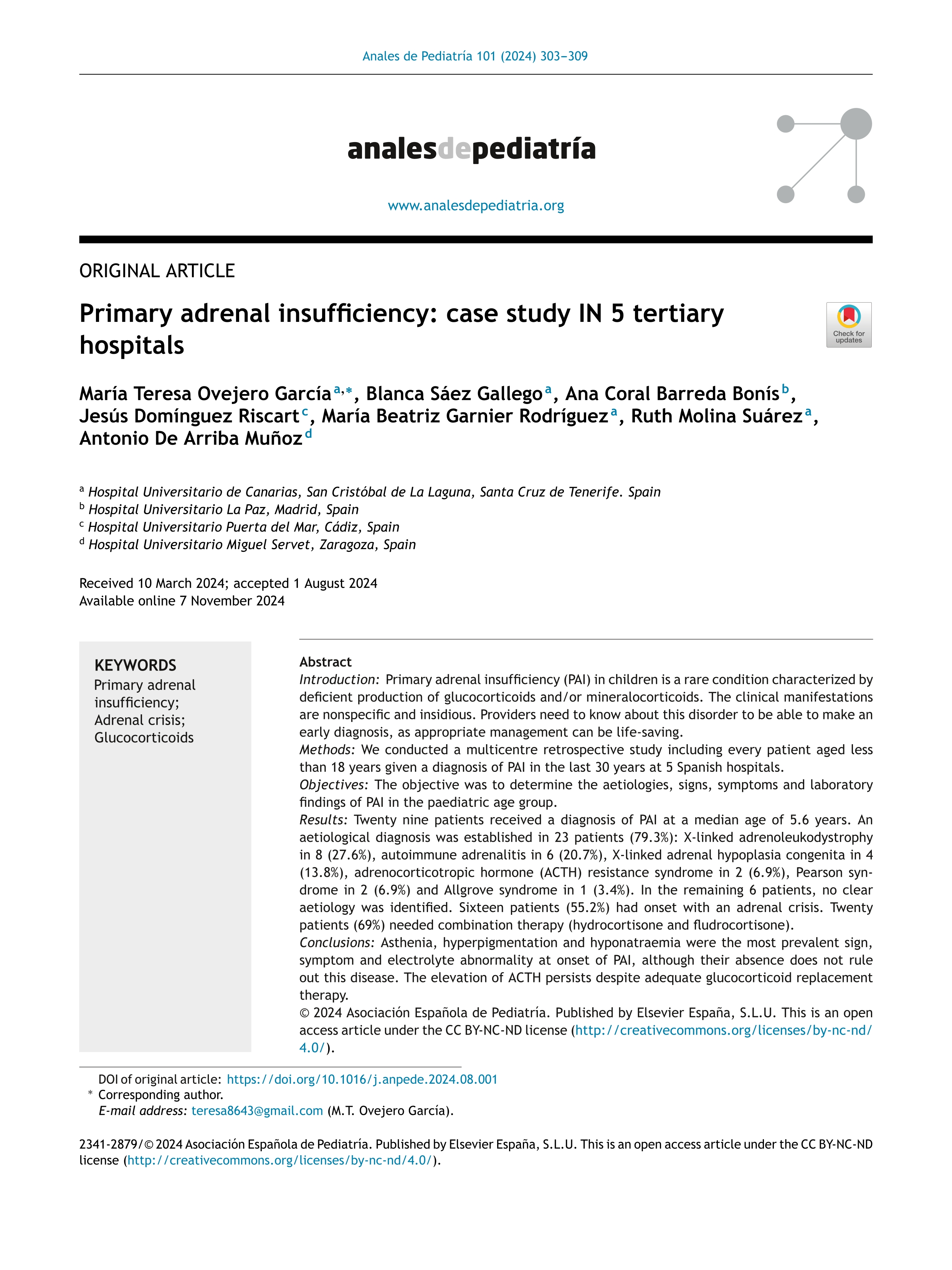
Resumen: Introduction
Primary adrenal insufficiency (PAI) in children is a rare condition characterized by deficient production of glucocorticoids and/or mineralocorticoids. The clinical manifestations are nonspecific and insidious. Providers need to know about this disorder to be able to make an early diagnosis, as appropriate management can be life-saving.
Methods
We conducted a multicentre retrospective study including every patient aged less than 18 years given a diagnosis of PAI in the last 30 years at 5 Spanish hospitals.
Objectives
The objective was to determine the aetiologies, signs, symptoms and laboratory findings of PAI in the paediatric age group.
Results
Twenty nine patients received a diagnosis of PAI at a median age of 5.6 years. An aetiological diagnosis was established in 23 patients (79.3%): X-linked adrenoleukodystrophy in 8 (27.6%), autoimmune adrenalitis in 6 (20.7%), X-linked adrenal hypoplasia congenita in 4 (13.8%), adrenocorticotropic hormone (ACTH) resistance syndrome in 2 (6.9%), Pearson syndrome in 2 (6.9%) and Allgrove syndrome in 1 (3.4%). In the remaining 6 patients, no clear aetiology was identified. Sixteen patients (55.2%) had onset with an adrenal crisis. Twenty patients (69%) needed combination therapy (hydrocortisone and fludrocortisone).
Conclusions
Asthenia, hyperpigmentation and hyponatraemia were the most prevalent sign, symptom and electrolyte abnormality at onset of PAI, although their absence does not rule out this disease. The elevation of ACTH persists despite adequate glucocorticoid replacement therapy.
Idioma: Inglés
DOI: 10.1016/j.anpede.2024.10.008
Año: 2024
Publicado en: Anales de Pediatría (English Edition) 101, 5 (2024), 303-309
ISSN: 2341-2879
Tipo y forma: Artículo (Versión definitiva)
Área (Departamento): Área Pediatría (Dpto. Microb.Ped.Radio.Sal.Pú.)
 Debe reconocer adecuadamente la autoría, proporcionar un enlace a la licencia e indicar si se han realizado cambios. Puede hacerlo de cualquier manera razonable, pero no de una manera que sugiera que tiene el apoyo del licenciador o lo recibe por el uso que hace. No puede utilizar el material para una finalidad comercial. Si remezcla, transforma o crea a partir del material, no puede difundir el material modificado.
Exportado de SIDERAL (2025-01-24-14:49:19)
Visitas y descargas
Primary adrenal insufficiency (PAI) in children is a rare condition characterized by deficient production of glucocorticoids and/or mineralocorticoids. The clinical manifestations are nonspecific and insidious. Providers need to know about this disorder to be able to make an early diagnosis, as appropriate management can be life-saving.
Methods
We conducted a multicentre retrospective study including every patient aged less than 18 years given a diagnosis of PAI in the last 30 years at 5 Spanish hospitals.
Objectives
The objective was to determine the aetiologies, signs, symptoms and laboratory findings of PAI in the paediatric age group.
Results
Twenty nine patients received a diagnosis of PAI at a median age of 5.6 years. An aetiological diagnosis was established in 23 patients (79.3%): X-linked adrenoleukodystrophy in 8 (27.6%), autoimmune adrenalitis in 6 (20.7%), X-linked adrenal hypoplasia congenita in 4 (13.8%), adrenocorticotropic hormone (ACTH) resistance syndrome in 2 (6.9%), Pearson syndrome in 2 (6.9%) and Allgrove syndrome in 1 (3.4%). In the remaining 6 patients, no clear aetiology was identified. Sixteen patients (55.2%) had onset with an adrenal crisis. Twenty patients (69%) needed combination therapy (hydrocortisone and fludrocortisone).
Conclusions
Asthenia, hyperpigmentation and hyponatraemia were the most prevalent sign, symptom and electrolyte abnormality at onset of PAI, although their absence does not rule out this disease. The elevation of ACTH persists despite adequate glucocorticoid replacement therapy.
Idioma: Inglés
DOI: 10.1016/j.anpede.2024.10.008
Año: 2024
Publicado en: Anales de Pediatría (English Edition) 101, 5 (2024), 303-309
ISSN: 2341-2879
Tipo y forma: Artículo (Versión definitiva)
Área (Departamento): Área Pediatría (Dpto. Microb.Ped.Radio.Sal.Pú.)
Debe reconocer adecuadamente la autoría, proporcionar un enlace a la licencia e indicar si se han realizado cambios. Puede hacerlo de cualquier manera razonable, pero no de una manera que sugiera que tiene el apoyo del licenciador o lo recibe por el uso que hace. No puede utilizar el material para una finalidad comercial. Si remezcla, transforma o crea a partir del material, no puede difundir el material modificado.Exportado de SIDERAL (2025-01-24-14:49:19)
Enlace permanente:
Visitas y descargas
Este artículo se encuentra en las siguientes colecciones:
Artículos > Artículos por área > Pediatría
Registro creado el 2025-01-24, última modificación el 2025-01-24