The Millennial of Castile (1943): the historical culture of Spanish Fascism
Alares López, Gustavo (Universidad de Zaragoza)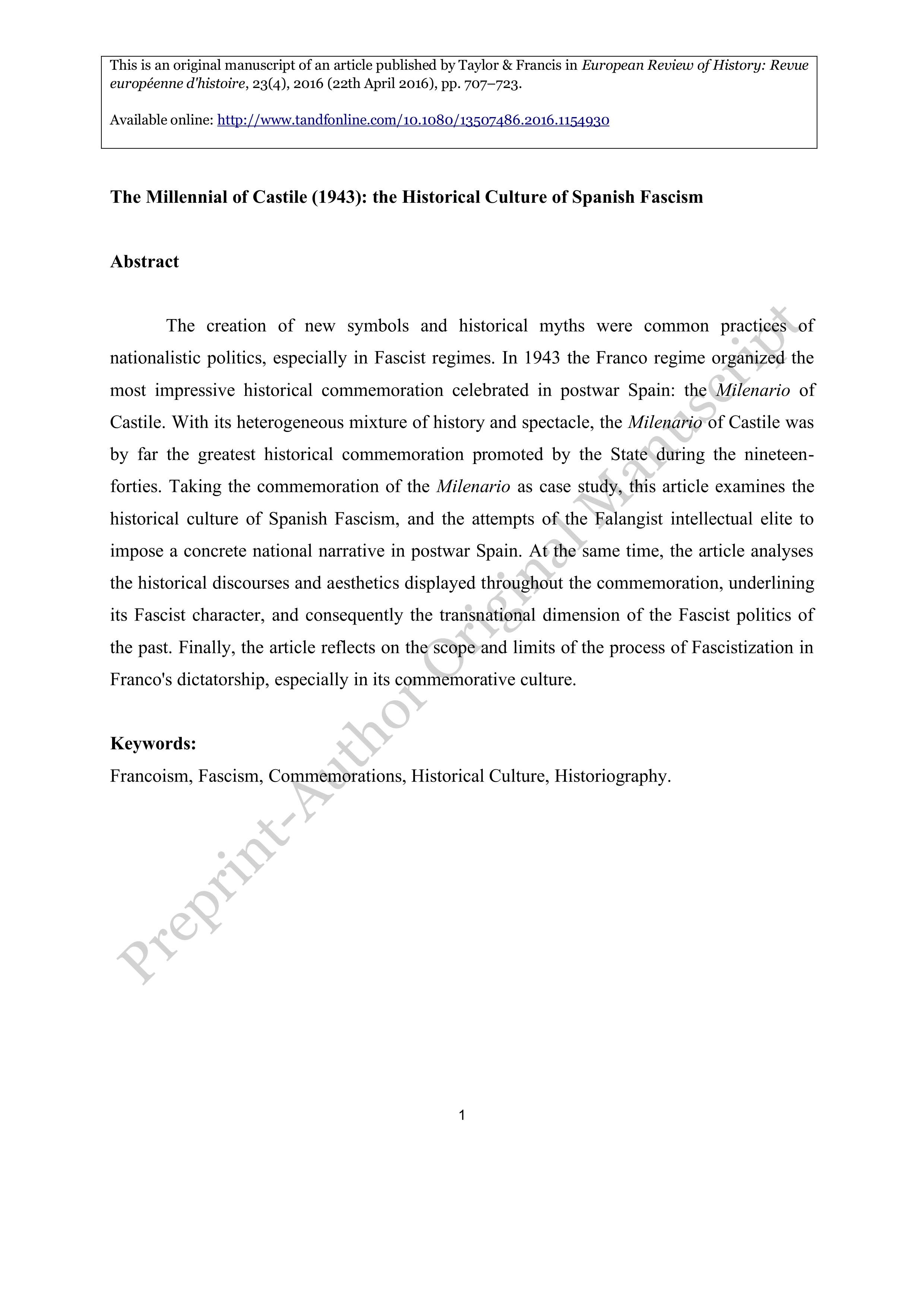
Resumen: The creation of new symbols and historical myths were common practices of nationalist politics, especially in Fascist regimes. In 1943 the Franco regime organized the most impressive historical commemoration celebrated in post-war Spain: the Milenario of Castile. With its heterogeneous mixture of history and spectacle, the Milenario of Castile was by far the greatest historical commemoration promoted by the State during the 1940s. Taking the commemoration of the Milenario as a case study, this article examines the historical culture of Spanish Fascism, as well as the attempts of the Falangist intellectual elite to impose a concrete national narrative in post-war Spain. At the same time, the article analyses the historical discourses and aesthetics displayed throughout the commemoration, underlining its Fascist character, and consequently the transnational dimension of the Fascist politics of the past. Finally, the article reflects on the scope and limits of the process of Fascistisation in Franco''s dictatorship, especially in its commemorative culture.
Idioma: Inglés
DOI: 10.1080/13507486.2016.1154930
Año: 2016
Publicado en: European review of history 23, 4 (2016), 707-723
ISSN: 1350-7486
Factor impacto SCIMAGO: 0.241 - History (Q1)
Tipo y forma: Article (PrePrint)
Área (Departamento): Área Historia Contemporánea (Dpto. Historia Moder. Contemp.)
Dataset asociado: DOI ( https://doi.org/10.1080/13507486.2016.1154930)
 You must give appropriate credit, provide a link to the license, and indicate if changes were made. You may do so in any reasonable manner, but not in any way that suggests the licensor endorses you or your use. You may not use the material for commercial purposes. If you remix, transform, or build upon the material, you may not distribute the modified material.
Exportado de SIDERAL (2025-10-17-14:29:18)
Visitas y descargas
Idioma: Inglés
DOI: 10.1080/13507486.2016.1154930
Año: 2016
Publicado en: European review of history 23, 4 (2016), 707-723
ISSN: 1350-7486
Factor impacto SCIMAGO: 0.241 - History (Q1)
Tipo y forma: Article (PrePrint)
Área (Departamento): Área Historia Contemporánea (Dpto. Historia Moder. Contemp.)
Dataset asociado: DOI ( https://doi.org/10.1080/13507486.2016.1154930)
You must give appropriate credit, provide a link to the license, and indicate if changes were made. You may do so in any reasonable manner, but not in any way that suggests the licensor endorses you or your use. You may not use the material for commercial purposes. If you remix, transform, or build upon the material, you may not distribute the modified material. Exportado de SIDERAL (2025-10-17-14:29:18)
Permalink:
Visitas y descargas
Este artículo se encuentra en las siguientes colecciones:
Articles > Artículos por área > Historia Moderna Contemporánea
Articles > Artículos por área > Historia Contemporánea
Record created 2025-01-30, last modified 2025-10-17