Ecotoxicity of a novel biopesticide from Artemisia absinthium on non-target aquatic organisms
Pino-Otín, M.R. ; Ballestero, D. ; Navarro, E. (Universidad de Zaragoza) ; González-Coloma, A. ; Val, J. ; Mainar, A.M. (Universidad de Zaragoza)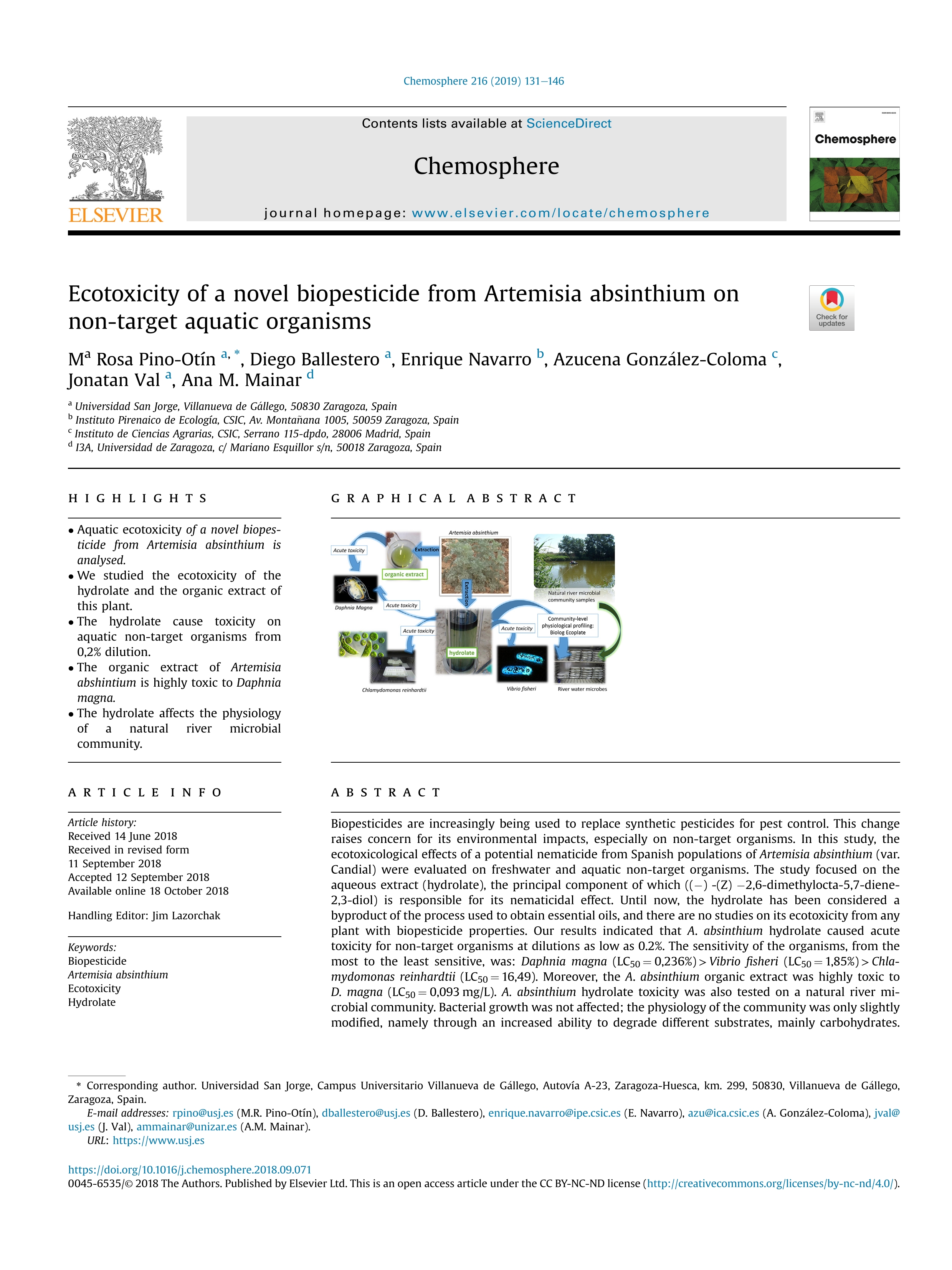
Resumen: Biopesticides are increasingly being used to replace synthetic pesticides for pest control. This change raises concern for its environmental impacts, especially on non-target organisms. In this study, the ecotoxicological effects of a potential nematicide from Spanish populations of Artemisia absinthium (var. Candial) were evaluated on freshwater and aquatic non-target organisms. The study focused on the aqueous extract (hydrolate), the principal component of which ((-) -(Z) -2, 6-dimethylocta-5, 7-diene-2, 3-diol) is responsible for its nematicidal effect. Until now, the hydrolate has been considered a byproduct of the process used to obtain essential oils, and there are no studies on its ecotoxicity from any plant with biopesticide properties. Our results indicated that A. absinthium hydrolate caused acute toxicity for non-target organisms at dilutions as low as 0.2%. The sensitivity of the organisms, from the most to the least sensitive, was: Daphnia magna (LC50 = 0, 236%) > Vibrio fisheri (LC50 = 1, 85%) > Chlamydomonas reinhardtii (LC50 = 16, 49). Moreover, the A. absinthium organic extract was highly toxic to D. magna (LC50 = 0, 093 mg/L). A. absinthium hydrolate toxicity was also tested on a natural river microbial community. Bacterial growth was not affected; the physiology of the community was only slightly modified, namely through an increased ability to degrade different substrates, mainly carbohydrates. This study provides for the first time an exhaustive assessment of the environmental exposure of a plant-derived biopesticide and shows that these products may cause a broad range of toxicity on non-target aquatic organisms.
Idioma: Inglés
DOI: 10.1016/j.chemosphere.2018.09.071
Año: 2019
Publicado en: CHEMOSPHERE 216 (2019), 131-146
ISSN: 0045-6535
Factor impacto JCR: 5.778 (2019)
Categ. JCR: ENVIRONMENTAL SCIENCES rank: 29 / 264 = 0.11 (2019) - Q1 - T1
Factor impacto SCIMAGO: 1.53 - Chemistry (miscellaneous) (Q1) - Environmental Chemistry (Q1) - Pollution (Q1) - Health, Toxicology and Mutagenesis (Q1) - Medicine (miscellaneous) (Q1) - Environmental Engineering (Q1)
Financiación: info:eu-repo/grantAgreement/ES/DGA/E39-17R
Financiación: info:eu-repo/grantAgreement/ES/MINECO-FEDER/CTQ2015-64049-C3-2-R
Tipo y forma: Artículo (Versión definitiva)
Área (Departamento): Área Química Física (Dpto. Química Física)
Área (Departamento): Área Bioquímica y Biolog.Mole. (Dpto. Bioq.Biolog.Mol. Celular)
 Debe reconocer adecuadamente la autoría, proporcionar un enlace a la licencia e indicar si se han realizado cambios. Puede hacerlo de cualquier manera razonable, pero no de una manera que sugiera que tiene el apoyo del licenciador o lo recibe por el uso que hace. No puede utilizar el material para una finalidad comercial. Si remezcla, transforma o crea a partir del material, no puede difundir el material modificado.
Exportado de SIDERAL (2025-10-17-14:11:23)
Visitas y descargas
Idioma: Inglés
DOI: 10.1016/j.chemosphere.2018.09.071
Año: 2019
Publicado en: CHEMOSPHERE 216 (2019), 131-146
ISSN: 0045-6535
Factor impacto JCR: 5.778 (2019)
Categ. JCR: ENVIRONMENTAL SCIENCES rank: 29 / 264 = 0.11 (2019) - Q1 - T1
Factor impacto SCIMAGO: 1.53 - Chemistry (miscellaneous) (Q1) - Environmental Chemistry (Q1) - Pollution (Q1) - Health, Toxicology and Mutagenesis (Q1) - Medicine (miscellaneous) (Q1) - Environmental Engineering (Q1)
Financiación: info:eu-repo/grantAgreement/ES/DGA/E39-17R
Financiación: info:eu-repo/grantAgreement/ES/MINECO-FEDER/CTQ2015-64049-C3-2-R
Tipo y forma: Artículo (Versión definitiva)
Área (Departamento): Área Química Física (Dpto. Química Física)
Área (Departamento): Área Bioquímica y Biolog.Mole. (Dpto. Bioq.Biolog.Mol. Celular)
Debe reconocer adecuadamente la autoría, proporcionar un enlace a la licencia e indicar si se han realizado cambios. Puede hacerlo de cualquier manera razonable, pero no de una manera que sugiera que tiene el apoyo del licenciador o lo recibe por el uso que hace. No puede utilizar el material para una finalidad comercial. Si remezcla, transforma o crea a partir del material, no puede difundir el material modificado.Exportado de SIDERAL (2025-10-17-14:11:23)
Enlace permanente:
Visitas y descargas
Este artículo se encuentra en las siguientes colecciones:
Artículos > Artículos por área > Bioquímica y Biología Molecular
Artículos > Artículos por área > Química Física
Registro creado el 2025-02-01, última modificación el 2025-10-17