An acute stress scale for health care professionals caring for patients with covid-19: Validation study
Mira, J.J. ; Cobos, A. ; Martínez García, Olga ; Domínguez, M.J.B. ; Astier-Peña, M.P. (Universidad de Zaragoza) ; Pérez, P.P. ; Carrillo, I. ; Guilabert, M. ; Perez-Jover, V. ; Fernandez, C. ; Vicente, M.A. ; Lahera-Martin, M. ; Busto, C.S. ; Martínez, S.L. ; Martinez, A.S. ; Martin-Delgado, J. ; Mula, A. ; Marco-Gomez, B. ; Bouzan, C.A. ; Aibar-Remon, C. (Universidad de Zaragoza) ; Aranaz-Andres, J.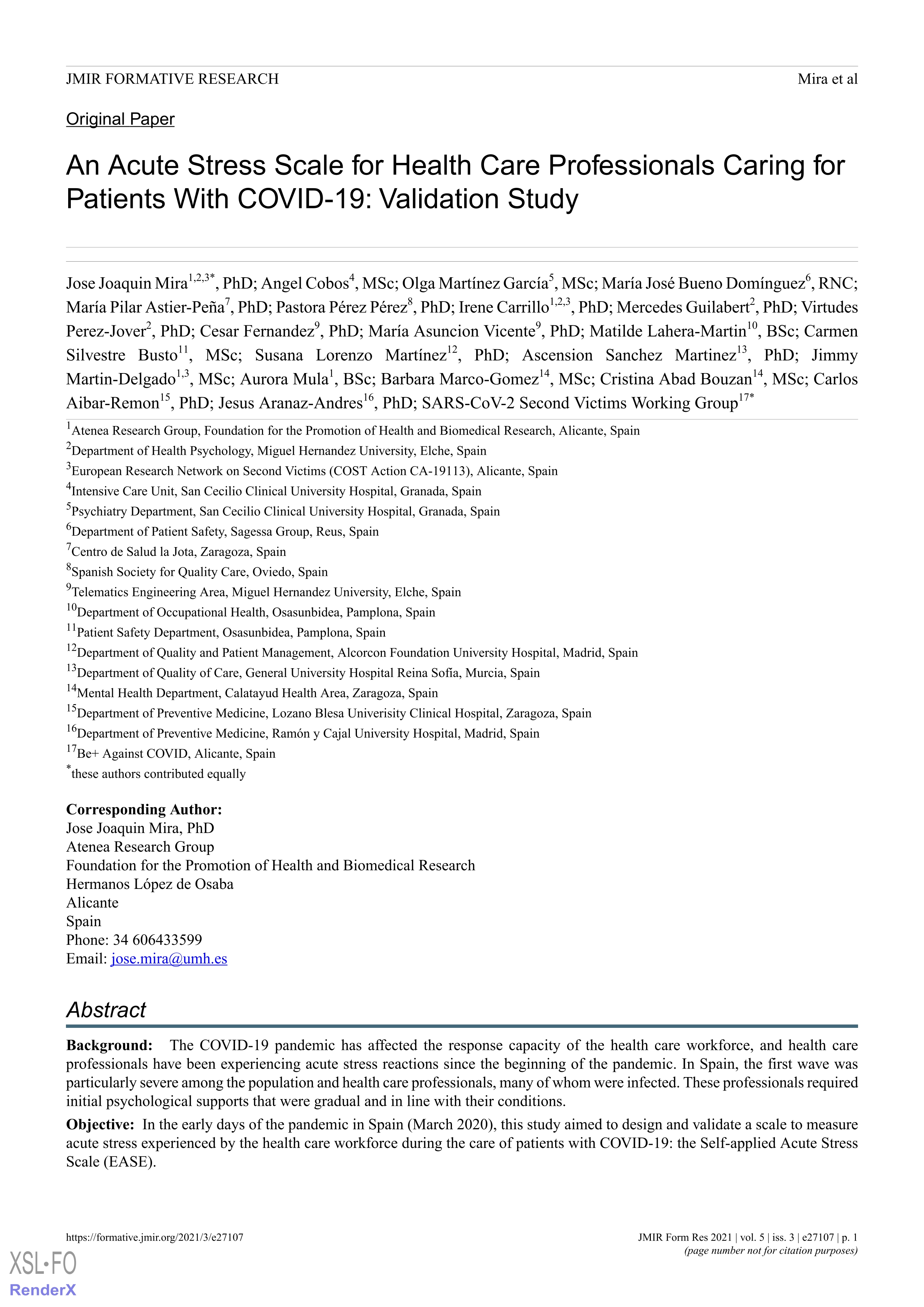
Resumen: Background: The COVID-19 pandemic has affected the response capacity of the health care workforce, and health care professionals have been experiencing acute stress reactions since the beginning of the pandemic. In Spain, the first wave was particularly severe among the population and health care professionals, many of whom were infected. These professionals required initial psychological supports that were gradual and in line with their conditions. Objective: In the early days of the pandemic in Spain (March 2020), this study aimed to design and validate a scale to measure acute stress experienced by the health care workforce during the care of patients with COVID-19: The Self-applied Acute Stress Scale (EASE). Methods: Item development, scale development, and scale evaluation were considered. Qualitative research was conducted to produce the initial pool of items, assure their legibility, and assess the validity of the content. Internal consistency was calculated using Cronbach a and McDonald ¿. Confirmatory factor analysis and the Mann-Whitney-Wilcoxon test were used to assess construct validity. Linear regression was applied to assess criterion validity. Back-translation methodology was used to translate the scale into Portuguese and English. Results: A total of 228 health professionals from the Spanish public health system responded to the 10 items of the EASE scale. Internal consistency was.87 (McDonald ¿). Goodness-of-fit indices confirmed a two-factor structure, explaining 55% of the variance. As expected, the highest level of stress was found among professionals working in health services where a higher number of deaths from COVID-19 occurred (P<.05). Conclusions: The EASE scale was shown to have adequate metric properties regarding consistency and construct validity. The EASE scale could be used to determine the levels of acute stress among the health care workforce in order to give them proportional support according to their needs during emergency conditions, such as the COVID-19 pandemic.
Idioma: Inglés
DOI: 10.2196/27107
Año: 2021
Publicado en: JMIR Formative Research 5, 3 (2021), [23 pp.]
ISSN: 2561-326X
Factor impacto CITESCORE: 1.8 - Medicine (Q3)
Factor impacto SCIMAGO: 0.49 - Medicine (miscellaneous) (Q3) - Health Informatics (Q3)
Tipo y forma: Article (Published version)
Área (Departamento): Area Medicina (Dpto. Medicina, Psiqu. y Derm.)
Área (Departamento): Área Medic.Prevent.Salud Públ. (Dpto. Microb.Ped.Radio.Sal.Pú.)
 You must give appropriate credit, provide a link to the license, and indicate if changes were made. You may do so in any reasonable manner, but not in any way that suggests the licensor endorses you or your use.
Exportado de SIDERAL (2025-10-17-14:15:27)
Visitas y descargas
Idioma: Inglés
DOI: 10.2196/27107
Año: 2021
Publicado en: JMIR Formative Research 5, 3 (2021), [23 pp.]
ISSN: 2561-326X
Factor impacto CITESCORE: 1.8 - Medicine (Q3)
Factor impacto SCIMAGO: 0.49 - Medicine (miscellaneous) (Q3) - Health Informatics (Q3)
Tipo y forma: Article (Published version)
Área (Departamento): Area Medicina (Dpto. Medicina, Psiqu. y Derm.)
Área (Departamento): Área Medic.Prevent.Salud Públ. (Dpto. Microb.Ped.Radio.Sal.Pú.)
You must give appropriate credit, provide a link to the license, and indicate if changes were made. You may do so in any reasonable manner, but not in any way that suggests the licensor endorses you or your use. Exportado de SIDERAL (2025-10-17-14:15:27)
Permalink:
Visitas y descargas
Este artículo se encuentra en las siguientes colecciones:
Articles > Artículos por área > Medicina Preventiva y Salud Pública
Articles > Artículos por área > Medicina
Record created 2025-02-27, last modified 2025-10-17