Electrophysiological characterization of pre‐adolescents born with intrauterine growth restriction: insights from clinical and computational data
Bueno-Palomeque, Freddy L. ; Zacur, Ernesto ; Pueyo, Esther (Universidad de Zaragoza) ; Crispi, Fàtima ; Laguna, Pablo (Universidad de Zaragoza) ; Mincholé, Ana (Universidad de Zaragoza)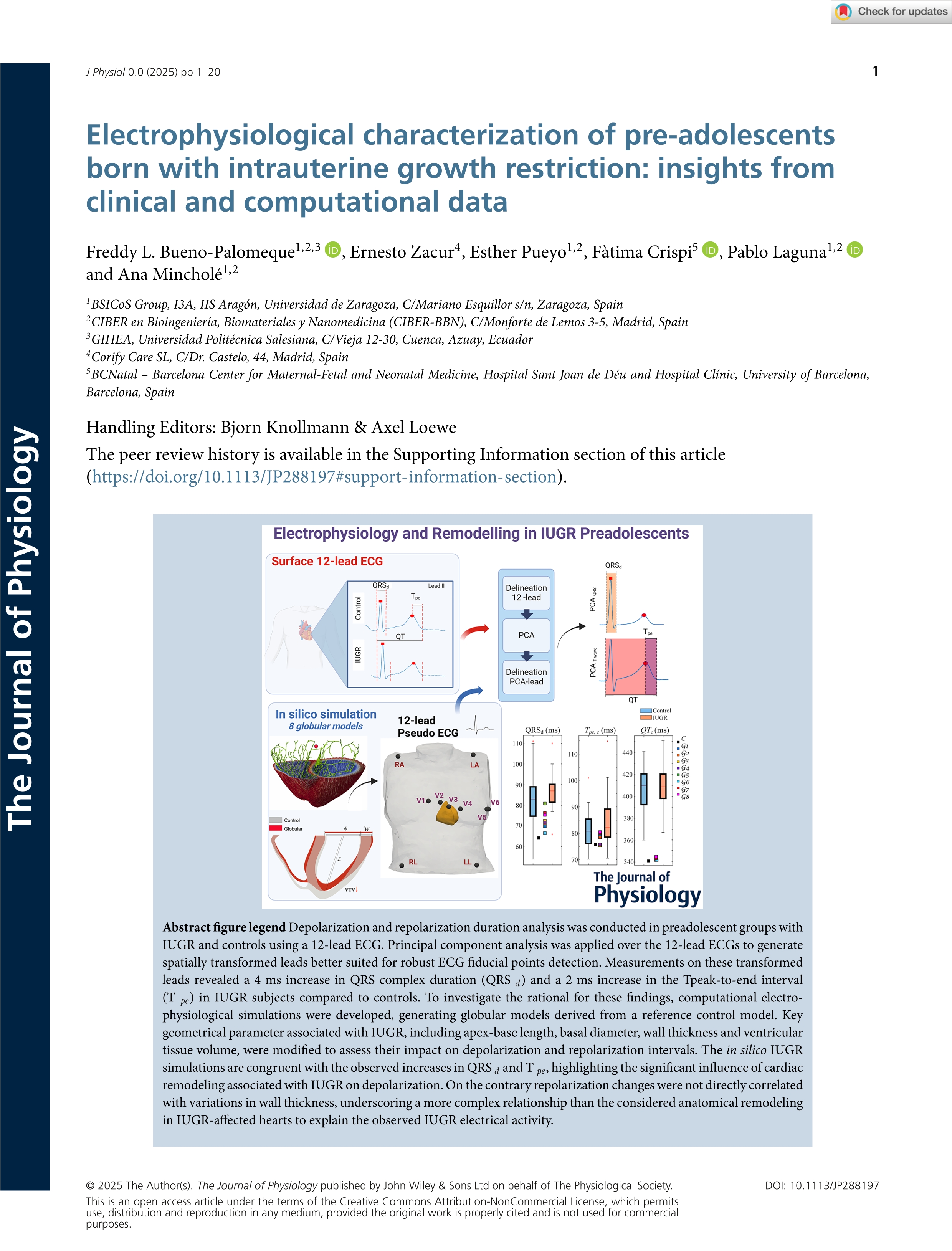
Resumen: Anatomical changes associated with intra-uterine growth restriction (IUGR) have been observed in different age groups and linked to cardiovascular complications. This study analysed the electrocardiogram (ECG) in pre-adolescents with severe IUGR, comparing QRS complex and T-wave biomarkers with controls. Computer simulations explored links between anatomical re-modelling and ECG biomarkers, providing insights into the potential cardiovascular risk associated with IUGR-induced re-modelling. Clinical recordings were analysed using principal component analysis (PCA) to compute spatially transformed leads, enhancing QRS complex and T-wave delineation for depolarization and repolarization assessment. Transformed leads analysis revealed a 4-ms increase in QRS complex duration (QRS ) and a 2-ms increase in the T peak-to-end interval (T ) in IUGR subjects compared to controls. We conducted electrophysiological in silico simulations using anatomical models based on clinical IUGR data. These models, derived from a reference control, incorporated key geometric changes associated with IUGR, the apex-base length, basal diameter, wall thickness () and ventricular tissue volume, to assess their impact on depolarization and repolarization intervals. In silico PCA leads showed increased QRS , QRS amplitude and T in globular models, consistent with clinical data. Despite the QRS increase, the QT interval increases but is not linearly related to the change. These findings suggest that cardiac re-modelling primarily influences the depolarization cycle, notably QRS , while repolarization intervals increase but are not directly related to the increase. The study highlights the impact of geometric and volumetric changes in IUGR-related cardiac re-modelling, also emphasizing the need for further research on electrophysiological re-modelling and its effects on cardiac function.
Idioma: Inglés
DOI: 10.1113/JP288197
Año: 2025
Publicado en: JOURNAL OF PHYSIOLOGY-LONDON (2025), [20 pp.]
ISSN: 0022-3751
Financiación: info:eu-repo/grantAgreement/ES/AEI/PID2021-128972OA-I00
Financiación: info:eu-repo/grantAgreement/ES/DGA/T39-23R
Financiación: info:eu-repo/grantAgreement/ES/MICINN/CNS2022-135899
Financiación: info:eu-repo/grantAgreement/ES/MICINN/PID2022-140556OB-I00
Financiación: info:eu-repo/grantAgreement/ES/MICINN/RYC2019-027420-I
Financiación: info:eu-repo/grantAgreement/EUR/MICINN/TED2021-130459B-I00
Tipo y forma: Artículo (Versión definitiva)
Área (Departamento): Área Teoría Señal y Comunicac. (Dpto. Ingeniería Electrón.Com.)
 Debe reconocer adecuadamente la autoría, proporcionar un enlace a la licencia e indicar si se han realizado cambios. Puede hacerlo de cualquier manera razonable, pero no de una manera que sugiera que tiene el apoyo del licenciador o lo recibe por el uso que hace. No puede utilizar el material para una finalidad comercial.
Exportado de SIDERAL (2025-10-17-14:26:56)
Visitas y descargas
Idioma: Inglés
DOI: 10.1113/JP288197
Año: 2025
Publicado en: JOURNAL OF PHYSIOLOGY-LONDON (2025), [20 pp.]
ISSN: 0022-3751
Financiación: info:eu-repo/grantAgreement/ES/AEI/PID2021-128972OA-I00
Financiación: info:eu-repo/grantAgreement/ES/DGA/T39-23R
Financiación: info:eu-repo/grantAgreement/ES/MICINN/CNS2022-135899
Financiación: info:eu-repo/grantAgreement/ES/MICINN/PID2022-140556OB-I00
Financiación: info:eu-repo/grantAgreement/ES/MICINN/RYC2019-027420-I
Financiación: info:eu-repo/grantAgreement/EUR/MICINN/TED2021-130459B-I00
Tipo y forma: Artículo (Versión definitiva)
Área (Departamento): Área Teoría Señal y Comunicac. (Dpto. Ingeniería Electrón.Com.)
Debe reconocer adecuadamente la autoría, proporcionar un enlace a la licencia e indicar si se han realizado cambios. Puede hacerlo de cualquier manera razonable, pero no de una manera que sugiera que tiene el apoyo del licenciador o lo recibe por el uso que hace. No puede utilizar el material para una finalidad comercial.Exportado de SIDERAL (2025-10-17-14:26:56)
Enlace permanente:
Visitas y descargas
Este artículo se encuentra en las siguientes colecciones:
Artículos > Artículos por área > Teoría de la Señal y Comunicaciones
Registro creado el 2025-06-12, última modificación el 2025-10-17