Engineering an epoxy tanning agent via facile functionalization of sucrose with silane coupling agent for sustainable leather production
Ding, Wei ; Wang, Xinyue ; Remón, Javier (Universidad de Zaragoza) ; Jiang, Zhicheng ; Pang, Xiaoyan ; Ding, Zhiwen ; Wu, Yibo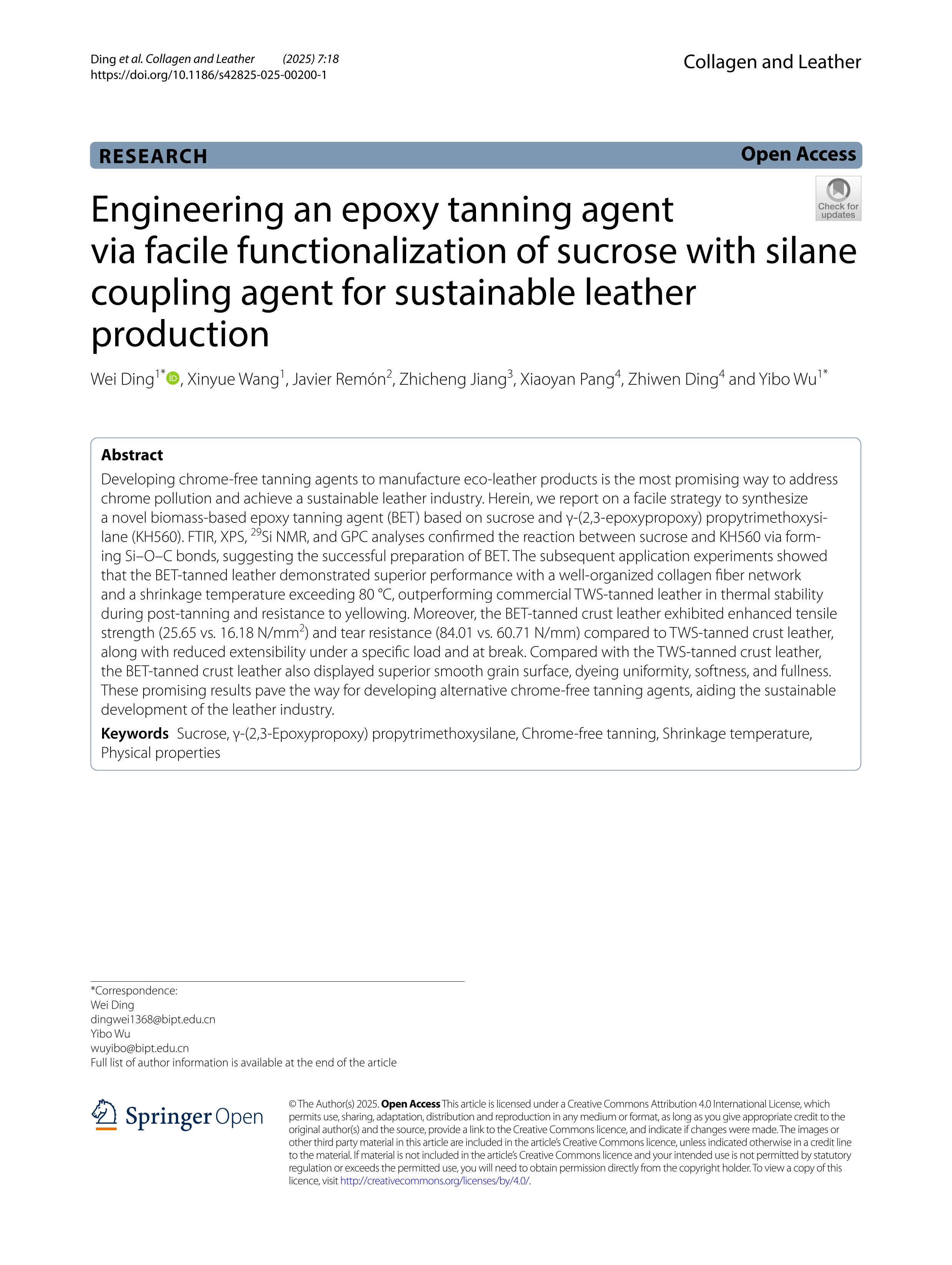
Resumen: Developing chrome-free tanning agents to manufacture eco-leather products is the most promising way to address chrome pollution and achieve a sustainable leather industry. Herein, we report on a facile strategy to synthesize a novel biomass-based epoxy tanning agent (BET) based on sucrose and γ-(2,3-epoxypropoxy) propytrimethoxysilane (KH560). FTIR, XPS, 29Si NMR, and GPC analyses confirmed the reaction between sucrose and KH560 via forming Si–O–C bonds, suggesting the successful preparation of BET. The subsequent application experiments showed that the BET-tanned leather demonstrated superior performance with a well-organized collagen fiber network and a shrinkage temperature exceeding 80 °C, outperforming commercial TWS-tanned leather in thermal stability during post-tanning and resistance to yellowing. Moreover, the BET-tanned crust leather exhibited enhanced tensile strength (25.65 vs. 16.18 N/mm2) and tear resistance (84.01 vs. 60.71 N/mm) compared to TWS-tanned crust leather, along with reduced extensibility under a specific load and at break. Compared with the TWS-tanned crust leather, the BET-tanned crust leather also displayed superior smooth grain surface, dyeing uniformity, softness, and fullness. These promising results pave the way for developing alternative chrome-free tanning agents, aiding the sustainable development of the leather industry.
Idioma: Inglés
DOI: 10.1186/s42825-025-00200-1
Año: 2025
Publicado en: Collagen and Leather 7, 1 (2025), 16 pp.
ISSN: 2097-1419
Tipo y forma: Artículo (Versión definitiva)
Área (Departamento): Área Ingeniería Química (Dpto. Ing.Quím.Tecnol.Med.Amb.)
 Debe reconocer adecuadamente la autoría, proporcionar un enlace a la licencia e indicar si se han realizado cambios. Puede hacerlo de cualquier manera razonable, pero no de una manera que sugiera que tiene el apoyo del licenciador o lo recibe por el uso que hace.
Exportado de SIDERAL (2025-10-17-14:27:25)
Visitas y descargas
Idioma: Inglés
DOI: 10.1186/s42825-025-00200-1
Año: 2025
Publicado en: Collagen and Leather 7, 1 (2025), 16 pp.
ISSN: 2097-1419
Tipo y forma: Artículo (Versión definitiva)
Área (Departamento): Área Ingeniería Química (Dpto. Ing.Quím.Tecnol.Med.Amb.)
Debe reconocer adecuadamente la autoría, proporcionar un enlace a la licencia e indicar si se han realizado cambios. Puede hacerlo de cualquier manera razonable, pero no de una manera que sugiera que tiene el apoyo del licenciador o lo recibe por el uso que hace. Exportado de SIDERAL (2025-10-17-14:27:25)
Enlace permanente:
Visitas y descargas
Este artículo se encuentra en las siguientes colecciones:
Artículos > Artículos por área > Ingeniería Química
Registro creado el 2025-06-12, última modificación el 2025-10-17