Modifying lumbar flexion pain thresholds in patients with chronic low back pain through visual-proprioceptive manipulation with virtual reality: a cross-sectional study
Jordán-López, Jaime ; Arguisuelas, María D. ; Doménech, Julio ; Peñalver-Barrios, M. Lourdes ; Miragall, Marta ; Herrero, Rocío (Universidad de Zaragoza) ; Baños, Rosa M. ; Amer-Cuenca, Juan J. ; Lisón, Juan F.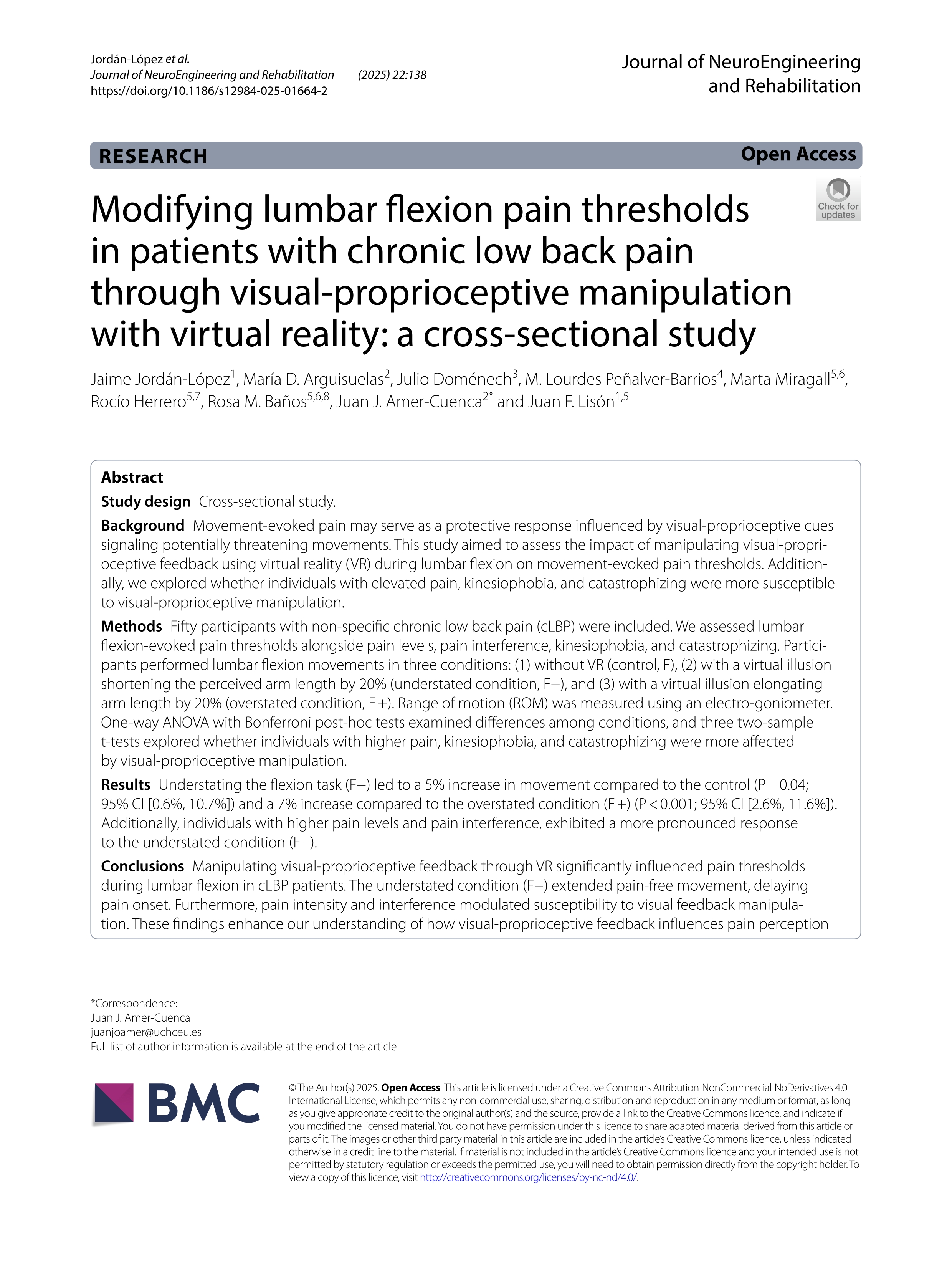
Resumen: Study design. Cross-sectional study. Background. Movement-evoked pain may serve as a protective response influenced by visual-proprioceptive cues signaling potentially threatening movements. This study aimed to assess the impact of manipulating visual-proprioceptive feedback using virtual reality (VR) during lumbar flexion on movement-evoked pain thresholds. Additionally, we explored whether individuals with elevated pain, kinesiophobia, and catastrophizing were more susceptible to visual-proprioceptive manipulation. Methods. Fifty participants with non-specific chronic low back pain (cLBP) were included. We assessed lumbar flexion-evoked pain thresholds alongside pain levels, pain interference, kinesiophobia, and catastrophizing. Participants performed lumbar flexion movements in three conditions: (1) without VR (control, F), (2) with a virtual illusion shortening the perceived arm length by 20% (understated condition, F−), and (3) with a virtual illusion elongating arm length by 20% (overstated condition, F +). Range of motion (ROM) was measured using an electro-goniometer. One-way ANOVA with Bonferroni post-hoc tests examined differences among conditions, and three two-sample t-tests explored whether individuals with higher pain, kinesiophobia, and catastrophizing were more affected by visual-proprioceptive manipulation.
Results. Understating the flexion task (F−) led to a 5% increase in movement compared to the control (P = 0.04; 95% CI [0.6%, 10.7%]) and a 7% increase compared to the overstated condition (F +) (P < 0.001; 95% CI [2.6%, 11.6%]). Additionally, individuals with higher pain levels and pain interference, exhibited a more pronounced response to the understated condition (F−). Conclusions. Manipulating visual-proprioceptive feedback through VR significantly influenced pain thresholds during lumbar flexion in cLBP patients. The understated condition (F−) extended pain-free movement, delaying pain onset. Furthermore, pain intensity and interference modulated susceptibility to visual feedback manipulation. These findings enhance our understanding of how visual-proprioceptive feedback influences pain perception and movement patterns in cLBP. They suggest new avenues for pain assessment, therapeutic interventions, and clinical strategies, particularly for individuals with high pain levels, interference, kinesiophobia, and catastrophizing.
Idioma: Inglés
DOI: 10.1186/s12984-025-01664-2
Año: 2025
Publicado en: Journal of NeuroEngineering and Rehabilitation 22, 1 (2025), 11 pp.
ISSN: 1743-0003
Financiación: info:eu-repo/grantAgreement/ES/MCINN/PID2020-115609RB-C22
Tipo y forma: Article (Published version)
Área (Departamento): Área Person.Eval.Trat.Psicoló. (Dpto. Psicología y Sociología)
 You must give appropriate credit, provide a link to the license, and indicate if changes were made. You may do so in any reasonable manner, but not in any way that suggests the licensor endorses you or your use. You may not use the material for commercial purposes. If you remix, transform, or build upon the material, you may not distribute the modified material.
Exportado de SIDERAL (2025-10-17-14:12:39)
Visitas y descargas
Results. Understating the flexion task (F−) led to a 5% increase in movement compared to the control (P = 0.04; 95% CI [0.6%, 10.7%]) and a 7% increase compared to the overstated condition (F +) (P < 0.001; 95% CI [2.6%, 11.6%]). Additionally, individuals with higher pain levels and pain interference, exhibited a more pronounced response to the understated condition (F−). Conclusions. Manipulating visual-proprioceptive feedback through VR significantly influenced pain thresholds during lumbar flexion in cLBP patients. The understated condition (F−) extended pain-free movement, delaying pain onset. Furthermore, pain intensity and interference modulated susceptibility to visual feedback manipulation. These findings enhance our understanding of how visual-proprioceptive feedback influences pain perception and movement patterns in cLBP. They suggest new avenues for pain assessment, therapeutic interventions, and clinical strategies, particularly for individuals with high pain levels, interference, kinesiophobia, and catastrophizing.
Idioma: Inglés
DOI: 10.1186/s12984-025-01664-2
Año: 2025
Publicado en: Journal of NeuroEngineering and Rehabilitation 22, 1 (2025), 11 pp.
ISSN: 1743-0003
Financiación: info:eu-repo/grantAgreement/ES/MCINN/PID2020-115609RB-C22
Tipo y forma: Article (Published version)
Área (Departamento): Área Person.Eval.Trat.Psicoló. (Dpto. Psicología y Sociología)
You must give appropriate credit, provide a link to the license, and indicate if changes were made. You may do so in any reasonable manner, but not in any way that suggests the licensor endorses you or your use. You may not use the material for commercial purposes. If you remix, transform, or build upon the material, you may not distribute the modified material. Exportado de SIDERAL (2025-10-17-14:12:39)
Permalink:
Visitas y descargas
Este artículo se encuentra en las siguientes colecciones:
Articles > Artículos por área > Personalidad,Evaluación y Tratamiento Psicológicos
Record created 2025-07-02, last modified 2025-10-17