Delayed correct diagnoses in emerging disease outbreaks: historical patterns and lessons for contemporary responses
Pellejero-Sagastizábal, Galadriel ; Bulescu, Casandra ; Gupta, Nitin ; Jokelainen, Pikka ; Gkrania-Klotsas, Effrossyni ; Barac, Aleksandra ; Goorhuis, Abraham ; Jacob, Shevin T. ; Agnandji, Selidji T. ; Ntoumi, Francine ; Mora-Rillo, Marta ; Paño-Pardo, José Ramón (Universidad de Zaragoza) ; Lescure, F.-Xavier ; Grobusch, Martin P.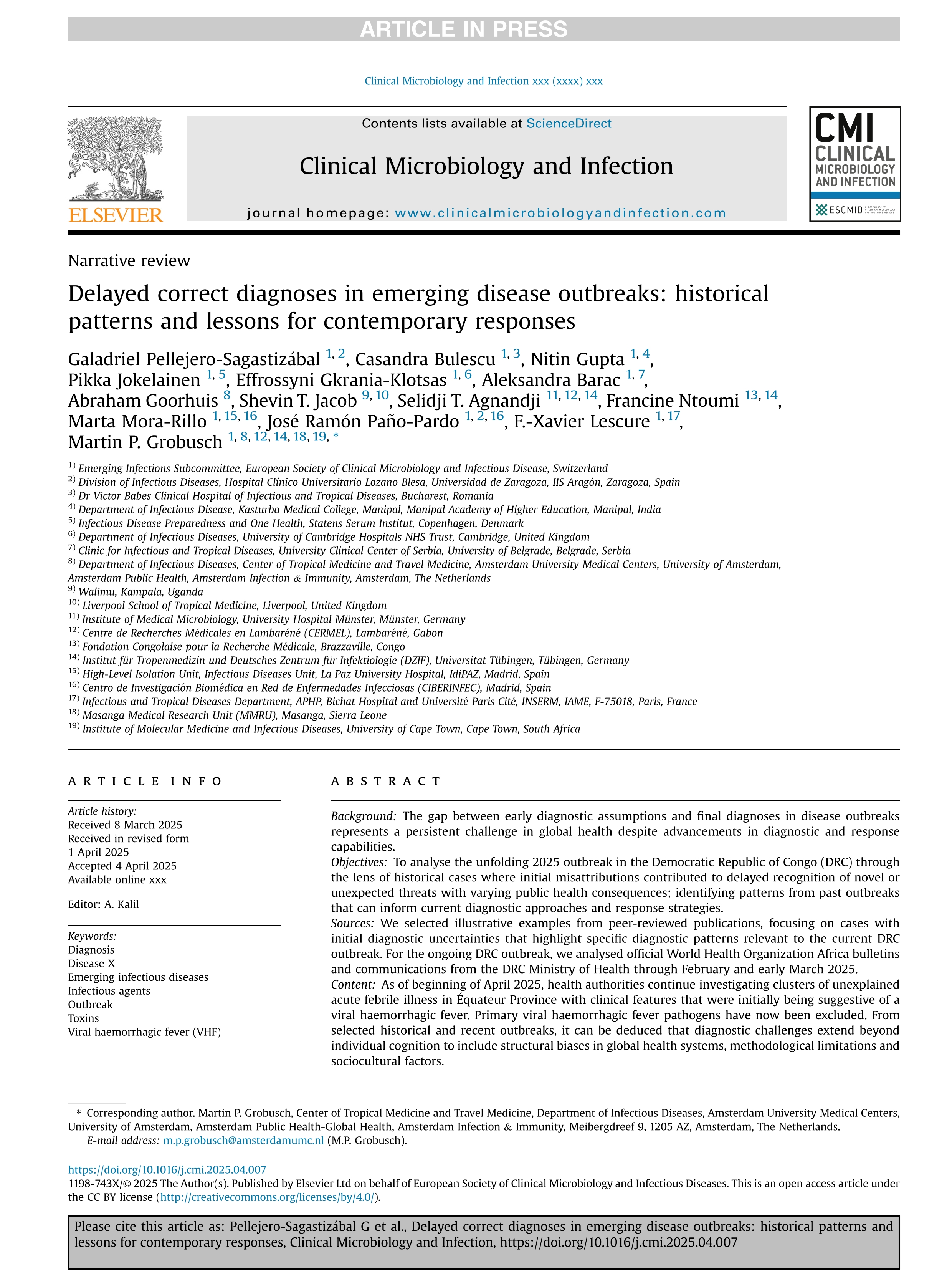
Resumen: Background
The gap between early diagnostic assumptions and final diagnoses in disease outbreaks represents a persistent challenge in global health despite advancements in diagnostic and response capabilities.
Objectives
To analyse the unfolding 2025 outbreak in the Democratic Republic of Congo (DRC) through the lens of historical cases where initial misattributions contributed to delayed recognition of novel or unexpected threats with varying public health consequences; identifying patterns from past outbreaks that can inform current diagnostic approaches and response strategies.
Sources
We selected illustrative examples from peer-reviewed publications, focusing on cases with initial diagnostic uncertainties that highlight specific diagnostic patterns relevant to the current DRC outbreak. For the ongoing DRC outbreak, we analysed official World Health Organization Africa bulletins and communications from the DRC Ministry of Health through February and early March 2025.
Content
As of beginning of April 2025, health authorities continue investigating clusters of unexplained acute febrile illness in Équateur Province with clinical features that were initially being suggestive of a viral haemorrhagic fever. Primary viral haemorrhagic fever pathogens have now been excluded. From selected historical and recent outbreaks, it can be deduced that diagnostic challenges extend beyond individual cognition to include structural biases in global health systems, methodological limitations and sociocultural factors.
Implications
We identified five evidence-informed interventions to mitigate diagnostic delays: systematic consideration of multiple working hypotheses, development of sustainable local diagnostic capacity, enhancement of clinician-to-public-health communication networks, implementation of cognitive debiasing strategies, and strengthening of One Health surveillance platforms. Historical misdiagnoses offer crucial lessons for transforming outbreak response from reactive to anticipatory, potentially averting future epidemics through earlier, more accurate recognition of emerging pathogens within their complex ecological and social contexts.
Idioma: Inglés
DOI: 10.1016/j.cmi.2025.04.007
Año: 2025
Publicado en: Clinical Microbiology and Infection 31, 8 (2025), 1298-1306
ISSN: 1198-743X
Tipo y forma: Article (Published version)
Área (Departamento): Area Medicina (Dpto. Medicina, Psiqu. y Derm.)
 You must give appropriate credit, provide a link to the license, and indicate if changes were made. You may do so in any reasonable manner, but not in any way that suggests the licensor endorses you or your use.
Exportado de SIDERAL (2026-04-30-14:05:36)
Visitas y descargas
The gap between early diagnostic assumptions and final diagnoses in disease outbreaks represents a persistent challenge in global health despite advancements in diagnostic and response capabilities.
Objectives
To analyse the unfolding 2025 outbreak in the Democratic Republic of Congo (DRC) through the lens of historical cases where initial misattributions contributed to delayed recognition of novel or unexpected threats with varying public health consequences; identifying patterns from past outbreaks that can inform current diagnostic approaches and response strategies.
Sources
We selected illustrative examples from peer-reviewed publications, focusing on cases with initial diagnostic uncertainties that highlight specific diagnostic patterns relevant to the current DRC outbreak. For the ongoing DRC outbreak, we analysed official World Health Organization Africa bulletins and communications from the DRC Ministry of Health through February and early March 2025.
Content
As of beginning of April 2025, health authorities continue investigating clusters of unexplained acute febrile illness in Équateur Province with clinical features that were initially being suggestive of a viral haemorrhagic fever. Primary viral haemorrhagic fever pathogens have now been excluded. From selected historical and recent outbreaks, it can be deduced that diagnostic challenges extend beyond individual cognition to include structural biases in global health systems, methodological limitations and sociocultural factors.
Implications
We identified five evidence-informed interventions to mitigate diagnostic delays: systematic consideration of multiple working hypotheses, development of sustainable local diagnostic capacity, enhancement of clinician-to-public-health communication networks, implementation of cognitive debiasing strategies, and strengthening of One Health surveillance platforms. Historical misdiagnoses offer crucial lessons for transforming outbreak response from reactive to anticipatory, potentially averting future epidemics through earlier, more accurate recognition of emerging pathogens within their complex ecological and social contexts.
Idioma: Inglés
DOI: 10.1016/j.cmi.2025.04.007
Año: 2025
Publicado en: Clinical Microbiology and Infection 31, 8 (2025), 1298-1306
ISSN: 1198-743X
Tipo y forma: Article (Published version)
Área (Departamento): Area Medicina (Dpto. Medicina, Psiqu. y Derm.)
You must give appropriate credit, provide a link to the license, and indicate if changes were made. You may do so in any reasonable manner, but not in any way that suggests the licensor endorses you or your use. Exportado de SIDERAL (2026-04-30-14:05:36)
Permalink:
Visitas y descargas
Este artículo se encuentra en las siguientes colecciones:
Articles > Artículos por área > Medicina
Record created 2025-07-10, last modified 2026-04-30