The DEPRE’5 study: pragmatic, multicentre, five-arm, parallel-group randomised controlled trial with blinded assessment to compare treatment strategies in major depression after a failed selective serotonin reuptake inhibitor treatment
Pérez, Víctor ; Puigdemont, Dolors ; de Diego-Adeliño, Javier ; Elices, Matilde ; Leal, Itziar ; Cabello, Maria ; Rodriguez-Jimenez, Roberto ; Álvarez-Mon, Miguel Ángel ; García-Fernández, Lorena ; Aguilar García-Iturrospe, Eduardo José ; Escartí, Maria José ; Montejo, Angel Luis ; Montes, José Manuel ; Usall, Judith ; Gallego-Nogueras, Ascensión ; Lujan, Elena ; López-Carrilero, Raquel ; González-Pinto, Ana ; Ortiz-Jauregui, Agurtzane ; Blanch, Jordi ; Urretavizcaya, Mikel ; Colom, Francesc ; García-Campayo, Javier (Universidad de Zaragoza) ; Ayuso-Mateos, José Luis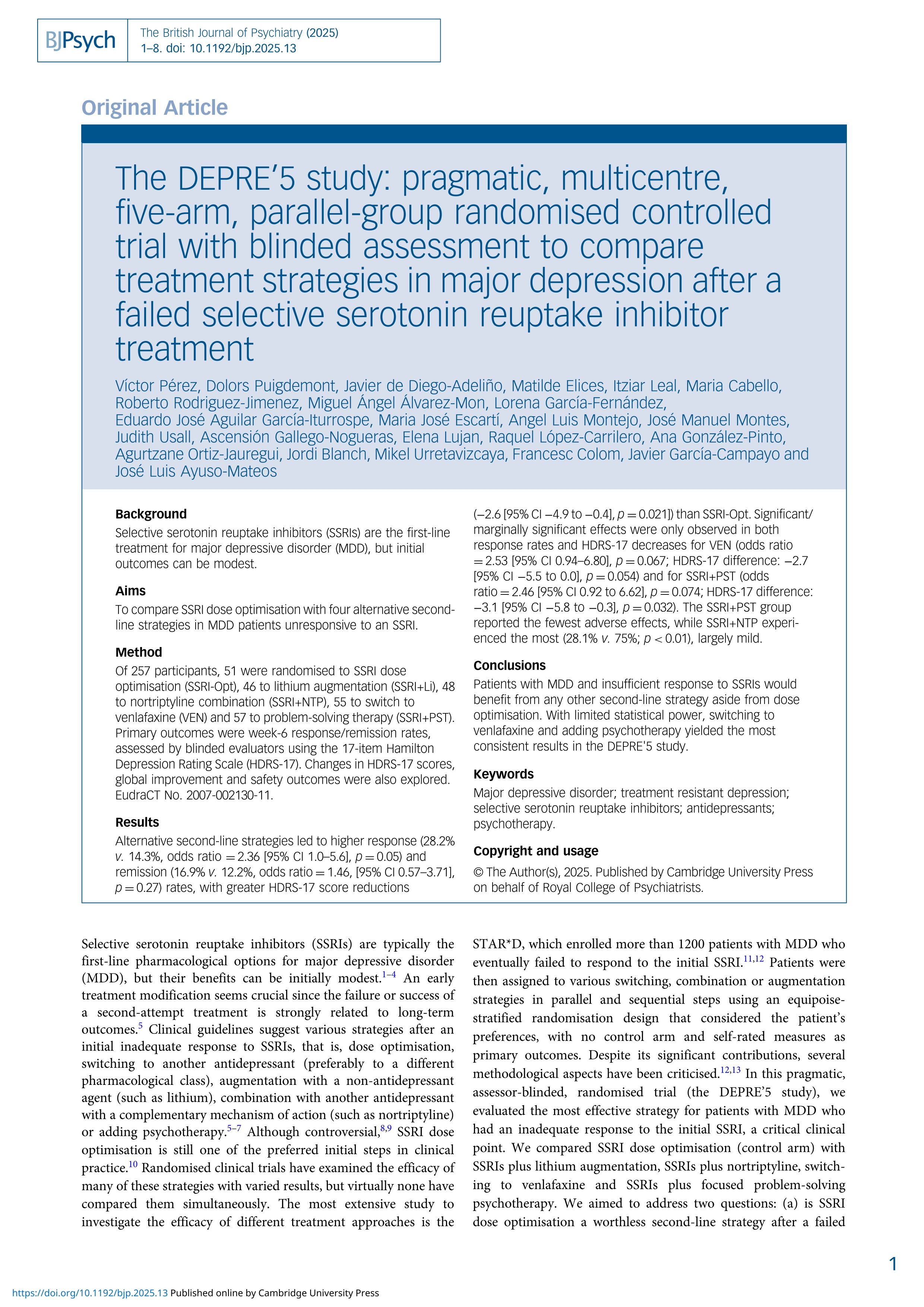
Resumen: Background
Selective serotonin reuptake inhibitors (SSRIs) are the first-line treatment for major depressive disorder (MDD), but initial outcomes can be modest.
Aims
To compare SSRI dose optimisation with four alternative second-line strategies in MDD patients unresponsive to an SSRI.
Method
Of 257 participants, 51 were randomised to SSRI dose optimisation (SSRI-Opt), 46 to lithium augmentation (SSRI+Li), 48 to nortriptyline combination (SSRI+NTP), 55 to switch to venlafaxine (VEN) and 57 to problem-solving therapy (SSRI+PST). Primary outcomes were week-6 response/remission rates, assessed by blinded evaluators using the 17-item Hamilton Depression Rating Scale (HDRS-17). Changes in HDRS-17 scores, global improvement and safety outcomes were also explored. EudraCT No. 2007-002130-11.
Results
Alternative second-line strategies led to higher response (28.2% v. 14.3%, odds ratio = 2.36 [95% CI 1.0–5.6], p = 0.05) and remission (16.9% v. 12.2%, odds ratio = 1.46, [95% CI 0.57–3.71], p = 0.27) rates, with greater HDRS-17 score reductions (−2.6 [95% CI −4.9 to −0.4], p = 0.021]) than SSRI-Opt. Significant/marginally significant effects were only observed in both response rates and HDRS-17 decreases for VEN (odds ratio = 2.53 [95% CI 0.94–6.80], p = 0.067; HDRS-17 difference: −2.7 [95% CI −5.5 to 0.0], p = 0.054) and for SSRI+PST (odds ratio = 2.46 [95% CI 0.92 to 6.62], p = 0.074; HDRS-17 difference: −3.1 [95% CI −5.8 to −0.3], p = 0.032). The SSRI+PST group reported the fewest adverse effects, while SSRI+NTP experienced the most (28.1% v. 75%; p < 0.01), largely mild.
Conclusions
Patients with MDD and insufficient response to SSRIs would benefit from any other second-line strategy aside from dose optimisation. With limited statistical power, switching to venlafaxine and adding psychotherapy yielded the most consistent results in the DEPRE'5 study.
Idioma: Inglés
DOI: 10.1192/bjp.2025.13
Año: 2025
Publicado en: BRITISH JOURNAL OF PSYCHIATRY 227, 5 (2025), 748-755
ISSN: 0007-1250
Financiación: info:eu-repo/grantAgreement/ES/ISCIII/FIS/EC07-90244
Tipo y forma: Artículo (Versión definitiva)
Área (Departamento): Área Person.Eval.Trat.Psicoló. (Dpto. Psicología y Sociología)
 Derechos reservados por el editor de la revista
Exportado de SIDERAL (2026-04-18-11:05:07)
Visitas y descargas
Selective serotonin reuptake inhibitors (SSRIs) are the first-line treatment for major depressive disorder (MDD), but initial outcomes can be modest.
Aims
To compare SSRI dose optimisation with four alternative second-line strategies in MDD patients unresponsive to an SSRI.
Method
Of 257 participants, 51 were randomised to SSRI dose optimisation (SSRI-Opt), 46 to lithium augmentation (SSRI+Li), 48 to nortriptyline combination (SSRI+NTP), 55 to switch to venlafaxine (VEN) and 57 to problem-solving therapy (SSRI+PST). Primary outcomes were week-6 response/remission rates, assessed by blinded evaluators using the 17-item Hamilton Depression Rating Scale (HDRS-17). Changes in HDRS-17 scores, global improvement and safety outcomes were also explored. EudraCT No. 2007-002130-11.
Results
Alternative second-line strategies led to higher response (28.2% v. 14.3%, odds ratio = 2.36 [95% CI 1.0–5.6], p = 0.05) and remission (16.9% v. 12.2%, odds ratio = 1.46, [95% CI 0.57–3.71], p = 0.27) rates, with greater HDRS-17 score reductions (−2.6 [95% CI −4.9 to −0.4], p = 0.021]) than SSRI-Opt. Significant/marginally significant effects were only observed in both response rates and HDRS-17 decreases for VEN (odds ratio = 2.53 [95% CI 0.94–6.80], p = 0.067; HDRS-17 difference: −2.7 [95% CI −5.5 to 0.0], p = 0.054) and for SSRI+PST (odds ratio = 2.46 [95% CI 0.92 to 6.62], p = 0.074; HDRS-17 difference: −3.1 [95% CI −5.8 to −0.3], p = 0.032). The SSRI+PST group reported the fewest adverse effects, while SSRI+NTP experienced the most (28.1% v. 75%; p < 0.01), largely mild.
Conclusions
Patients with MDD and insufficient response to SSRIs would benefit from any other second-line strategy aside from dose optimisation. With limited statistical power, switching to venlafaxine and adding psychotherapy yielded the most consistent results in the DEPRE'5 study.
Idioma: Inglés
DOI: 10.1192/bjp.2025.13
Año: 2025
Publicado en: BRITISH JOURNAL OF PSYCHIATRY 227, 5 (2025), 748-755
ISSN: 0007-1250
Financiación: info:eu-repo/grantAgreement/ES/ISCIII/FIS/EC07-90244
Tipo y forma: Artículo (Versión definitiva)
Área (Departamento): Área Person.Eval.Trat.Psicoló. (Dpto. Psicología y Sociología)
Derechos reservados por el editor de la revistaExportado de SIDERAL (2026-04-18-11:05:07)
Enlace permanente:
Visitas y descargas
Este artículo se encuentra en las siguientes colecciones:
Artículos > Artículos por área > Personalidad,Evaluación y Tratamiento Psicológicos
Registro creado el 2025-07-10, última modificación el 2026-04-20