Impulsivity in Male Episodic Cluster Headache
Rodríguez-Montolío, Joana ; Cajape-Mosquera, Javier (Universidad de Zaragoza) ; del Moral-Sahuquillo, Belén ; Lasry-Mizzi, Miriam ; Bellosta-Diago, Elena ; Santos-Lasaosa, Sonia (Universidad de Zaragoza)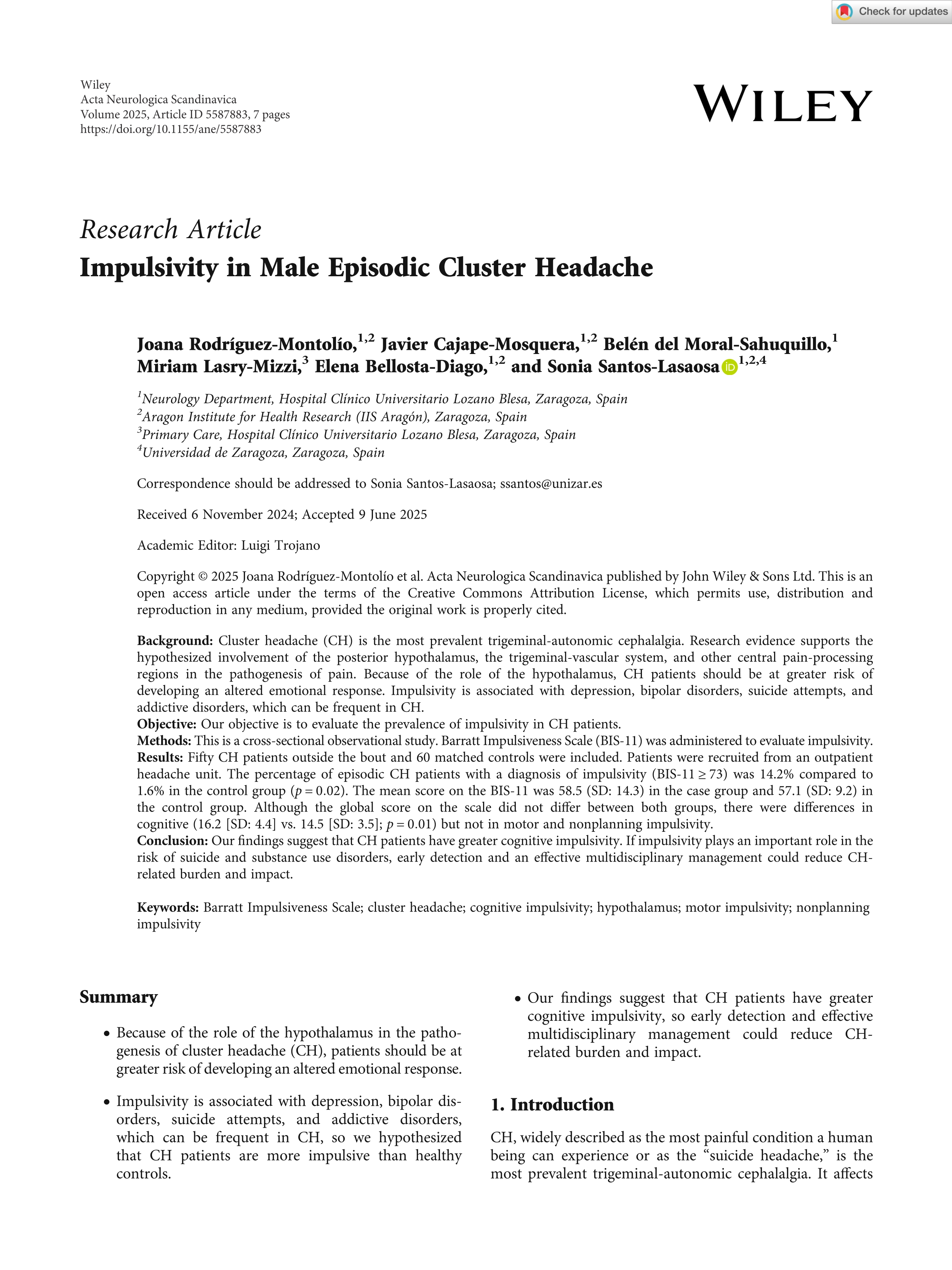
Resumen: Background: Cluster headache (CH) is the most prevalent trigeminal‐autonomic cephalalgia. Research evidence supports the hypothesized involvement of the posterior hypothalamus, the trigeminal‐vascular system, and other central pain‐processing regions in the pathogenesis of pain. Because of the role of the hypothalamus, CH patients should be at greater risk of developing an altered emotional response. Impulsivity is associated with depression, bipolar disorders, suicide attempts, and addictive disorders, which can be frequent in CH.Objective: Our objective is to evaluate the prevalence of impulsivity in CH patients.Methods: This is a cross‐sectional observational study. Barratt Impulsiveness Scale (BIS‐11) was administered to evaluate impulsivity.Results: Fifty CH patients outside the bout and 60 matched controls were included. Patients were recruited from an outpatient headache unit. The percentage of episodic CH patients with a diagnosis of impulsivity (BIS‐11 ≥ 73) was 14.2% compared to 1.6% in the control group (p = 0.02). The mean score on the BIS‐11 was 58.5 (SD: 14.3) in the case group and 57.1 (SD: 9.2) in the control group. Although the global score on the scale did not differ between both groups, there were differences in cognitive (16.2 [SD: 4.4] vs. 14.5 [SD: 3.5]; p = 0.01) but not in motor and nonplanning impulsivity.Conclusion: Our findings suggest that CH patients have greater cognitive impulsivity. If impulsivity plays an important role in the risk of suicide and substance use disorders, early detection and an effective multidisciplinary management could reduce CH‐related burden and impact.
Idioma: Inglés
DOI: 10.1155/ane/5587883
Año: 2025
Publicado en: ACTA NEUROLOGICA SCANDINAVICA 2025, 1 (2025), 7 pp.
ISSN: 0001-6314
Tipo y forma: Article (Published version)
Área (Departamento): Area Medicina (Dpto. Medicina, Psiqu. y Derm.)
 You must give appropriate credit, provide a link to the license, and indicate if changes were made. You may do so in any reasonable manner, but not in any way that suggests the licensor endorses you or your use.
Exportado de SIDERAL (2025-10-17-14:31:13)
Visitas y descargas
Idioma: Inglés
DOI: 10.1155/ane/5587883
Año: 2025
Publicado en: ACTA NEUROLOGICA SCANDINAVICA 2025, 1 (2025), 7 pp.
ISSN: 0001-6314
Tipo y forma: Article (Published version)
Área (Departamento): Area Medicina (Dpto. Medicina, Psiqu. y Derm.)
You must give appropriate credit, provide a link to the license, and indicate if changes were made. You may do so in any reasonable manner, but not in any way that suggests the licensor endorses you or your use. Exportado de SIDERAL (2025-10-17-14:31:13)
Permalink:
Visitas y descargas
Este artículo se encuentra en las siguientes colecciones:
Articles > Artículos por área > Medicina
Record created 2025-07-10, last modified 2025-10-17