Ligand‐Controlled Chemoselectivity in the Rhodium‐Catalyzed Synthesis of Pentafulvenes via (2 + 2 + 1) Alkyne Cyclotrimerization
Español-Sánchez, Belinda (Universidad de Zaragoza) ; Moradell, Jesús ; Galiana-Cameo, María ; Barrenas, Eduardo ; Pérez-Torrente, Jesús J. (Universidad de Zaragoza) ; Passarelli, Vincenzo ; Castarlenas, Ricardo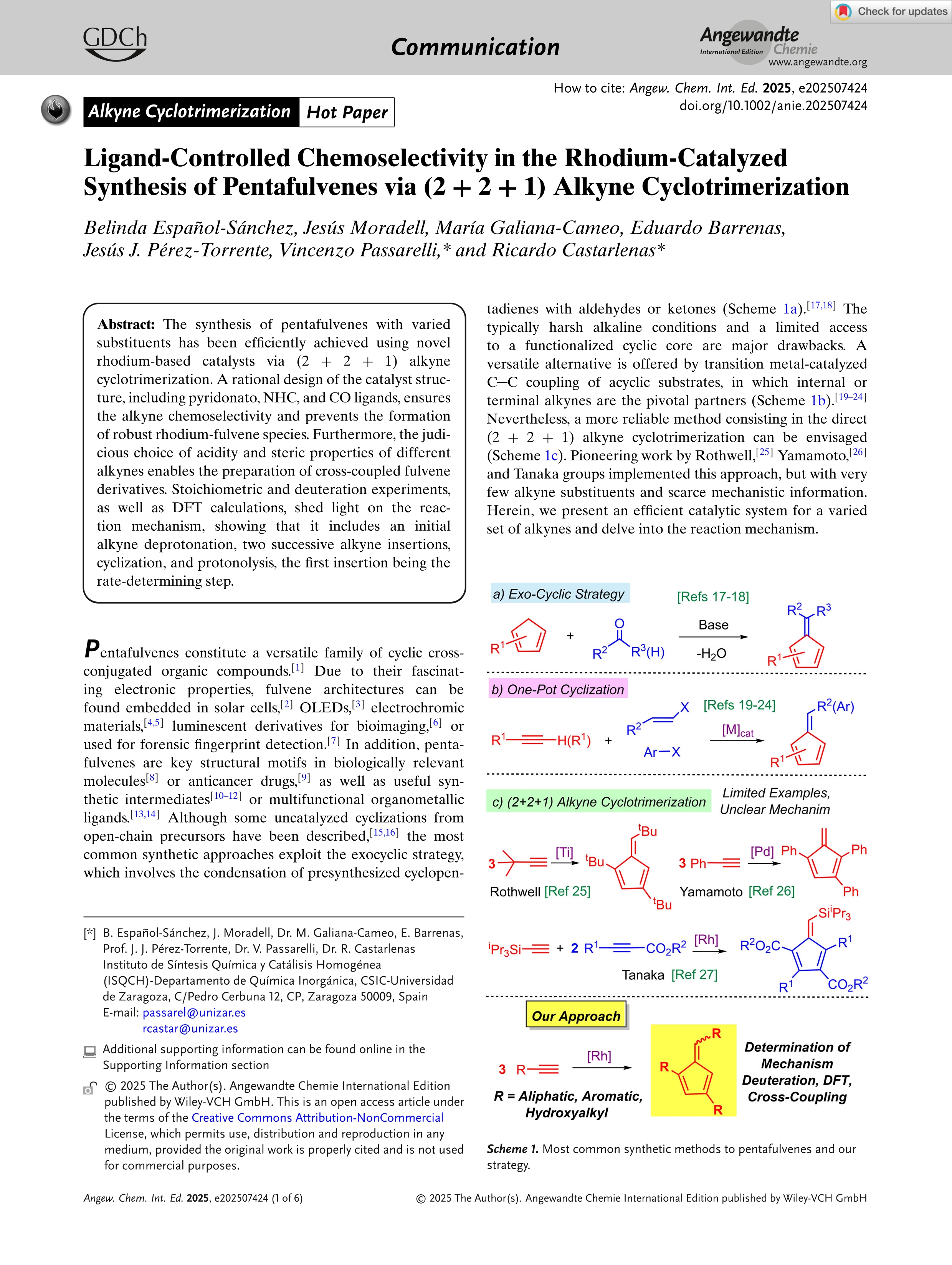
Resumen: The synthesis of pentafulvenes with varied substituents has been efficiently achieved using novel rhodium‐based catalysts via (2 + 2 + 1) alkyne cyclotrimerization. A rational design of the catalyst structure, including pyridonato, NHC, and CO ligands, ensures the alkyne chemoselectivity and prevents the formation of robust rhodium‐fulvene species. Furthermore, the judicious choice of acidity and steric properties of different alkynes enables the preparation of cross‐coupled fulvene derivatives. Stoichiometric and deuteration experiments, as well as DFT calculations, shed light on the reaction mechanism, showing that it includes an initial alkyne deprotonation, two successive alkyne insertions, cyclization, and protonolysis, the first insertion being the rate‐determining step.
Idioma: Inglés
DOI: 10.1002/anie.202507424
Año: 2025
Publicado en: Angewandte Chemie (International ed.) (2025), e202507424 ([6 pp.)
ISSN: 1433-7851
Financiación: info:eu-repo/grantAgreement/ES/DGA/E42-23R
Financiación: info:eu-repo/grantAgreement/ES/MICINN-FEDER/PID2019-103965GB-I00
Financiación: info:eu-repo/grantAgreement/ES/MICINN/PID2022-137208NB-I00
Tipo y forma: Congress (Published version)
Área (Departamento): Área Química Inorgánica (Dpto. Química Inorgánica)
 You must give appropriate credit, provide a link to the license, and indicate if changes were made. You may do so in any reasonable manner, but not in any way that suggests the licensor endorses you or your use. You may not use the material for commercial purposes.
Exportado de SIDERAL (2025-10-17-14:25:00)
Visitas y descargas
Idioma: Inglés
DOI: 10.1002/anie.202507424
Año: 2025
Publicado en: Angewandte Chemie (International ed.) (2025), e202507424 ([6 pp.)
ISSN: 1433-7851
Financiación: info:eu-repo/grantAgreement/ES/DGA/E42-23R
Financiación: info:eu-repo/grantAgreement/ES/MICINN-FEDER/PID2019-103965GB-I00
Financiación: info:eu-repo/grantAgreement/ES/MICINN/PID2022-137208NB-I00
Tipo y forma: Congress (Published version)
Área (Departamento): Área Química Inorgánica (Dpto. Química Inorgánica)
You must give appropriate credit, provide a link to the license, and indicate if changes were made. You may do so in any reasonable manner, but not in any way that suggests the licensor endorses you or your use. You may not use the material for commercial purposes. Exportado de SIDERAL (2025-10-17-14:25:00)
Permalink:
Visitas y descargas
Este artículo se encuentra en las siguientes colecciones:
Articles > Artículos por área > Química Inorgánica
Record created 2025-07-17, last modified 2025-10-17