Elucidating the Role of KRAS, NRAS, and BRAF Mutations and Microsatellite Instability in Colorectal Cancer via Next-Generation Sequencing
Rada Rodríguez, Marta ; Angulo Biedma, Bárbara ; Rodríguez Pérez, Irene ; Azúa Romeo, Javier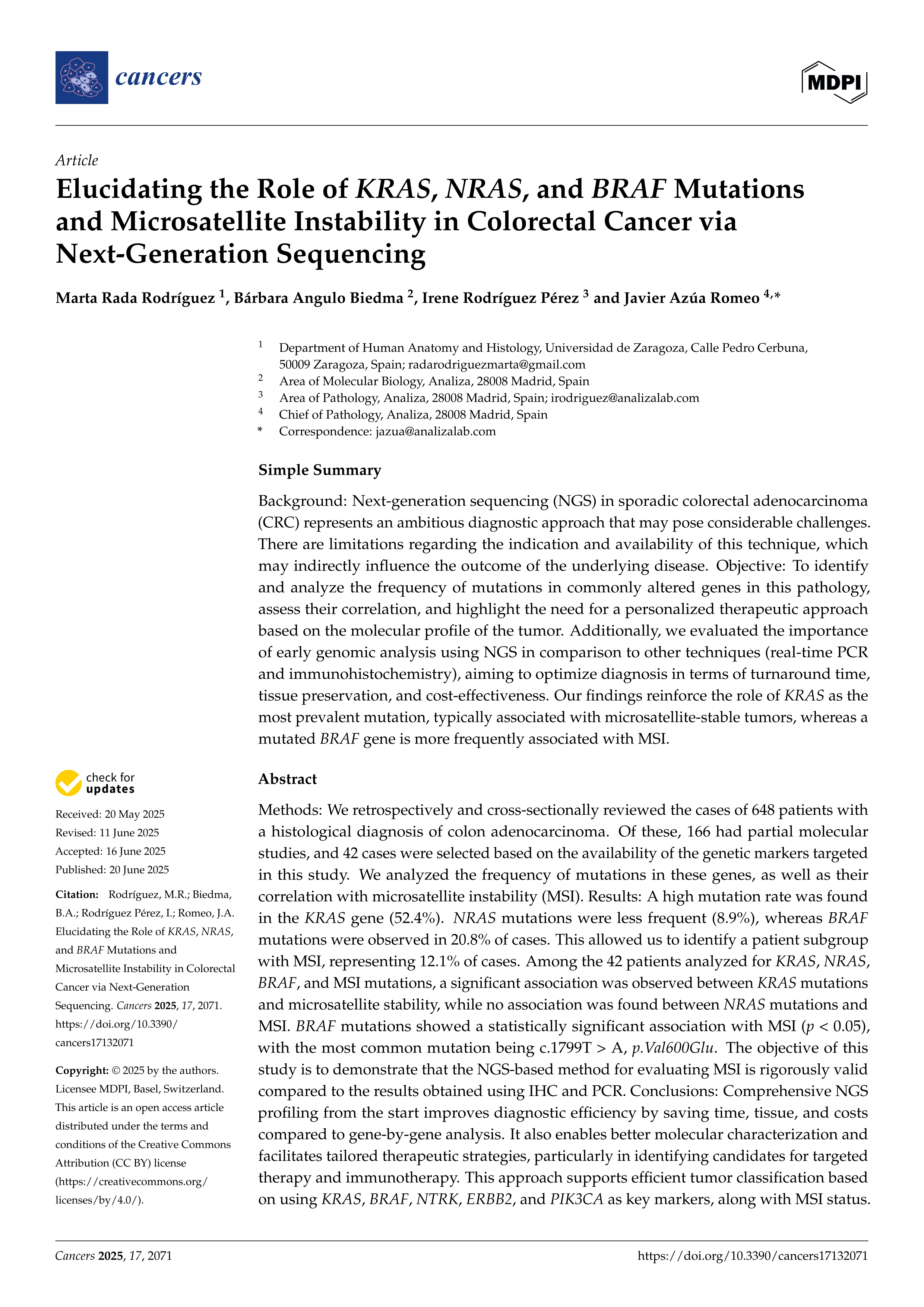
Resumen: Methods: We retrospectively and cross-sectionally reviewed the cases of 648 patients with a histological diagnosis of colon adenocarcinoma. Of these, 166 had partial molecular studies, and 42 cases were selected based on the availability of the genetic markers targeted in this study. We analyzed the frequency of mutations in these genes, as well as their correlation with microsatellite instability (MSI). Results: A high mutation rate was found in the KRAS gene (52.4%). NRAS mutations were less frequent (8.9%), whereas BRAF mutations were observed in 20.8% of cases. This allowed us to identify a patient subgroup with MSI, representing 12.1% of cases. Among the 42 patients analyzed for KRAS, NRAS, BRAF, and MSI mutations, a significant association was observed between KRAS mutations and microsatellite stability, while no association was found between NRAS mutations and MSI. BRAF mutations showed a statistically significant association with MSI (p < 0.05), with the most common mutation being c.1799T > A, p.Val600Glu. The objective of this study is to demonstrate that the NGS-based method for evaluating MSI is rigorously valid compared to the results obtained using IHC and PCR. Conclusions: Comprehensive NGS profiling from the start improves diagnostic efficiency by saving time, tissue, and costs compared to gene-by-gene analysis. It also enables better molecular characterization and facilitates tailored therapeutic strategies, particularly in identifying candidates for targeted therapy and immunotherapy. This approach supports efficient tumor classification based on using KRAS, BRAF, NTRK, ERBB2, and PIK3CA as key markers, along with MSI status. We recommend that, if initial NGS is not feasible, start with KRAS analysis, then test BRAF and MSI if no mutation is found.
Idioma: Inglés
DOI: 10.3390/cancers17132071
Año: 2025
Publicado en: Cancers 17, 13 (2025), 2071 [15 pp.]
ISSN: 2072-6694
Tipo y forma: Artículo (Versión definitiva)
 Debe reconocer adecuadamente la autoría, proporcionar un enlace a la licencia e indicar si se han realizado cambios. Puede hacerlo de cualquier manera razonable, pero no de una manera que sugiera que tiene el apoyo del licenciador o lo recibe por el uso que hace.
Exportado de SIDERAL (2025-10-17-14:13:50)
Visitas y descargas
Idioma: Inglés
DOI: 10.3390/cancers17132071
Año: 2025
Publicado en: Cancers 17, 13 (2025), 2071 [15 pp.]
ISSN: 2072-6694
Tipo y forma: Artículo (Versión definitiva)
Debe reconocer adecuadamente la autoría, proporcionar un enlace a la licencia e indicar si se han realizado cambios. Puede hacerlo de cualquier manera razonable, pero no de una manera que sugiera que tiene el apoyo del licenciador o lo recibe por el uso que hace. Exportado de SIDERAL (2025-10-17-14:13:50)
Enlace permanente:
Visitas y descargas
Este artículo se encuentra en las siguientes colecciones:
Artículos
Registro creado el 2025-07-22, última modificación el 2025-10-17