Evaluation of the gambling habits of Spanish adolescents and young adults post-COVID-19 and implementation of a digital escape room intervention for preventing gambling: study protocol of a cluster-randomized controlled trial (GAMBL-OUT project)
Barceló-Soler, Alberto (Universidad de Zaragoza) ; Monreal-Bartolomé, Alicia (Universidad de Zaragoza) ; Pérez-Aranda, Adrián ; Campos, Daniel (Universidad de Zaragoza) ; Beltrán-Ruiz, María (Universidad de Zaragoza) ; Puebla-Guedea, Marta (Universidad de Zaragoza) ; Cabrera-Gil, Itxaso (Universidad de Zaragoza) ; García-Campayo, Javier (Universidad de Zaragoza) ; López-del-Hoyo, Yolanda (Universidad de Zaragoza)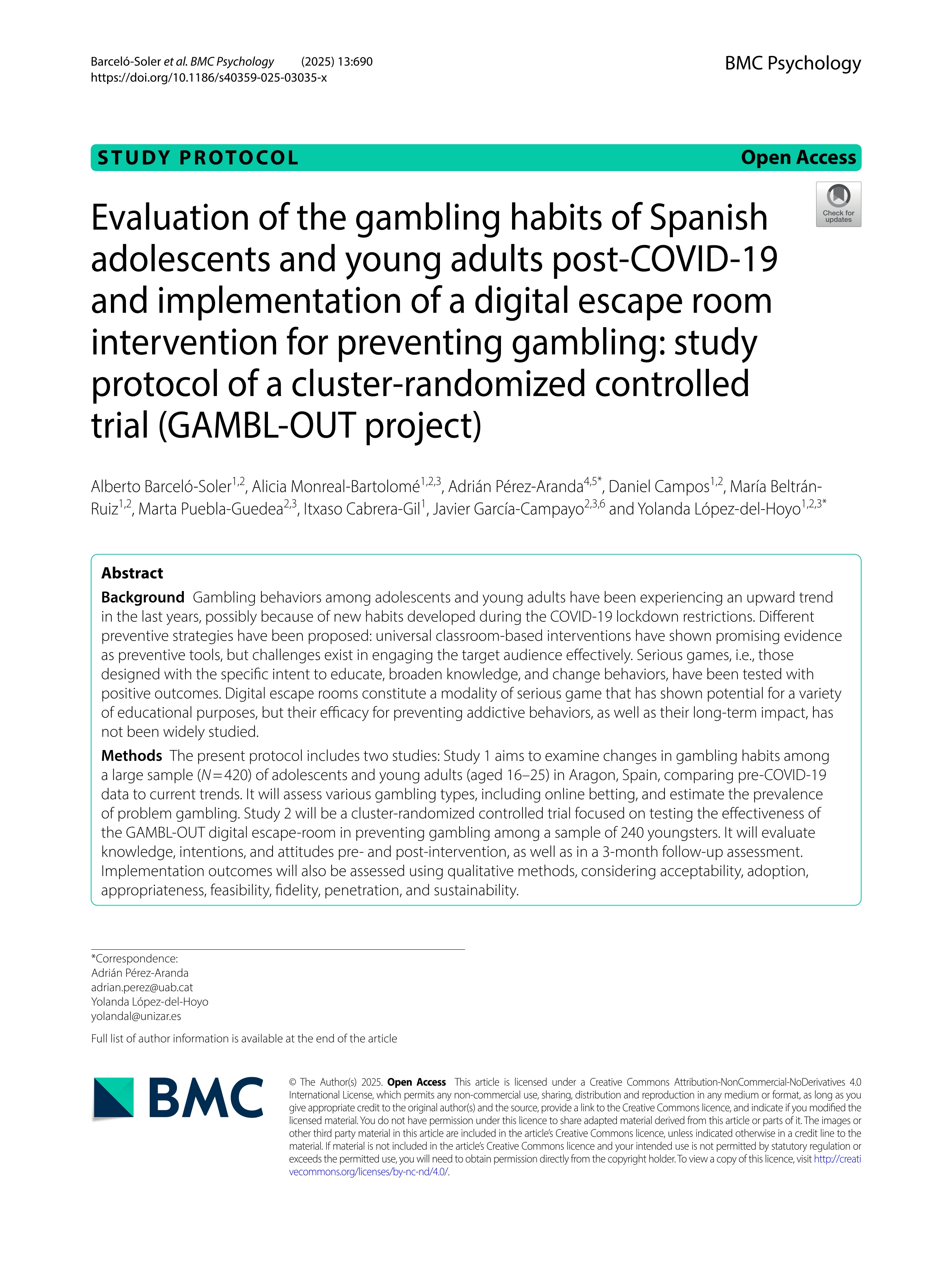
Resumen: Gambling behaviors among adolescents and young adults have been experiencing an upward trend in the last years, possibly because of new habits developed during the COVID-19 lockdown restrictions. Different preventive strategies have been proposed: universal classroom-based interventions have shown promising evidence as preventive tools, but challenges exist in engaging the target audience effectively. Serious games, i.e., those designed with the specific intent to educate, broaden knowledge, and change behaviors, have been tested with positive outcomes. Digital escape rooms constitute a modality of serious game that has shown potential for a variety of educational purposes, but their efficacy for preventing addictive behaviors, as well as their long-term impact, has not been widely studied.
Methods. The present protocol includes two studies: Study 1 aims to examine changes in gambling habits among a large sample (N = 420) of adolescents and young adults (aged 16–25) in Aragon, Spain, comparing pre-COVID-19 data to current trends. It will assess various gambling types, including online betting, and estimate the prevalence of problem gambling. Study 2 will be a cluster-randomized controlled trial focused on testing the effectiveness of the GAMBL-OUT digital escape-room in preventing gambling among a sample of 240 youngsters. It will evaluate knowledge, intentions, and attitudes pre- and post-intervention, as well as in a 3-month follow-up assessment. Implementation outcomes will also be assessed using qualitative methods, considering acceptability, adoption, appropriateness, feasibility, fidelity, penetration, and sustainability.
Discussion. The present project aims at assessing the gambling habits of a sample of 16–25-year-olds in the region of Aragon, Spain, that could be compared to the data gathered before the pandemic started, so not only the prevalence rates can be updated but also potential differences in habits (e.g., preferred gambling alternatives) can be detected. This will undoubtedly help the design of effective preventive measures, such as the GAMBL-OUT digital escape room, a serious game to be implemented in high schools with the aim of increasing knowledge, reducing intentions to gamble, and changing attitudes towards gambling.
Idioma: Inglés
DOI: 10.1186/s40359-025-03035-x
Año: 2025
Publicado en: BMC Psychology 13, 1 (2025), 11 pp.
ISSN: 2050-7283
Tipo y forma: Artículo (Versión definitiva)
Área (Departamento): Área Psicología Básica (Dpto. Psicología y Sociología)
Área (Departamento): Area Psiquiatría (Dpto. Medicina, Psiqu. y Derm.)
Área (Departamento): Área Psicolog.Evolut.Educac (Dpto. Psicología y Sociología)
 Debe reconocer adecuadamente la autoría, proporcionar un enlace a la licencia e indicar si se han realizado cambios. Puede hacerlo de cualquier manera razonable, pero no de una manera que sugiera que tiene el apoyo del licenciador o lo recibe por el uso que hace. No puede utilizar el material para una finalidad comercial. Si remezcla, transforma o crea a partir del material, no puede difundir el material modificado.
Exportado de SIDERAL (2025-10-17-14:37:46)
Visitas y descargas
Methods. The present protocol includes two studies: Study 1 aims to examine changes in gambling habits among a large sample (N = 420) of adolescents and young adults (aged 16–25) in Aragon, Spain, comparing pre-COVID-19 data to current trends. It will assess various gambling types, including online betting, and estimate the prevalence of problem gambling. Study 2 will be a cluster-randomized controlled trial focused on testing the effectiveness of the GAMBL-OUT digital escape-room in preventing gambling among a sample of 240 youngsters. It will evaluate knowledge, intentions, and attitudes pre- and post-intervention, as well as in a 3-month follow-up assessment. Implementation outcomes will also be assessed using qualitative methods, considering acceptability, adoption, appropriateness, feasibility, fidelity, penetration, and sustainability.
Discussion. The present project aims at assessing the gambling habits of a sample of 16–25-year-olds in the region of Aragon, Spain, that could be compared to the data gathered before the pandemic started, so not only the prevalence rates can be updated but also potential differences in habits (e.g., preferred gambling alternatives) can be detected. This will undoubtedly help the design of effective preventive measures, such as the GAMBL-OUT digital escape room, a serious game to be implemented in high schools with the aim of increasing knowledge, reducing intentions to gamble, and changing attitudes towards gambling.
Idioma: Inglés
DOI: 10.1186/s40359-025-03035-x
Año: 2025
Publicado en: BMC Psychology 13, 1 (2025), 11 pp.
ISSN: 2050-7283
Tipo y forma: Artículo (Versión definitiva)
Área (Departamento): Área Psicología Básica (Dpto. Psicología y Sociología)
Área (Departamento): Area Psiquiatría (Dpto. Medicina, Psiqu. y Derm.)
Área (Departamento): Área Psicolog.Evolut.Educac (Dpto. Psicología y Sociología)
Debe reconocer adecuadamente la autoría, proporcionar un enlace a la licencia e indicar si se han realizado cambios. Puede hacerlo de cualquier manera razonable, pero no de una manera que sugiera que tiene el apoyo del licenciador o lo recibe por el uso que hace. No puede utilizar el material para una finalidad comercial. Si remezcla, transforma o crea a partir del material, no puede difundir el material modificado.Exportado de SIDERAL (2025-10-17-14:37:46)
Enlace permanente:
Visitas y descargas
Este artículo se encuentra en las siguientes colecciones:
Artículos > Artículos por área > Psicología Evolutiva y de la Educación
Artículos > Artículos por área > Psicología Básica
Artículos > Artículos por área > Psiquiatría
Registro creado el 2025-07-22, última modificación el 2025-10-17