Serum lncRNAs NEAT1, PVT1 and H19 as novel biomarkers for sarcopenia diagnosis and treatment response
Aparicio, Paula ; López-Royo, Tresa ; Navarrete-Villanueva, David (Universidad de Zaragoza) ; Gómez Cabello, Alba María ; González-Gross, Marcela ; Ara, Ignacio ; Vicente-Rodríguez, Germán (Universidad de Zaragoza) ; Osta, Rosario (Universidad de Zaragoza) ; Manzano, Raquel (Universidad de Zaragoza)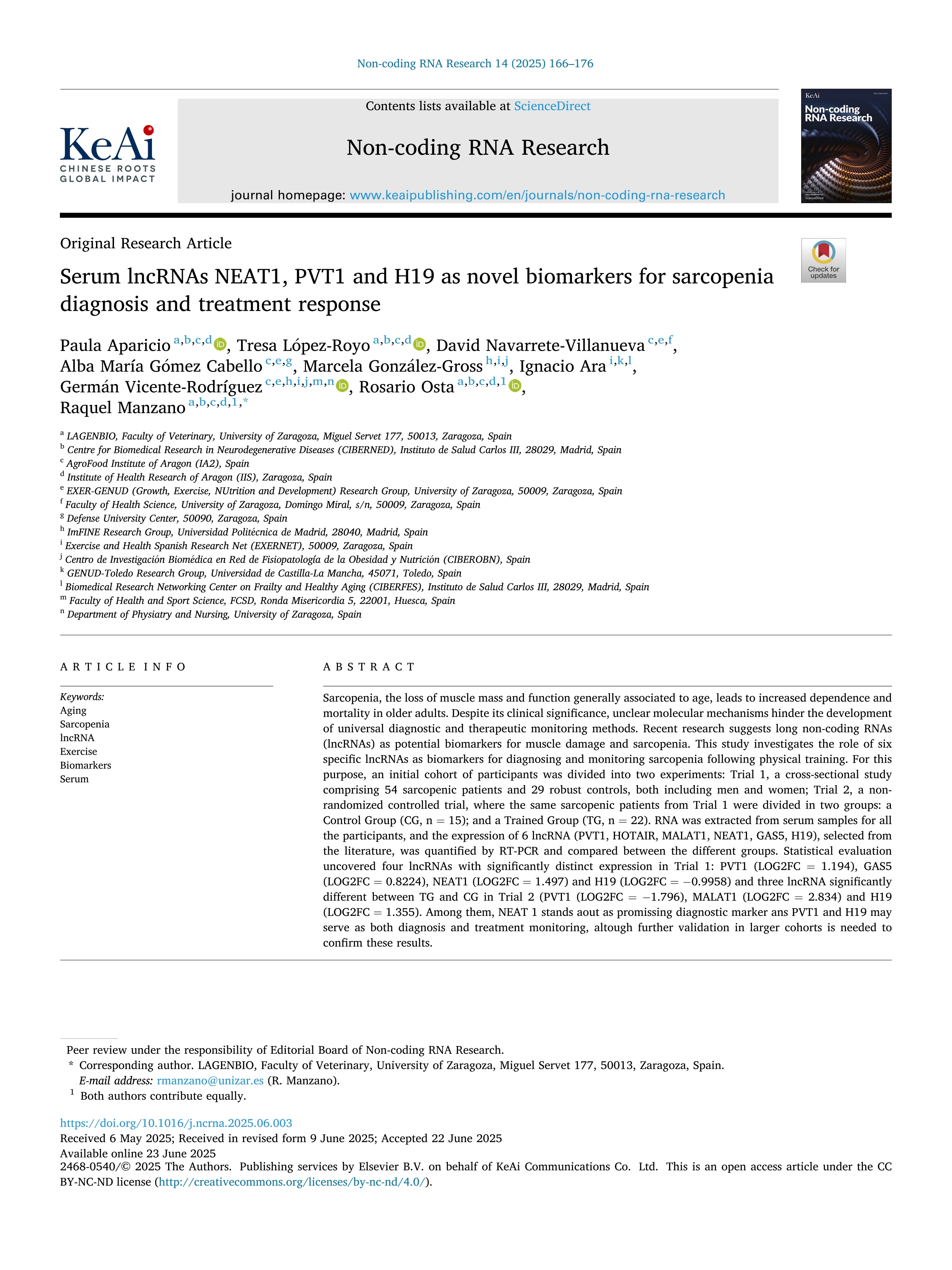
Resumen: Sarcopenia, the loss of muscle mass and function generally associated to age, leads to increased dependence and mortality in older adults. Despite its clinical significance, unclear molecular mechanisms hinder the development of universal diagnostic and therapeutic monitoring methods. Recent research suggests long non-coding RNAs (lncRNAs) as potential biomarkers for muscle damage and sarcopenia. This study investigates the role of six specific lncRNAs as biomarkers for diagnosing and monitoring sarcopenia following physical training. For this purpose, an initial cohort of participants was divided into two experiments: Trial 1, a cross-sectional study comprising 54 sarcopenic patients and 29 robust controls, both including men and women; Trial 2, a non-randomized controlled trial, where the same sarcopenic patients from Trial 1 were divided in two groups: a Control Group (CG, n = 15); and a Trained Group (TG, n = 22). RNA was extracted from serum samples for all the participants, and the expression of 6 lncRNA (PVT1, HOTAIR, MALAT1, NEAT1, GAS5, H19), selected from the literature, was quantified by RT-PCR and compared between the different groups. Statistical evaluation uncovered four lncRNAs with significantly distinct expression in Trial 1: PVT1 (LOG2FC = 1.194), GAS5 (LOG2FC = 0.8224), NEAT1 (LOG2FC = 1.497) and H19 (LOG2FC = −0.9958) and three lncRNA significantly different between TG and CG in Trial 2 (PVT1 (LOG2FC = −1.796), MALAT1 (LOG2FC = 2.834) and H19 (LOG2FC = 1.355). Among them, NEAT 1 stands aout as promissing diagnostic marker ans PVT1 and H19 may serve as both diagnosis and treatment monitoring, altough further validation in larger cohorts is needed to confirm these results.
Idioma: Inglés
DOI: 10.1016/j.ncrna.2025.06.003
Año: 2025
Publicado en: Non-coding RNA Research 14 (2025), 166-176
ISSN: 2468-0540
Financiación: info:eu-repo/grantAgreement/ES/AEI/PID2022-140911OB-I00
Financiación: info:eu-repo/grantAgreement/ES/ISCIII/CB12-03-30038
Financiación: info:eu-repo/grantAgreement/ES/ISCIII/CB18-05-0037
Financiación: info:eu-repo/grantAgreement/ES/ISCIII/FEDER/PI21-00372
Financiación: info:eu-repo/grantAgreement/ES/MICINN-AEI/PRTR-C17.I1
Financiación: info:eu-repo/grantAgreement/ES/MINECO/DEP2016-78309-R
Financiación: info:eu-repo/grantAgreement/ES/UZ/UZCUD2017-BIO-01
Financiación: info:eu-repo/grantAgreement/ES/UZ/UZ2021-BIO-05
Tipo y forma: Article (Published version)
Área (Departamento): Área Enfermería (Dpto. Fisiatría y Enfermería)
Área (Departamento): Área Genética (Dpto. Anatom.,Embri.Genét.Ani.)
Área (Departamento): Área Educación Física y Depor. (Dpto. Fisiatría y Enfermería)
Exportado de SIDERAL (2025-10-17-14:37:36)
Visitas y descargas
Idioma: Inglés
DOI: 10.1016/j.ncrna.2025.06.003
Año: 2025
Publicado en: Non-coding RNA Research 14 (2025), 166-176
ISSN: 2468-0540
Financiación: info:eu-repo/grantAgreement/ES/AEI/PID2022-140911OB-I00
Financiación: info:eu-repo/grantAgreement/ES/ISCIII/CB12-03-30038
Financiación: info:eu-repo/grantAgreement/ES/ISCIII/CB18-05-0037
Financiación: info:eu-repo/grantAgreement/ES/ISCIII/FEDER/PI21-00372
Financiación: info:eu-repo/grantAgreement/ES/MICINN-AEI/PRTR-C17.I1
Financiación: info:eu-repo/grantAgreement/ES/MINECO/DEP2016-78309-R
Financiación: info:eu-repo/grantAgreement/ES/UZ/UZCUD2017-BIO-01
Financiación: info:eu-repo/grantAgreement/ES/UZ/UZ2021-BIO-05
Tipo y forma: Article (Published version)
Área (Departamento): Área Enfermería (Dpto. Fisiatría y Enfermería)
Área (Departamento): Área Genética (Dpto. Anatom.,Embri.Genét.Ani.)
Área (Departamento): Área Educación Física y Depor. (Dpto. Fisiatría y Enfermería)
Exportado de SIDERAL (2025-10-17-14:37:36)
Permalink:
Visitas y descargas
Este artículo se encuentra en las siguientes colecciones:
articulos > articulos-por-area > educacion_fisica_y_deportiva
articulos > articulos-por-area > enfermeria
articulos > articulos-por-area > genetica
Notice créée le 2025-08-18, modifiée le 2025-10-17