Intermediate imports and innovation performance: do family firms benefit more?
Ramirez-Aleson, Marisa (Universidad de Zaragoza) ; Fernandez-Olmos, Marta (Universidad de Zaragoza)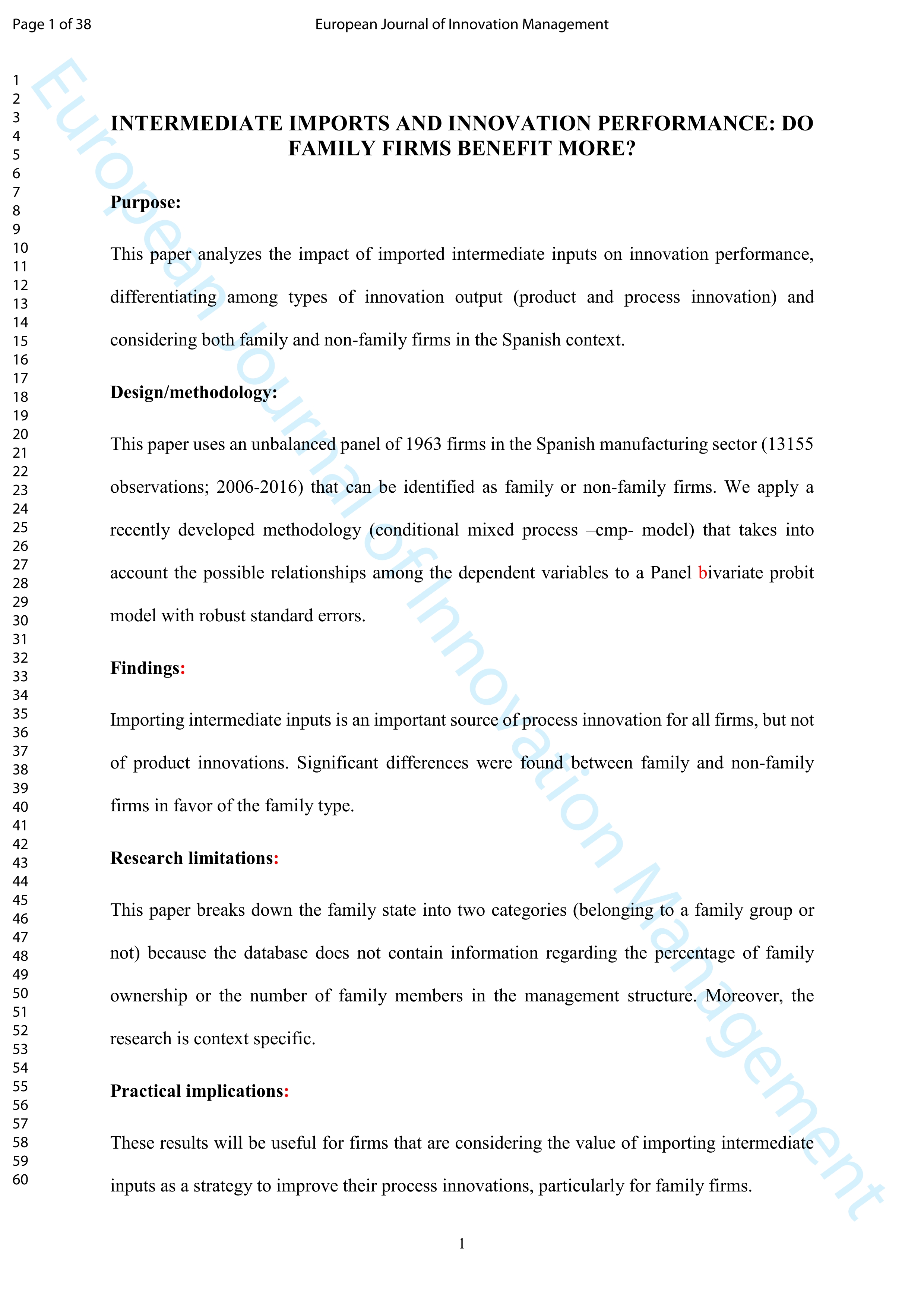
Resumen: Purpose: The purpose of this paper is to analyze the impact of imported intermediate inputs on innovation performance, differentiating among types of innovation output (product and process innovation) and considering both family and non-family firms in the Spanish context.
Design/methodology/approach: This paper uses an unbalanced panel of 1963 firms in the Spanish manufacturing sector (13, 155 observations; 2006-2016) that can be identified as family or non-family firms. The authors apply a recently developed methodology (conditional mixed process model) that takes into account the possible relationships among the dependent variables to a panel bivariate probit model with robust standard errors.
Findings: Importing intermediate inputs is an important source of process innovation for all firms, but not of product innovations. Significant differences were found between family and non-family firms in favor of the family type.
Research limitations/implications: This paper breaks down the family state into two categories (belonging to a family group or not) because the database does not contain information regarding the percentage of family ownership or the number of family members in the management structure. Moreover, the research is context specific.
Practical implications: These results will be useful for firms that are considering the value of importing intermediate inputs as a strategy to improve their process innovations, particularly for family firms.
Social implications: Family firms are more successful in the utilization of imported intermediate inputs to achieve greater innovation performance. If family firms are more competent in leveraging their intermediate input imports in innovation performance, it should contribute to increasing business performance.
Originality/value: The research on imports takes into account the different impacts of intermediate imports depending on innovation performance (product innovation vs process innovation) and the nature of the firm (family firms vs non-family firms).
Idioma: Inglés
DOI: 10.1108/EJIM-05-2019-0116
Año: 2020
Publicado en: European Journal of Innovation Management 23, 5 (2020), 835-855
ISSN: 1460-1060
Factor impacto JCR: 4.691 (2020)
Categ. JCR: BUSINESS rank: 65 / 153 = 0.425 (2020) - Q2 - T2
Categ. JCR: NURSING rank: 94 / 346 = 0.272 (2020) - Q2 - T1
Categ. JCR: MANAGEMENT rank: 93 / 225 = 0.413 (2020) - Q2 - T2
Factor impacto SCIMAGO: 0.775 - Management of Technology and Innovation (Q2)
Financiación: info:eu-repo/grantAgreement/ES/AEI-FEDER/ECO2016-77-P
Financiación: info:eu-repo/grantAgreement/ES/DGA-FEDER/S52-17R-COMPETE
Tipo y forma: Article (PostPrint)
Área (Departamento): Área Organización de Empresas (Dpto. Direcc.Organiza.Empresas)
Exportado de SIDERAL (2025-10-17-14:14:55)
Visitas y descargas
Design/methodology/approach: This paper uses an unbalanced panel of 1963 firms in the Spanish manufacturing sector (13, 155 observations; 2006-2016) that can be identified as family or non-family firms. The authors apply a recently developed methodology (conditional mixed process model) that takes into account the possible relationships among the dependent variables to a panel bivariate probit model with robust standard errors.
Findings: Importing intermediate inputs is an important source of process innovation for all firms, but not of product innovations. Significant differences were found between family and non-family firms in favor of the family type.
Research limitations/implications: This paper breaks down the family state into two categories (belonging to a family group or not) because the database does not contain information regarding the percentage of family ownership or the number of family members in the management structure. Moreover, the research is context specific.
Practical implications: These results will be useful for firms that are considering the value of importing intermediate inputs as a strategy to improve their process innovations, particularly for family firms.
Social implications: Family firms are more successful in the utilization of imported intermediate inputs to achieve greater innovation performance. If family firms are more competent in leveraging their intermediate input imports in innovation performance, it should contribute to increasing business performance.
Originality/value: The research on imports takes into account the different impacts of intermediate imports depending on innovation performance (product innovation vs process innovation) and the nature of the firm (family firms vs non-family firms).
Idioma: Inglés
DOI: 10.1108/EJIM-05-2019-0116
Año: 2020
Publicado en: European Journal of Innovation Management 23, 5 (2020), 835-855
ISSN: 1460-1060
Factor impacto JCR: 4.691 (2020)
Categ. JCR: BUSINESS rank: 65 / 153 = 0.425 (2020) - Q2 - T2
Categ. JCR: NURSING rank: 94 / 346 = 0.272 (2020) - Q2 - T1
Categ. JCR: MANAGEMENT rank: 93 / 225 = 0.413 (2020) - Q2 - T2
Factor impacto SCIMAGO: 0.775 - Management of Technology and Innovation (Q2)
Financiación: info:eu-repo/grantAgreement/ES/AEI-FEDER/ECO2016-77-P
Financiación: info:eu-repo/grantAgreement/ES/DGA-FEDER/S52-17R-COMPETE
Tipo y forma: Article (PostPrint)
Área (Departamento): Área Organización de Empresas (Dpto. Direcc.Organiza.Empresas)
Exportado de SIDERAL (2025-10-17-14:14:55)
Permalink:
Visitas y descargas
Este artículo se encuentra en las siguientes colecciones:
articulos > articulos-por-area > organizacion_de_empresas
Notice créée le 2025-08-29, modifiée le 2025-10-17