Conserved quantities in the ocean surface boundary layer: A fresh perspective on a classical problem
Llorente, Víctor J. (Universidad de Zaragoza) ; Padilla, Enrique M. ; Díez-Minguito, Manuel ; Valle-Levinson, Arnoldo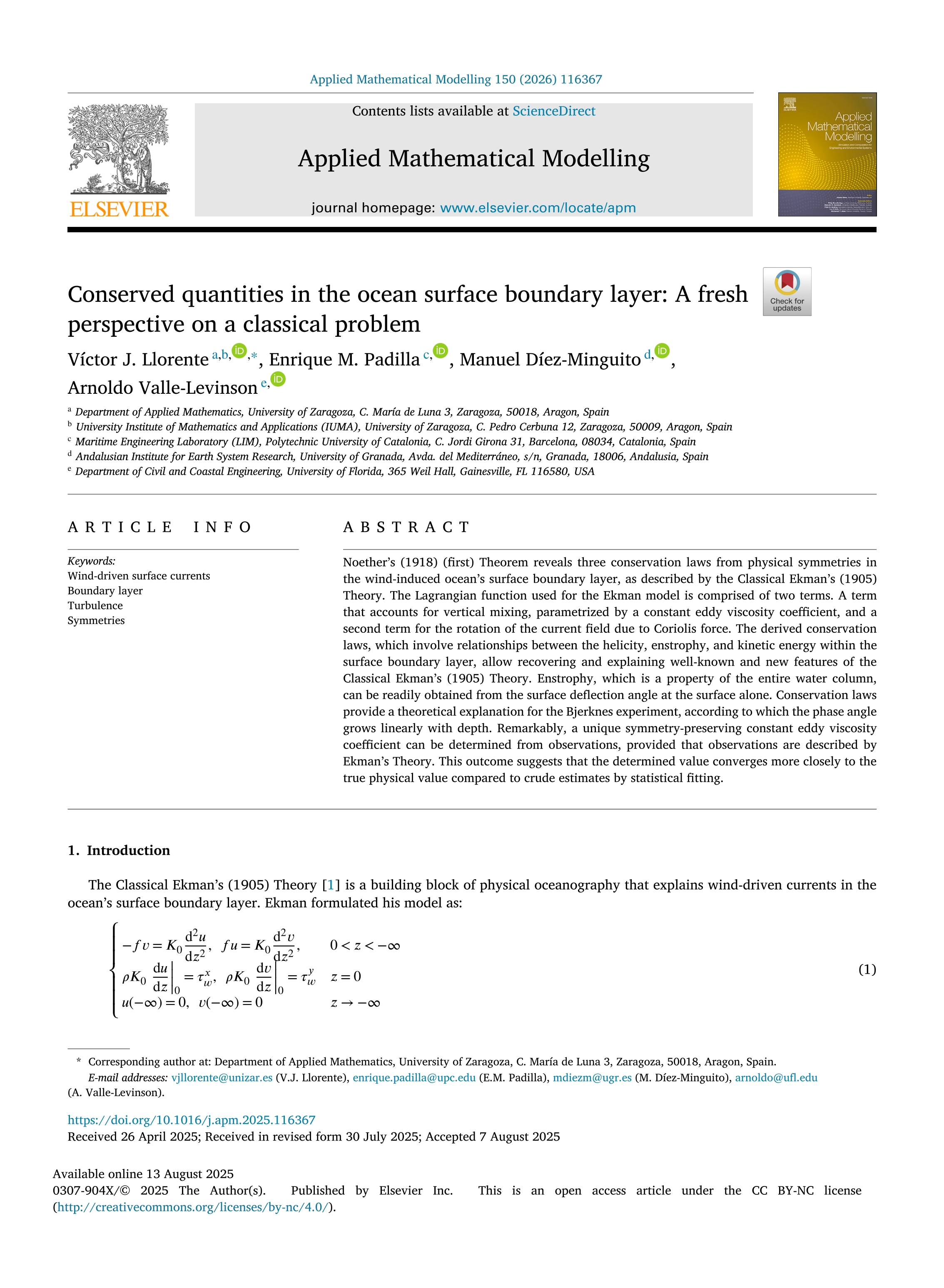
Resumen: Noether's (1918) (first) Theorem reveals three conservation laws from physical symmetries in the wind-induced ocean's surface boundary layer, as described by the Classical Ekman's (1905) Theory. The Lagrangian function used for the Ekman model is comprised of two terms. A term that accounts for vertical mixing, parametrized by a constant eddy viscosity coefficient, and a second term for the rotation of the current field due to Coriolis force. The derived conservation laws, which involve relationships between the helicity, enstrophy, and kinetic energy within the surface boundary layer, allow recovering and explaining well-known and new features of the Classical Ekman's (1905) Theory. Enstrophy, which is a property of the entire water column, can be readily obtained from the surface deflection angle at the surface alone. Conservation laws provide a theoretical explanation for the Bjerknes experiment, according to which the phase angle grows linearly with depth. Remarkably, a unique symmetry-preserving constant eddy viscosity coefficient can be determined from observations, provided that observations are described by Ekman's Theory. This outcome suggests that the determined value converges more closely to the true physical value compared to crude estimates by statistical fitting.
Idioma: Inglés
DOI: 10.1016/j.apm.2025.116367
Año: 2025
Publicado en: Applied mathematical modelling 150 (2025), 116367 [14 pp.]
ISSN: 0307-904X
Tipo y forma: Artículo (Versión definitiva)
Área (Departamento): Área Matemática Aplicada (Dpto. Matemática Aplicada)
 Debe reconocer adecuadamente la autoría, proporcionar un enlace a la licencia e indicar si se han realizado cambios. Puede hacerlo de cualquier manera razonable, pero no de una manera que sugiera que tiene el apoyo del licenciador o lo recibe por el uso que hace. No puede utilizar el material para una finalidad comercial.
Exportado de SIDERAL (2025-10-17-14:21:15)
Visitas y descargas
Idioma: Inglés
DOI: 10.1016/j.apm.2025.116367
Año: 2025
Publicado en: Applied mathematical modelling 150 (2025), 116367 [14 pp.]
ISSN: 0307-904X
Tipo y forma: Artículo (Versión definitiva)
Área (Departamento): Área Matemática Aplicada (Dpto. Matemática Aplicada)
Debe reconocer adecuadamente la autoría, proporcionar un enlace a la licencia e indicar si se han realizado cambios. Puede hacerlo de cualquier manera razonable, pero no de una manera que sugiera que tiene el apoyo del licenciador o lo recibe por el uso que hace. No puede utilizar el material para una finalidad comercial.Exportado de SIDERAL (2025-10-17-14:21:15)
Enlace permanente:
Visitas y descargas
Este artículo se encuentra en las siguientes colecciones:
Artículos > Artículos por área > Matemática Aplicada
Registro creado el 2025-09-08, última modificación el 2025-10-17