Novel Methodology to Assess Salt Movement Between Mortar and Stones from Heritage in Spain
Pollet, Linde ; Antolín-Rodríguez, Andrea ; Gisbert-Aguilar, Josep (Universidad de Zaragoza) ; Búrdalo-Salcedo, Gabriel ; Juan-Valdés, Andrés ; García-Álvarez, César ; Raga-Martín, Angel ; Schroeyers, Wouter ; Calvo, Víctor ; Fernández-Raga, María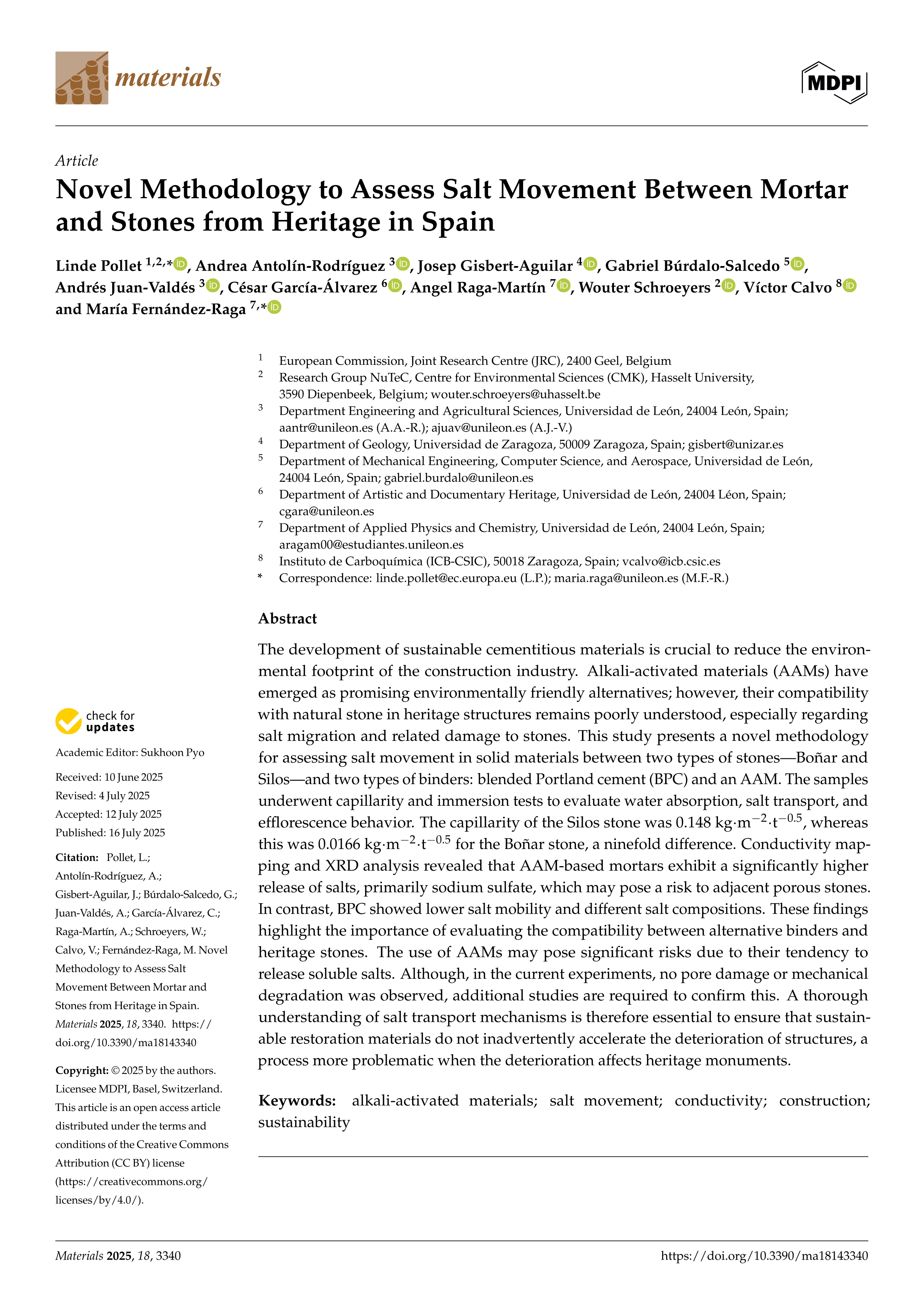
Resumen: The development of sustainable cementitious materials is crucial to reduce the environmental footprint of the construction industry. Alkali-activated materials (AAMs) have emerged as promising environmentally friendly alternatives; however, their compatibility with natural stone in heritage structures remains poorly understood, especially regarding salt migration and related damage to stones. This study presents a novel methodology for assessing salt movement in solid materials between two types of stones—Boñar and Silos—and two types of binders: blended Portland cement (BPC) and an AAM. The samples underwent capillarity and immersion tests to evaluate water absorption, salt transport, and efflorescence behavior. The capillarity of the Silos stone was 0.148 kg·m−2·t−0.5, whereas this was 0.0166 kg·m−2·t−0.5 for the Boñar stone, a ninefold difference. Conductivity mapping and XRD analysis revealed that AAM-based mortars exhibit a significantly higher release of salts, primarily sodium sulfate, which may pose a risk to adjacent porous stones. In contrast, BPC showed lower salt mobility and different salt compositions. These findings highlight the importance of evaluating the compatibility between alternative binders and heritage stones. The use of AAMs may pose significant risks due to their tendency to release soluble salts. Although, in the current experiments, no pore damage or mechanical degradation was observed, additional studies are required to confirm this. A thorough understanding of salt transport mechanisms is therefore essential to ensure that sustainable restoration materials do not inadvertently accelerate the deterioration of structures, a process more problematic when the deterioration affects heritage monuments.
Idioma: Inglés
DOI: 10.3390/ma18143340
Año: 2025
Publicado en: Materials 18, 14 (2025), 3340 [18 pp.]
ISSN: 1996-1944
Financiación: info:eu-repo/grantAgreement/ES/DGA/T03-23R
Financiación: info:eu-repo/grantAgreement/ES/MICINN/PID2023-147116OB-I00
Tipo y forma: Article (Published version)
Área (Departamento): Área Petrología y Geoquímica (Dpto. Ciencias de la Tierra)
Exportado de SIDERAL (2025-10-17-14:25:17)
Visitas y descargas
Idioma: Inglés
DOI: 10.3390/ma18143340
Año: 2025
Publicado en: Materials 18, 14 (2025), 3340 [18 pp.]
ISSN: 1996-1944
Financiación: info:eu-repo/grantAgreement/ES/DGA/T03-23R
Financiación: info:eu-repo/grantAgreement/ES/MICINN/PID2023-147116OB-I00
Tipo y forma: Article (Published version)
Área (Departamento): Área Petrología y Geoquímica (Dpto. Ciencias de la Tierra)
Exportado de SIDERAL (2025-10-17-14:25:17)
Permalink:
Visitas y descargas
Este artículo se encuentra en las siguientes colecciones:
articulos > articulos-por-area > petrologia_y_geoquimica
Notice créée le 2025-09-19, modifiée le 2025-10-17