When gender matters: inequalities in health services utilization and risk factors monitoring after acute myocardial infarction
López-Ferreruela, Irene ; Gimeno-Miguel, Antonio ; Laguna-Berna, Clara ; Malo, Sara (Universidad de Zaragoza) ; Castel-Feced, Sara (Universidad de Zaragoza) ; Rabanaque, María José (Universidad de Zaragoza) ; Aguilar-Palacio, Isabel (Universidad de Zaragoza)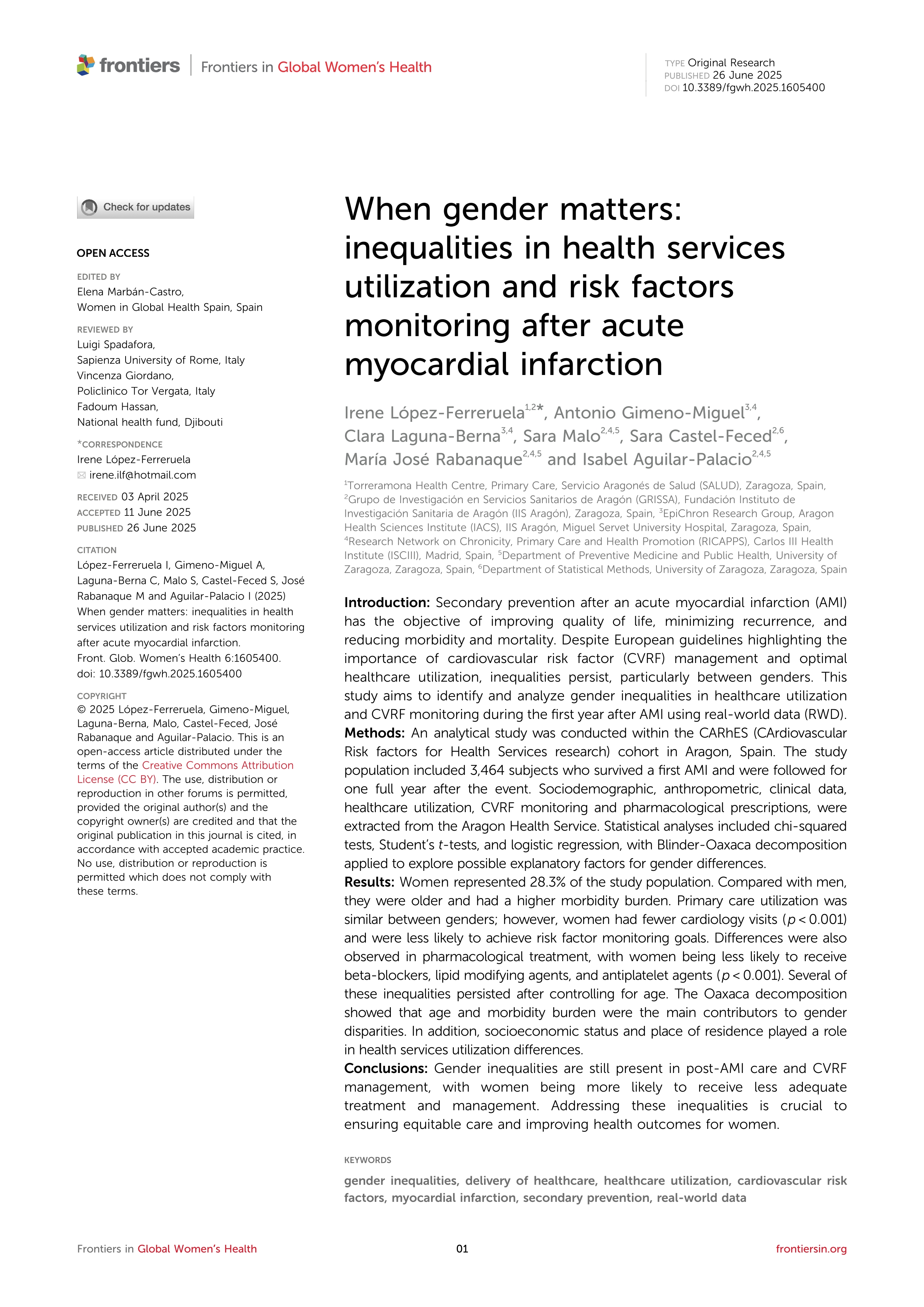
Resumen: Introduction: Secondary prevention after an acute myocardial infarction (AMI) has the objective of improving quality of life, minimizing recurrence, and reducing morbidity and mortality. Despite European guidelines highlighting the importance of cardiovascular risk factor (CVRF) management and optimal healthcare utilization, inequalities persist, particularly between genders. This study aims to identify and analyze gender inequalities in healthcare utilization and CVRF monitoring during the first year after AMI using real-world data (RWD).
Methods: An analytical study was conducted within the CARhES (CArdiovascular Risk factors for Health Services research) cohort in Aragon, Spain. The study population included 3,464 subjects who survived a first AMI and were followed for one full year after the event. Sociodemographic, anthropometric, clinical data, healthcare utilization, CVRF monitoring and pharmacological prescriptions, were extracted from the Aragon Health Service. Statistical analyses included chi-squared tests, Student's t-tests, and logistic regression, with Blinder-Oaxaca decomposition applied to explore possible explanatory factors for gender differences.
Results: Women represented 28.3% of the study population. Compared with men, they were older and had a higher morbidity burden. Primary care utilization was similar between genders; however, women had fewer cardiology visits (p < 0.001) and were less likely to achieve risk factor monitoring goals. Differences were also observed in pharmacological treatment, with women being less likely to receive beta-blockers, lipid modifying agents, and antiplatelet agents (p < 0.001). Several of these inequalities persisted after controlling for age. The Oaxaca decomposition showed that age and morbidity burden were the main contributors to gender disparities. In addition, socioeconomic status and place of residence played a role in health services utilization differences.
Conclusions: Gender inequalities are still present in post-AMI care and CVRF management, with women being more likely to receive less adequate treatment and management. Addressing these inequalities is crucial to ensuring equitable care and improving health outcomes for women.
Idioma: Inglés
DOI: 10.3389/fgwh.2025.1605400
Año: 2025
Publicado en: Frontiers in global women's health 6 (2025), [14 pp.]
ISSN:
Financiación: info:eu-repo/grantAgreement/ES/DGA-GRISSA/B09-23R
Financiación: info:eu-repo/grantAgreement/ES/ISCIII/PI22-01193
Tipo y forma: Artículo (Versión definitiva)
Área (Departamento): Área Estadís. Investig. Opera. (Dpto. Métodos Estadísticos)
Área (Departamento): Área Medic.Prevent.Salud Públ. (Dpto. Microb.Ped.Radio.Sal.Pú.)
 Debe reconocer adecuadamente la autoría, proporcionar un enlace a la licencia e indicar si se han realizado cambios. Puede hacerlo de cualquier manera razonable, pero no de una manera que sugiera que tiene el apoyo del licenciador o lo recibe por el uso que hace.
Exportado de SIDERAL (2025-10-17-14:37:55)
Visitas y descargas
Methods: An analytical study was conducted within the CARhES (CArdiovascular Risk factors for Health Services research) cohort in Aragon, Spain. The study population included 3,464 subjects who survived a first AMI and were followed for one full year after the event. Sociodemographic, anthropometric, clinical data, healthcare utilization, CVRF monitoring and pharmacological prescriptions, were extracted from the Aragon Health Service. Statistical analyses included chi-squared tests, Student's t-tests, and logistic regression, with Blinder-Oaxaca decomposition applied to explore possible explanatory factors for gender differences.
Results: Women represented 28.3% of the study population. Compared with men, they were older and had a higher morbidity burden. Primary care utilization was similar between genders; however, women had fewer cardiology visits (p < 0.001) and were less likely to achieve risk factor monitoring goals. Differences were also observed in pharmacological treatment, with women being less likely to receive beta-blockers, lipid modifying agents, and antiplatelet agents (p < 0.001). Several of these inequalities persisted after controlling for age. The Oaxaca decomposition showed that age and morbidity burden were the main contributors to gender disparities. In addition, socioeconomic status and place of residence played a role in health services utilization differences.
Conclusions: Gender inequalities are still present in post-AMI care and CVRF management, with women being more likely to receive less adequate treatment and management. Addressing these inequalities is crucial to ensuring equitable care and improving health outcomes for women.
Idioma: Inglés
DOI: 10.3389/fgwh.2025.1605400
Año: 2025
Publicado en: Frontiers in global women's health 6 (2025), [14 pp.]
ISSN:
Financiación: info:eu-repo/grantAgreement/ES/DGA-GRISSA/B09-23R
Financiación: info:eu-repo/grantAgreement/ES/ISCIII/PI22-01193
Tipo y forma: Artículo (Versión definitiva)
Área (Departamento): Área Estadís. Investig. Opera. (Dpto. Métodos Estadísticos)
Área (Departamento): Área Medic.Prevent.Salud Públ. (Dpto. Microb.Ped.Radio.Sal.Pú.)
Debe reconocer adecuadamente la autoría, proporcionar un enlace a la licencia e indicar si se han realizado cambios. Puede hacerlo de cualquier manera razonable, pero no de una manera que sugiera que tiene el apoyo del licenciador o lo recibe por el uso que hace. Exportado de SIDERAL (2025-10-17-14:37:55)
Enlace permanente:
Visitas y descargas
Este artículo se encuentra en las siguientes colecciones:
Artículos > Artículos por área > Estadística e Investigación Operativa
Artículos > Artículos por área > Medicina Preventiva y Salud Pública
Registro creado el 2025-09-19, última modificación el 2025-10-17