Exploring cluster formation in CO₂ + hydrocarbon mixtures: From binary to ternary systems
Acuña, Ariel A. ; Artal, Manuela (Universidad de Zaragoza) ; Galliero, Guillaume ; Daridon, Jean-Luc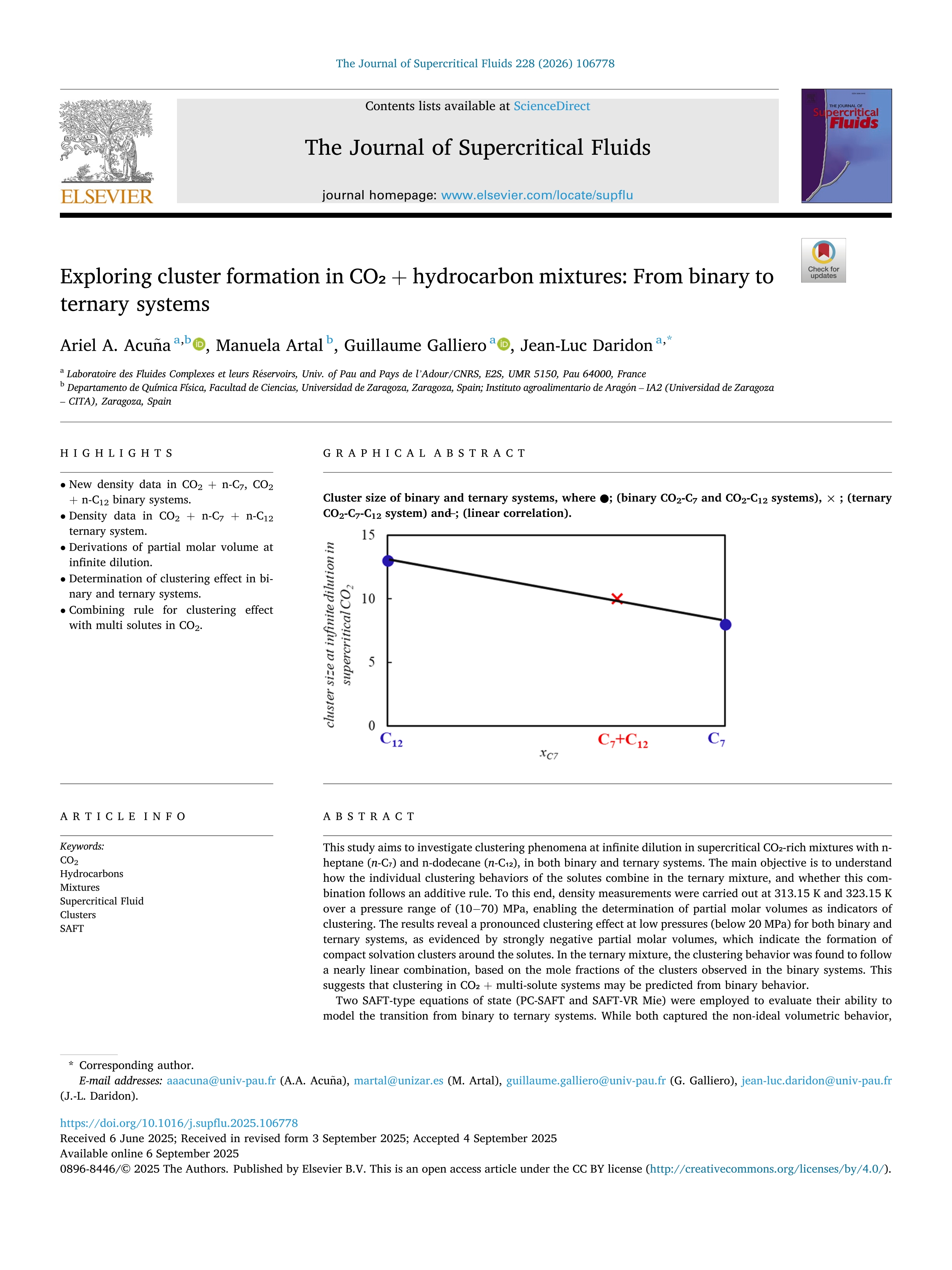
Resumen: This study aims to investigate clustering phenomena at infinite dilution in supercritical CO₂-rich mixtures with n-heptane (n-C₇) and n-dodecane (n-C₁₂), in both binary and ternary systems. The main objective is to understand how the individual clustering behaviors of the solutes combine in the ternary mixture, and whether this combination follows an additive rule. To this end, density measurements were carried out at 313.15 K and 323.15 K over a pressure range of (10−70) MPa, enabling the determination of partial molar volumes as indicators of clustering. The results reveal a pronounced clustering effect at low pressures (below 20 MPa) for both binary and ternary systems, as evidenced by strongly negative partial molar volumes, which indicate the formation of compact solvation clusters around the solutes. In the ternary mixture, the clustering behavior was found to follow a nearly linear combination, based on the mole fractions of the clusters observed in the binary systems. This suggests that clustering in CO₂ + multi-solute systems may be predicted from binary behavior.
Two SAFT-type equations of state (PC-SAFT and SAFT-VR Mie) were employed to evaluate their ability to model the transition from binary to ternary systems. While both captured the non-ideal volumetric behavior, SAFT-VR Mie demonstrated better quantitative agreement. These findings improve our understanding of solute–solvent interactions in CO₂-rich environments and support enhanced modeling of processes such as supercritical extraction, carbon capture and storage (CCUS), and enhanced oil recovery (EOR).
Idioma: Inglés
DOI: 10.1016/j.supflu.2025.106778
Año: 2025
Publicado en: Journal of Supercritical Fluids 228 (2025), 106778 [12 pp.]
ISSN: 0896-8446
Tipo y forma: Artículo (Versión definitiva)
Área (Departamento): Área Química Física (Dpto. Química Física)
 Debe reconocer adecuadamente la autoría, proporcionar un enlace a la licencia e indicar si se han realizado cambios. Puede hacerlo de cualquier manera razonable, pero no de una manera que sugiera que tiene el apoyo del licenciador o lo recibe por el uso que hace.
Exportado de SIDERAL (2025-10-09-13:25:57)
Visitas y descargas
Two SAFT-type equations of state (PC-SAFT and SAFT-VR Mie) were employed to evaluate their ability to model the transition from binary to ternary systems. While both captured the non-ideal volumetric behavior, SAFT-VR Mie demonstrated better quantitative agreement. These findings improve our understanding of solute–solvent interactions in CO₂-rich environments and support enhanced modeling of processes such as supercritical extraction, carbon capture and storage (CCUS), and enhanced oil recovery (EOR).
Idioma: Inglés
DOI: 10.1016/j.supflu.2025.106778
Año: 2025
Publicado en: Journal of Supercritical Fluids 228 (2025), 106778 [12 pp.]
ISSN: 0896-8446
Tipo y forma: Artículo (Versión definitiva)
Área (Departamento): Área Química Física (Dpto. Química Física)
Debe reconocer adecuadamente la autoría, proporcionar un enlace a la licencia e indicar si se han realizado cambios. Puede hacerlo de cualquier manera razonable, pero no de una manera que sugiera que tiene el apoyo del licenciador o lo recibe por el uso que hace. Exportado de SIDERAL (2025-10-09-13:25:57)
Enlace permanente:
Visitas y descargas
Este artículo se encuentra en las siguientes colecciones:
Artículos > Artículos por área > Química Física
Registro creado el 2025-10-02, última modificación el 2025-10-09