Relationships of Circulating Plasma Metabolites With the QT Interval in a Large Population Cohort
Young, William J. ; Sanghvi, Mihir M. ; Ramírez, Julia (Universidad de Zaragoza) ; Orini, Michele ; van Duijvenboden, Stefan ; Warren, Helen R. ; Tinker, Andrew ; Lambiase, Pier D. ; Munroe, Patricia B.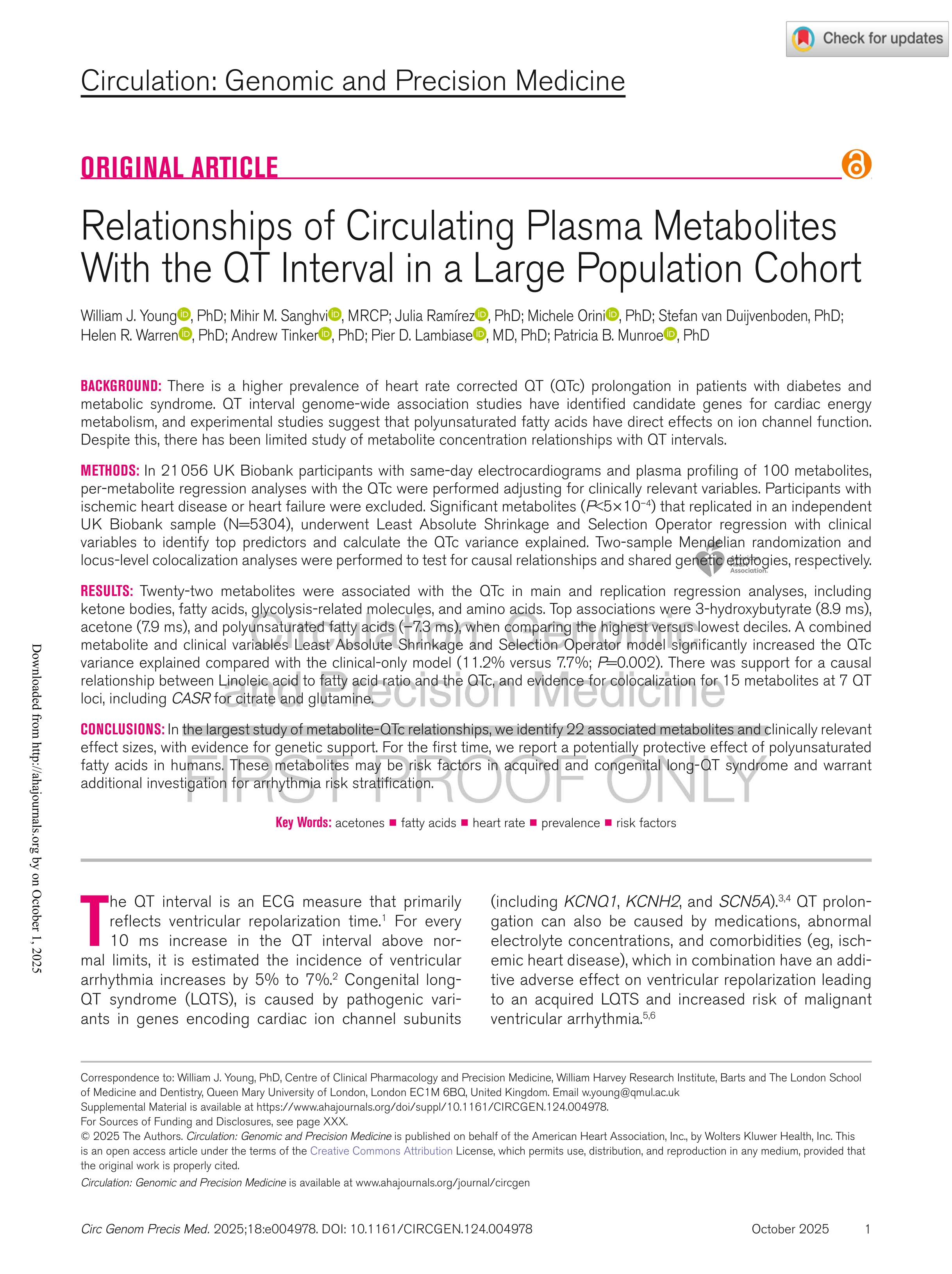
Resumen: BACKGROUND: There is a higher prevalence of heart rate corrected QT (QTc) prolongation in patients with diabetes and metabolic syndrome. QT interval genome-wide association studies have identified candidate genes for cardiac energy metabolism, and experimental studies suggest that polyunsaturated fatty acids have direct effects on ion channel function. Despite this, there has been limited study of metabolite concentration relationships with QT intervals. METHODS: In 21 056 UK Biobank participants with same-day electrocardiograms and plasma profiling of 100 metabolites, per-metabolite regression analyses with the QTc were performed adjusting for clinically relevant variables. Participants with ischemic heart disease or heart failure were excluded. Significant metabolites (P<5×10⁻⁴) that replicated in an independent UK Biobank sample (N=5304), underwent Least Absolute Shrinkage and Selection Operator regression with clinical
variables to identify top predictors and calculate the QTc variance explained. Two-sample Mendelian randomization and locus-level colocalization analyses were performed to test for causal relationships and shared genetic etiologies, respectively. RESULTS: Twenty-two metabolites were associated with the QTc in main and replication regression analyses, including ketone bodies, fatty acids, glycolysis-related molecules, and amino acids. Top associations were 3-hydroxybutyrate (8.9 ms), acetone (7.9 ms), and polyunsaturated fatty acids (–7.3 ms), when comparing the highest versus lowest deciles. A combined metabolite and clinical variables Least Absolute Shrinkage and Selection Operator model significantly increased the QTc variance explained compared with the clinical-only model (11.2% versus 7.7%; P=0.002). There was support for a causal relationship between Linoleic acid to fatty acid ratio and the QTc, and evidence for colocalization for 15 metabolites at 7 QT loci, including CASR for citrate and glutamine. CONCLUSIONS: In the largest study of metabolite-QTc relationships, we identify 22 associated metabolites and clinically relevant effect sizes, with evidence for genetic support. For the first time, we report a potentially protective effect of polyunsaturated fatty acids in humans. These metabolites may be risk factors in acquired and congenital long-QT syndrome and warrant additional investigation for arrhythmia risk stratification.
Idioma: Inglés
DOI: 10.1161/CIRCGEN.124.004978
Año: 2025
Publicado en: Circulation. Genomic and precision medicine (2025), [11 pp.]
ISSN: 2574-8300
Tipo y forma: Article (Published version)
Área (Departamento): Área Teoría Señal y Comunicac. (Dpto. Ingeniería Electrón.Com.)
 You must give appropriate credit, provide a link to the license, and indicate if changes were made. You may do so in any reasonable manner, but not in any way that suggests the licensor endorses you or your use.
Exportado de SIDERAL (2025-10-09-13:25:56)
Visitas y descargas
variables to identify top predictors and calculate the QTc variance explained. Two-sample Mendelian randomization and locus-level colocalization analyses were performed to test for causal relationships and shared genetic etiologies, respectively. RESULTS: Twenty-two metabolites were associated with the QTc in main and replication regression analyses, including ketone bodies, fatty acids, glycolysis-related molecules, and amino acids. Top associations were 3-hydroxybutyrate (8.9 ms), acetone (7.9 ms), and polyunsaturated fatty acids (–7.3 ms), when comparing the highest versus lowest deciles. A combined metabolite and clinical variables Least Absolute Shrinkage and Selection Operator model significantly increased the QTc variance explained compared with the clinical-only model (11.2% versus 7.7%; P=0.002). There was support for a causal relationship between Linoleic acid to fatty acid ratio and the QTc, and evidence for colocalization for 15 metabolites at 7 QT loci, including CASR for citrate and glutamine. CONCLUSIONS: In the largest study of metabolite-QTc relationships, we identify 22 associated metabolites and clinically relevant effect sizes, with evidence for genetic support. For the first time, we report a potentially protective effect of polyunsaturated fatty acids in humans. These metabolites may be risk factors in acquired and congenital long-QT syndrome and warrant additional investigation for arrhythmia risk stratification.
Idioma: Inglés
DOI: 10.1161/CIRCGEN.124.004978
Año: 2025
Publicado en: Circulation. Genomic and precision medicine (2025), [11 pp.]
ISSN: 2574-8300
Tipo y forma: Article (Published version)
Área (Departamento): Área Teoría Señal y Comunicac. (Dpto. Ingeniería Electrón.Com.)
You must give appropriate credit, provide a link to the license, and indicate if changes were made. You may do so in any reasonable manner, but not in any way that suggests the licensor endorses you or your use. Exportado de SIDERAL (2025-10-09-13:25:56)
Permalink:
Visitas y descargas
Este artículo se encuentra en las siguientes colecciones:
Articles > Artículos por área > Teoría de la Señal y Comunicaciones
Record created 2025-10-02, last modified 2025-10-09