Gender and generational differences in perspective about gender inequality in medical and dental research institutions in Nigeria
Foláyan, Moréniké Oluwátóyìn ; Obiyan, Mary ; Lusher, Joanne ; Gascón-Catalán, Ana (Universidad de Zaragoza) ; Martínez-Pérez, Guillermo Z.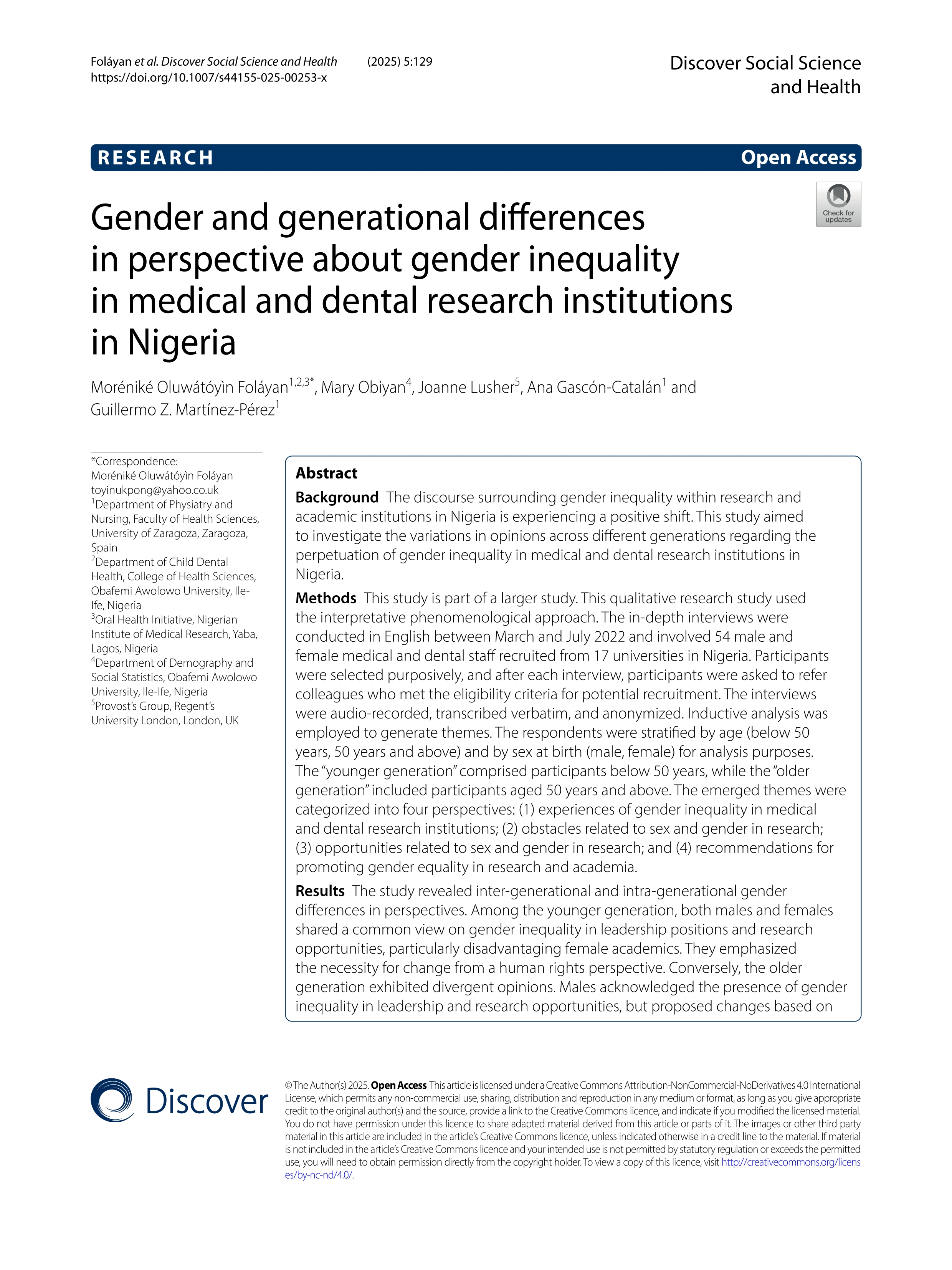
Resumen: Background: The discourse surrounding gender inequality within research and academic institutions in Nigeria is experiencing a positive shift. This study aimed to investigate the variations in opinions across different generations regarding the perpetuation of gender inequality in medical and dental research institutions in Nigeria.
Methods: This study is part of a larger study. This qualitative research study used the interpretative phenomenological approach. The in-depth interviews were conducted in English between March and July 2022 and involved 54 male and female medical and dental staff recruited from 17 universities in Nigeria. Participants were selected purposively, and after each interview, participants were asked to refer colleagues who met the eligibility criteria for potential recruitment. The interviews were audio-recorded, transcribed verbatim, and anonymized. Inductive analysis was employed to generate themes. The respondents were stratified by age (below 50 years, 50 years and above) and by sex at birth (male, female) for analysis purposes. The “younger generation” comprised participants below 50 years, while the “older generation” included participants aged 50 years and above. The emerged themes were categorized into four perspectives: (1) experiences of gender inequality in medical and dental research institutions; (2) obstacles related to sex and gender in research; (3) opportunities related to sex and gender in research; and (4) recommendations for promoting gender equality in research and academia.
Results: The study revealed inter-generational and intra-generational gender differences in perspectives. Among the younger generation, both males and females shared a common view on gender inequality in leadership positions and research opportunities, particularly disadvantaging female academics. They emphasized the necessity for change from a human rights perspective. Conversely, the older generation exhibited divergent opinions. Males acknowledged the presence of gender inequality in leadership and research opportunities, but proposed changes based on commodifying women. Older females adhered to traditional views regarding gender inequality. Recommendations for change included removing barriers to education for girls, which restrict their access to capacity-building opportunities.
Conclusion: The findings suggest a generational shift in attitudes toward gender equality in academia, with younger faculty members more inclined to challenge existing norms. Targeted, generation-sensitive strategies, such as inclusive mentorship, institutional policy reforms, and gender equity training, may address the persistent barriers and empower the next generation of academic leaders to drive sustainable and systemic change in the institutions.
Idioma: Inglés
DOI: 10.1007/s44155-025-00253-x
Año: 2025
Publicado en: Discover social science and health 5, 1 (2025), 129 [15 pp.]
ISSN:
Tipo y forma: Article (Published version)
Área (Departamento): Área Enfermería (Dpto. Fisiatría y Enfermería)
 You must give appropriate credit, provide a link to the license, and indicate if changes were made. You may do so in any reasonable manner, but not in any way that suggests the licensor endorses you or your use. You may not use the material for commercial purposes. If you remix, transform, or build upon the material, you may not distribute the modified material.
Exportado de SIDERAL (2025-10-09-13:25:56)
Visitas y descargas
Methods: This study is part of a larger study. This qualitative research study used the interpretative phenomenological approach. The in-depth interviews were conducted in English between March and July 2022 and involved 54 male and female medical and dental staff recruited from 17 universities in Nigeria. Participants were selected purposively, and after each interview, participants were asked to refer colleagues who met the eligibility criteria for potential recruitment. The interviews were audio-recorded, transcribed verbatim, and anonymized. Inductive analysis was employed to generate themes. The respondents were stratified by age (below 50 years, 50 years and above) and by sex at birth (male, female) for analysis purposes. The “younger generation” comprised participants below 50 years, while the “older generation” included participants aged 50 years and above. The emerged themes were categorized into four perspectives: (1) experiences of gender inequality in medical and dental research institutions; (2) obstacles related to sex and gender in research; (3) opportunities related to sex and gender in research; and (4) recommendations for promoting gender equality in research and academia.
Results: The study revealed inter-generational and intra-generational gender differences in perspectives. Among the younger generation, both males and females shared a common view on gender inequality in leadership positions and research opportunities, particularly disadvantaging female academics. They emphasized the necessity for change from a human rights perspective. Conversely, the older generation exhibited divergent opinions. Males acknowledged the presence of gender inequality in leadership and research opportunities, but proposed changes based on commodifying women. Older females adhered to traditional views regarding gender inequality. Recommendations for change included removing barriers to education for girls, which restrict their access to capacity-building opportunities.
Conclusion: The findings suggest a generational shift in attitudes toward gender equality in academia, with younger faculty members more inclined to challenge existing norms. Targeted, generation-sensitive strategies, such as inclusive mentorship, institutional policy reforms, and gender equity training, may address the persistent barriers and empower the next generation of academic leaders to drive sustainable and systemic change in the institutions.
Idioma: Inglés
DOI: 10.1007/s44155-025-00253-x
Año: 2025
Publicado en: Discover social science and health 5, 1 (2025), 129 [15 pp.]
ISSN:
Tipo y forma: Article (Published version)
Área (Departamento): Área Enfermería (Dpto. Fisiatría y Enfermería)
You must give appropriate credit, provide a link to the license, and indicate if changes were made. You may do so in any reasonable manner, but not in any way that suggests the licensor endorses you or your use. You may not use the material for commercial purposes. If you remix, transform, or build upon the material, you may not distribute the modified material. Exportado de SIDERAL (2025-10-09-13:25:56)
Permalink:
Visitas y descargas
Este artículo se encuentra en las siguientes colecciones:
Articles > Artículos por área > Enfermería
Record created 2025-10-02, last modified 2025-10-09