Flow Reactor Study of NH3/DEE Oxidation Chemistry
Ruiz-Gutiérrez, A. (Universidad de Zaragoza) ; Bello-Gallego, A. ; Alzueta, M. U. (Universidad de Zaragoza)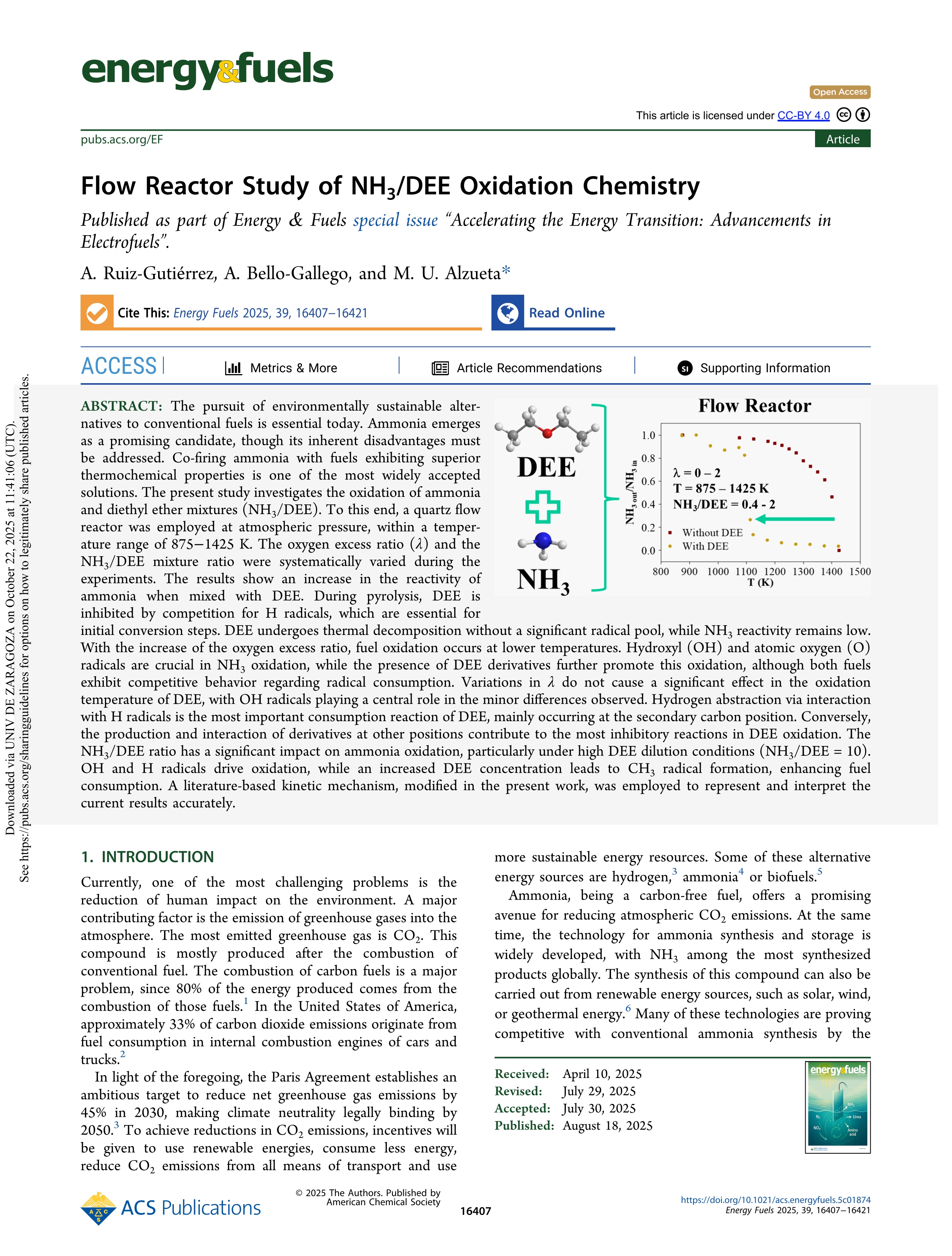
Resumen: The pursuit of environmentally sustainable alternatives to conventional fuels is essential today. Ammonia emerges as a promising candidate, though its inherent disadvantages must be addressed. Co-firing ammonia with fuels exhibiting superior thermochemical properties is one of the most widely accepted solutions. The present study investigates the oxidation of ammonia and diethyl ether mixtures (NH3/DEE). To this end, a quartz flow reactor was employed at atmospheric pressure, within a temperature range of 875–1425 K. The oxygen excess ratio (λ) and the NH3/DEE mixture ratio were systematically varied during the experiments. The results show an increase in the reactivity of ammonia when mixed with DEE. During pyrolysis, DEE is inhibited by competition for H radicals, which are essential for initial conversion steps. DEE undergoes thermal decomposition without a significant radical pool, while NH3 reactivity remains low. With the increase of the oxygen excess ratio, fuel oxidation occurs at lower temperatures. Hydroxyl (OH) and atomic oxygen (O) radicals are crucial in NH3 oxidation, while the presence of DEE derivatives further promote this oxidation, although both fuels exhibit competitive behavior regarding radical consumption. Variations in λ do not cause a significant effect in the oxidation temperature of DEE, with OH radicals playing a central role in the minor differences observed. Hydrogen abstraction via interaction with H radicals is the most important consumption reaction of DEE, mainly occurring at the secondary carbon position. Conversely, the production and interaction of derivatives at other positions contribute to the most inhibitory reactions in DEE oxidation. The NH3/DEE ratio has a significant impact on ammonia oxidation, particularly under high DEE dilution conditions (NH3/DEE = 10). OH and H radicals drive oxidation, while an increased DEE concentration leads to CH3 radical formation, enhancing fuel consumption. A literature-based kinetic mechanism, modified in the present work, was employed to represent and interpret the current results accurately.
Idioma: Inglés
DOI: 10.1021/acs.energyfuels.5c01874
Año: 2025
Publicado en: Energy and Fuels 39, 34 (2025), 16407-16421
ISSN: 0887-0624
Financiación: info:eu-repo/grantAgreement/ES/AEI/PID2021–12432OB-I00
Financiación: info:eu-repo/grantAgreement/ES/DGA/T22-23R
Financiación: info:eu-repo/grantAgreement/ES/MICINN PRE2022-104181
Financiación: info:eu-repo/grantAgreement/EUR/MICINN/TED2021-129557B-I00
Tipo y forma: Article (Published version)
Área (Departamento): Área Tecnologi. Medio Ambiente (Dpto. Ing.Quím.Tecnol.Med.Amb.)
Exportado de SIDERAL (2026-02-10-08:36:27)
Visitas y descargas
Idioma: Inglés
DOI: 10.1021/acs.energyfuels.5c01874
Año: 2025
Publicado en: Energy and Fuels 39, 34 (2025), 16407-16421
ISSN: 0887-0624
Financiación: info:eu-repo/grantAgreement/ES/AEI/PID2021–12432OB-I00
Financiación: info:eu-repo/grantAgreement/ES/DGA/T22-23R
Financiación: info:eu-repo/grantAgreement/ES/MICINN PRE2022-104181
Financiación: info:eu-repo/grantAgreement/EUR/MICINN/TED2021-129557B-I00
Tipo y forma: Article (Published version)
Área (Departamento): Área Tecnologi. Medio Ambiente (Dpto. Ing.Quím.Tecnol.Med.Amb.)
Exportado de SIDERAL (2026-02-10-08:36:27)
Permalink:
Visitas y descargas
Este artículo se encuentra en las siguientes colecciones:
articulos > articulos-por-area > tecnologias_del_medio_ambiente
Notice créée le 2025-10-24, modifiée le 2026-02-10