Exposure to nature scenes mitigates the adverse effects of adolescents’ social ostracism
Moll, Adrián ; Collado, Silvia (Universidad de Zaragoza) ; Ratcliffe, Eleanor ; Sorrel, Miguel Ángel ; Corraliza, José Antonio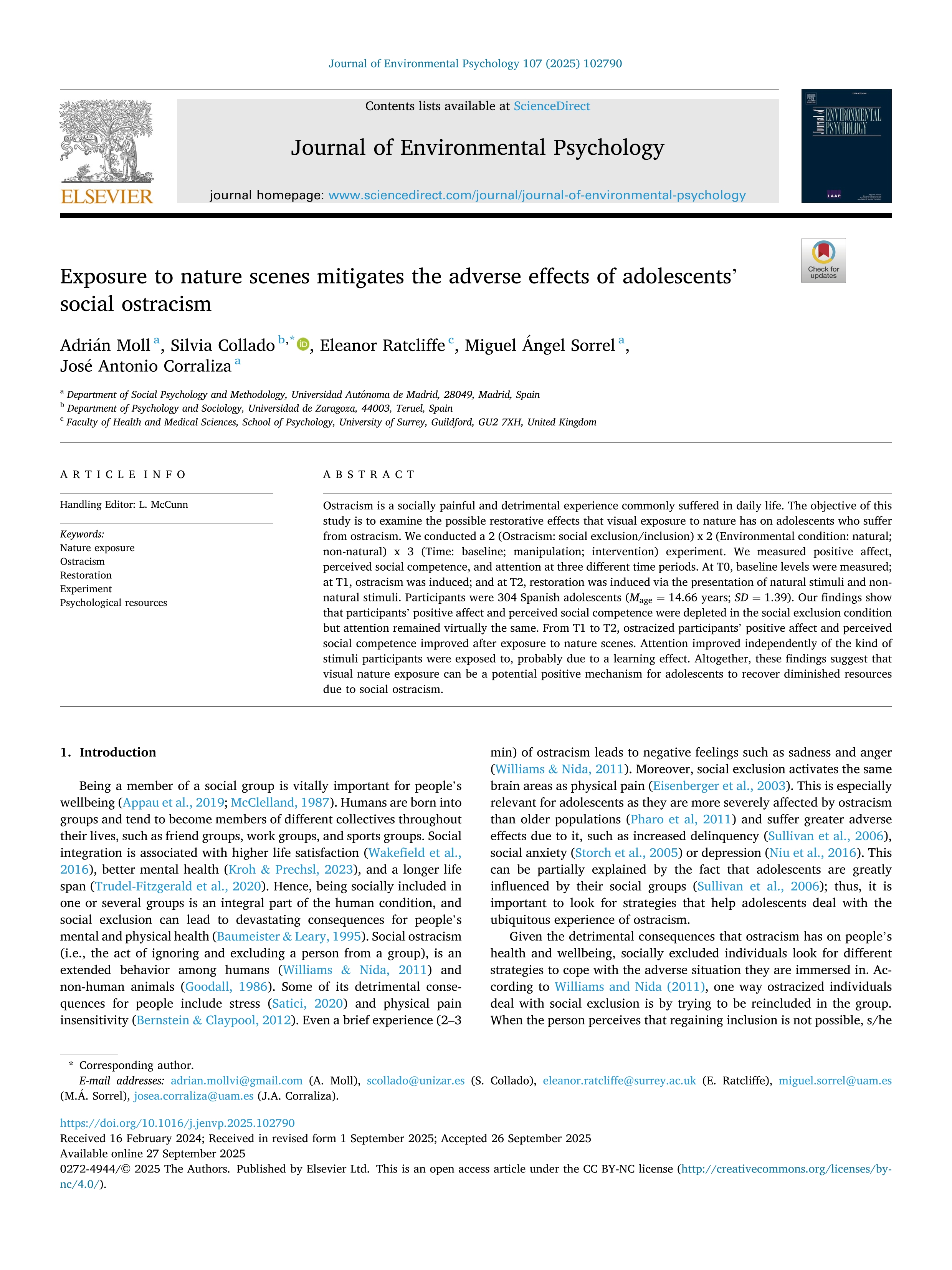
Resumen: Ostracism is a socially painful and detrimental experience commonly suffered in daily life. The objective of this study is to examine the possible restorative effects that visual exposure to nature has on adolescents who suffer from ostracism. We conducted a 2 (Ostracism: social exclusion/inclusion) x 2 (Environmental condition: natural; non-natural) x 3 (Time: baseline; manipulation; intervention) experiment. We measured positive affect, perceived social competence, and attention at three different time periods. At T0, baseline levels were measured; at T1, ostracism was induced; and at T2, restoration was induced via the presentation of natural stimuli and non-natural stimuli. Participants were 304 Spanish adolescents (Mage = 14.66 years; SD = 1.39). Our findings show that participants' positive affect and perceived social competence were depleted in the social exclusion condition but attention remained virtually the same. From T1 to T2, ostracized participants’ positive affect and perceived social competence improved after exposure to nature scenes. Attention improved independently of the kind of stimuli participants were exposed to, probably due to a learning effect. Altogether, these findings suggest that visual nature exposure can be a potential positive mechanism for adolescents to recover diminished resources due to social ostracism.
Idioma: Inglés
DOI: 10.1016/j.jenvp.2025.102790
Año: 2025
Publicado en: JOURNAL OF ENVIRONMENTAL PSYCHOLOGY 107 (2025), 102790 [13pp.]
ISSN: 0272-4944
Financiación: info:eu-repo/grantAgreement/ES/MCIU/PID2024-159714NB-I00
Tipo y forma: Article (Published version)
Área (Departamento): Área Psicología Social (Dpto. Psicología y Sociología)
Exportado de SIDERAL (2025-11-07-10:25:27)
Visitas y descargas
Idioma: Inglés
DOI: 10.1016/j.jenvp.2025.102790
Año: 2025
Publicado en: JOURNAL OF ENVIRONMENTAL PSYCHOLOGY 107 (2025), 102790 [13pp.]
ISSN: 0272-4944
Financiación: info:eu-repo/grantAgreement/ES/MCIU/PID2024-159714NB-I00
Tipo y forma: Article (Published version)
Área (Departamento): Área Psicología Social (Dpto. Psicología y Sociología)
Exportado de SIDERAL (2025-11-07-10:25:27)
Permalink:
Visitas y descargas
Este artículo se encuentra en las siguientes colecciones:
articulos > articulos-por-area > psicologia_social
Notice créée le 2025-11-07, modifiée le 2025-11-07