A Controllable Appearance Representation for Flexible Transfer and Editing
Jimenez-Navarro, Santiago (Universidad de Zaragoza) ; Guerrero-Viu, Julia (Universidad de Zaragoza) ; Masia, Belén (Universidad de Zaragoza)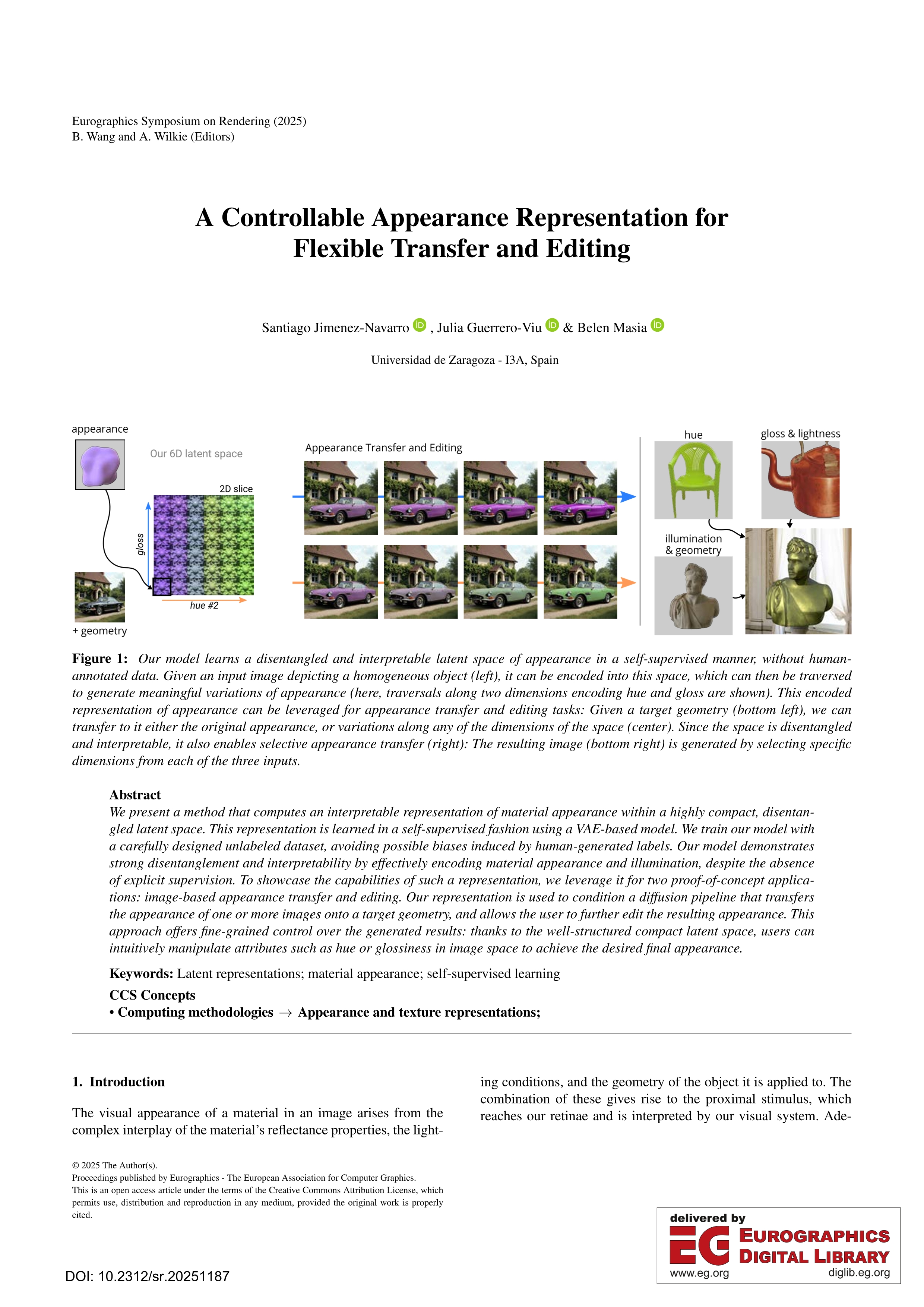

Resumen: We present a method that computes an interpretable representation of material appearance within a highly compact, disentangled latent space. This representation is learned in a self-supervised fashion using a VAE-based model. We train our model with a carefully designed unlabeled dataset, avoiding possible biases induced by human-generated labels. Our model demonstrates strong disentanglement and interpretability by effectively encoding material appearance and illumination, despite the absence of explicit supervision. To showcase the capabilities of such a representation, we leverage it for two proof-of-concept applications: image-based appearance transfer and editing. Our representation is used to condition a diffusion pipeline that transfers the appearance of one or more images onto a target geometry, and allows the user to further edit the resulting appearance. This approach offers fine-grained control over the generated results: thanks to the well-structured compact latent space, users can intuitively manipulate attributes such as hue or glossiness in image space to achieve the desired final appearance.
Idioma: Inglés
DOI: 10.2312/sr.20251187
Año: 2025
Publicado en: Eurographics Symposium on Rendering 2025 (2025), [13 pp.]
ISSN: 1553-0574
Financiación: info:eu-repo/grantAgreement/EC/H2020/956585/EU/Predictive Rendering In Manufacture and Engineering/PRIME
Financiación: info:eu-repo/grantAgreement/ES/MCIU/FPU20-02340
Financiación: info:eu-repo/grantAgreement/ES/MICIU/PID2022-141766OB-I00
Tipo y forma: Artículo (Versión definitiva)
Área (Departamento): Área Lenguajes y Sistemas Inf. (Dpto. Informát.Ingenie.Sistms.)
 Debe reconocer adecuadamente la autoría, proporcionar un enlace a la licencia e indicar si se han realizado cambios. Puede hacerlo de cualquier manera razonable, pero no de una manera que sugiera que tiene el apoyo del licenciador o lo recibe por el uso que hace.
Exportado de SIDERAL (2025-11-07-10:25:55)
Visitas y descargas
Idioma: Inglés
DOI: 10.2312/sr.20251187
Año: 2025
Publicado en: Eurographics Symposium on Rendering 2025 (2025), [13 pp.]
ISSN: 1553-0574
Financiación: info:eu-repo/grantAgreement/EC/H2020/956585/EU/Predictive Rendering In Manufacture and Engineering/PRIME
Financiación: info:eu-repo/grantAgreement/ES/MCIU/FPU20-02340
Financiación: info:eu-repo/grantAgreement/ES/MICIU/PID2022-141766OB-I00
Tipo y forma: Artículo (Versión definitiva)
Área (Departamento): Área Lenguajes y Sistemas Inf. (Dpto. Informát.Ingenie.Sistms.)
Debe reconocer adecuadamente la autoría, proporcionar un enlace a la licencia e indicar si se han realizado cambios. Puede hacerlo de cualquier manera razonable, pero no de una manera que sugiera que tiene el apoyo del licenciador o lo recibe por el uso que hace. Exportado de SIDERAL (2025-11-07-10:25:55)
Enlace permanente:
Visitas y descargas
Este artículo se encuentra en las siguientes colecciones:
Artículos > Artículos por área > Lenguajes y Sistemas Informáticos
Registro creado el 2025-11-07, última modificación el 2025-11-07