Prevalence and impact of Rotavirus A and C in suckling piglets from Spanish farms: an epidemiological study
Marcos-Cienfuegos, Marcial ; Martínez-Lobo, Francisco Javier ; Tejedor, M. Teresa (Universidad de Zaragoza) ; Castillo-Pérez, Jaime ; Prieto, Cinta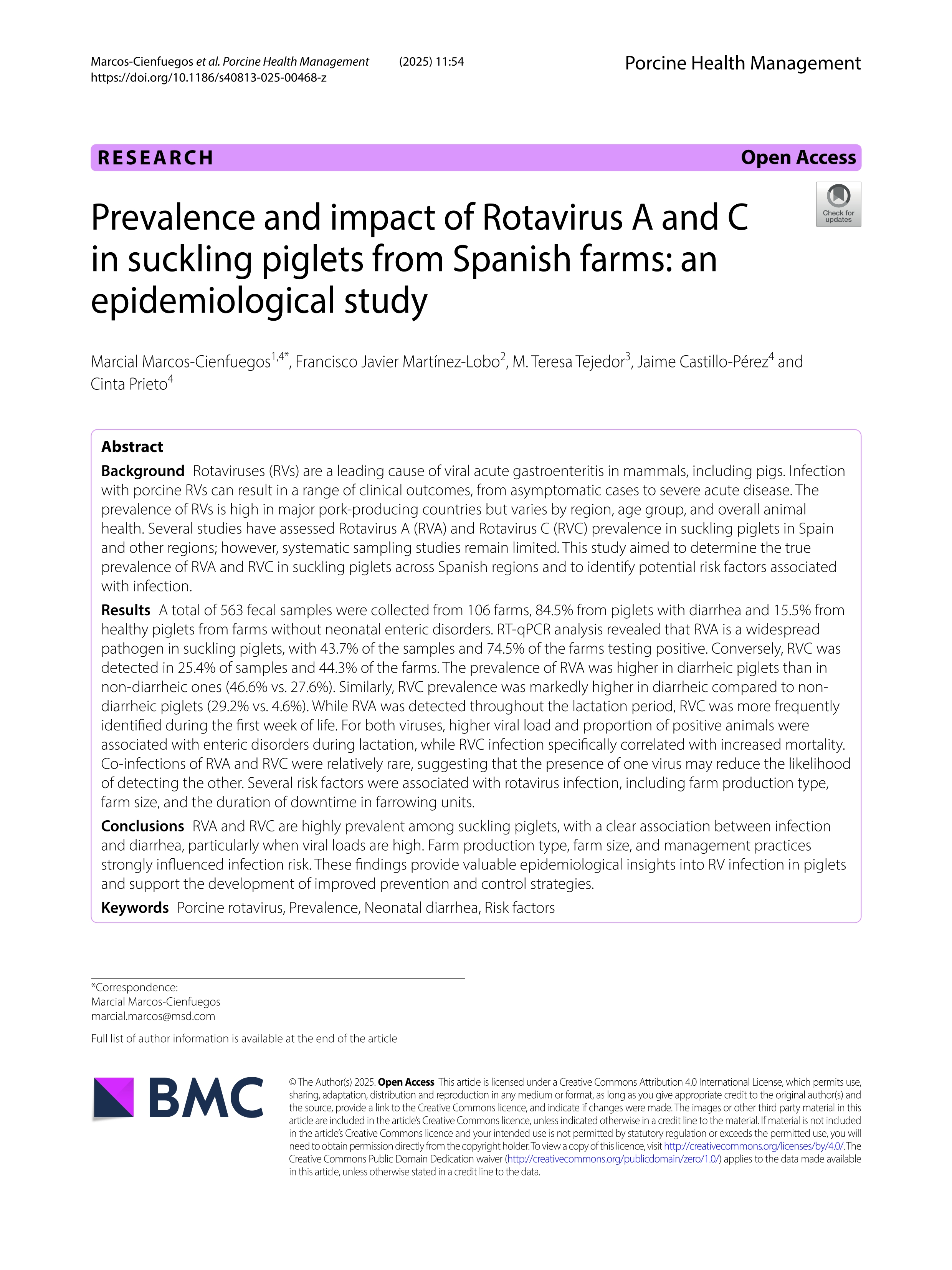
Resumen: Background: Rotaviruses (RVs) are a leading cause of viral acute gastroenteritis in mammals, including pigs. Infection with porcine RVs can result in a range of clinical outcomes, from asymptomatic cases to severe acute disease. The prevalence of RVs is high in major pork-producing countries but varies by region, age group, and overall animal health. Several studies have assessed Rotavirus A (RVA) and Rotavirus C (RVC) prevalence in suckling piglets in Spain and other regions; however, systematic sampling studies remain limited. This study aimed to determine the true prevalence of RVA and RVC in suckling piglets across Spanish regions and to identify potential risk factors associated with infection.
Results: A total of 563 fecal samples were collected from 106 farms, 84.5% from piglets with diarrhea and 15.5% from healthy piglets from farms without neonatal enteric disorders. RT-qPCR analysis revealed that RVA is a widespread pathogen in suckling piglets, with 43.7% of the samples and 74.5% of the farms testing positive. Conversely, RVC was detected in 25.4% of samples and 44.3% of the farms. The prevalence of RVA was higher in diarrheic piglets than in non-diarrheic ones (46.6% vs. 27.6%). Similarly, RVC prevalence was markedly higher in diarrheic compared to non-diarrheic piglets (29.2% vs. 4.6%). While RVA was detected throughout the lactation period, RVC was more frequently identified during the first week of life. For both viruses, higher viral load and proportion of positive animals were associated with enteric disorders during lactation, while RVC infection specifically correlated with increased mortality. Co-infections of RVA and RVC were relatively rare, suggesting that the presence of one virus may reduce the likelihood of detecting the other. Several risk factors were associated with rotavirus infection, including farm production type, farm size, and the duration of downtime in farrowing units.
Conclusions: RVA and RVC are highly prevalent among suckling piglets, with a clear association between infection and diarrhea, particularly when viral loads are high. Farm production type, farm size, and management practices strongly influenced infection risk. These findings provide valuable epidemiological insights into RV infection in piglets and support the development of improved prevention and control strategies.
Idioma: Inglés
DOI: 10.1186/s40813-025-00468-z
Año: 2025
Publicado en: Porcine Health Management 11 (2025), 54 [11 pp.]
ISSN: 2055-5660
Tipo y forma: Artículo (Versión definitiva)
Área (Departamento): Área Genética (Dpto. Anatom.,Embri.Genét.Ani.)
 Debe reconocer adecuadamente la autoría, proporcionar un enlace a la licencia e indicar si se han realizado cambios. Puede hacerlo de cualquier manera razonable, pero no de una manera que sugiera que tiene el apoyo del licenciador o lo recibe por el uso que hace.
Exportado de SIDERAL (2025-11-13-14:58:06)
Visitas y descargas
Results: A total of 563 fecal samples were collected from 106 farms, 84.5% from piglets with diarrhea and 15.5% from healthy piglets from farms without neonatal enteric disorders. RT-qPCR analysis revealed that RVA is a widespread pathogen in suckling piglets, with 43.7% of the samples and 74.5% of the farms testing positive. Conversely, RVC was detected in 25.4% of samples and 44.3% of the farms. The prevalence of RVA was higher in diarrheic piglets than in non-diarrheic ones (46.6% vs. 27.6%). Similarly, RVC prevalence was markedly higher in diarrheic compared to non-diarrheic piglets (29.2% vs. 4.6%). While RVA was detected throughout the lactation period, RVC was more frequently identified during the first week of life. For both viruses, higher viral load and proportion of positive animals were associated with enteric disorders during lactation, while RVC infection specifically correlated with increased mortality. Co-infections of RVA and RVC were relatively rare, suggesting that the presence of one virus may reduce the likelihood of detecting the other. Several risk factors were associated with rotavirus infection, including farm production type, farm size, and the duration of downtime in farrowing units.
Conclusions: RVA and RVC are highly prevalent among suckling piglets, with a clear association between infection and diarrhea, particularly when viral loads are high. Farm production type, farm size, and management practices strongly influenced infection risk. These findings provide valuable epidemiological insights into RV infection in piglets and support the development of improved prevention and control strategies.
Idioma: Inglés
DOI: 10.1186/s40813-025-00468-z
Año: 2025
Publicado en: Porcine Health Management 11 (2025), 54 [11 pp.]
ISSN: 2055-5660
Tipo y forma: Artículo (Versión definitiva)
Área (Departamento): Área Genética (Dpto. Anatom.,Embri.Genét.Ani.)
Debe reconocer adecuadamente la autoría, proporcionar un enlace a la licencia e indicar si se han realizado cambios. Puede hacerlo de cualquier manera razonable, pero no de una manera que sugiera que tiene el apoyo del licenciador o lo recibe por el uso que hace. Exportado de SIDERAL (2025-11-13-14:58:06)
Enlace permanente:
Visitas y descargas
Este artículo se encuentra en las siguientes colecciones:
Artículos > Artículos por área > Genética
Registro creado el 2025-11-13, última modificación el 2025-11-13