Deep Learning in Spanish University Students: The Role of Digital Literacy and Critical Thinking
Cebollero-Salinas, Ana (Universidad de Zaragoza) ; Mauri-Medrano, Marta (Universidad de Zaragoza) ; Denoni-Buján, Magalí (Universidad de Zaragoza)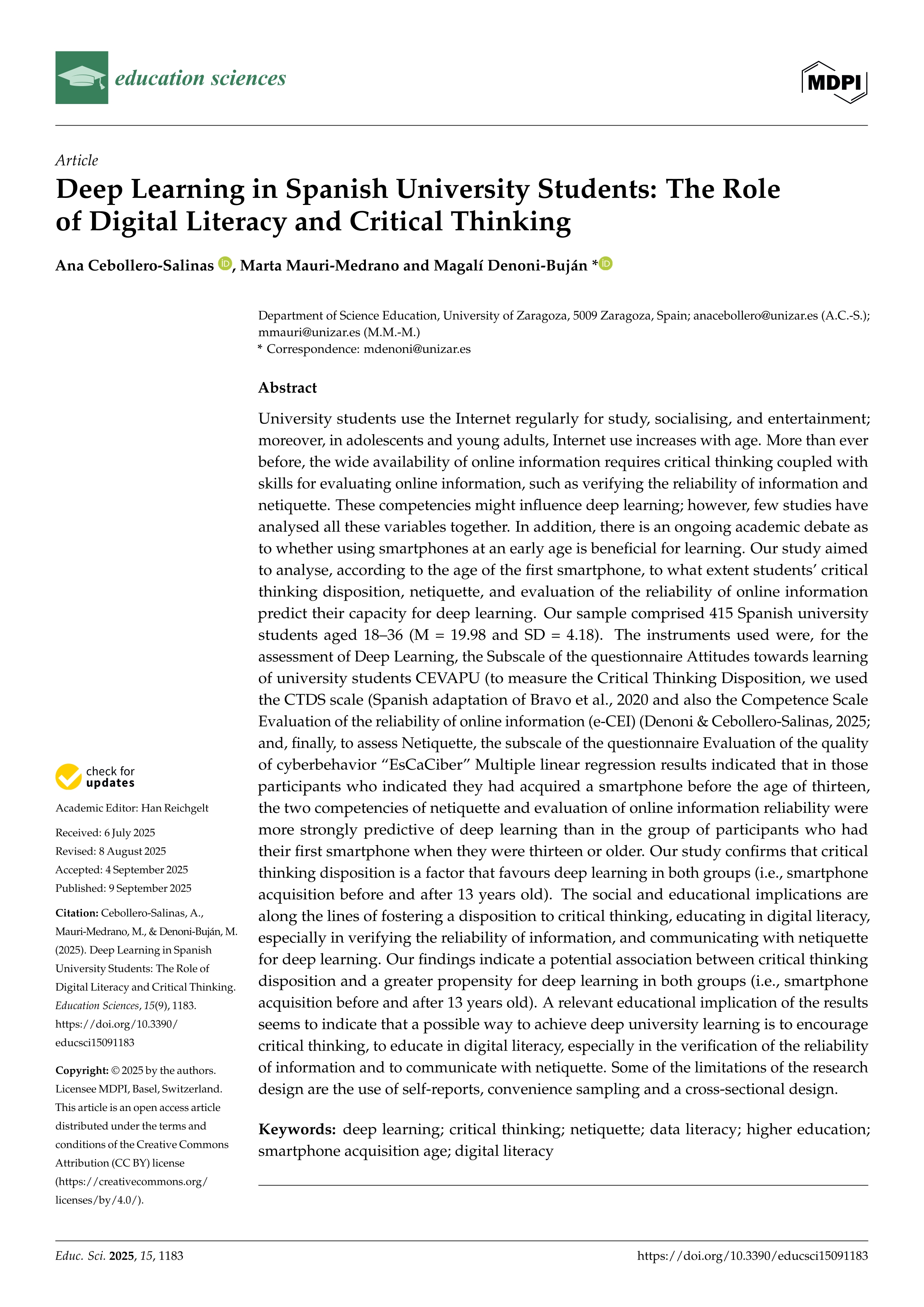
Resumen: University students use the Internet regularly for study, socialising, and entertainment; moreover, in adolescents and young adults, Internet use increases with age. More than ever before, the wide availability of online information requires critical thinking coupled with skills for evaluating online information, such as verifying the reliability of information and netiquette. These competencies might influence deep learning; however, few studies have analysed all these variables together. In addition, there is an ongoing academic debate as to whether using smartphones at an early age is beneficial for learning. Our study aimed to analyse, according to the age of the first smartphone, to what extent students’ critical thinking disposition, netiquette, and evaluation of the reliability of online information predict their capacity for deep learning. Our sample comprised 415 Spanish university students aged 18–36 (M = 19.98 and SD = 4.18). The instruments used were, for the assessment of Deep Learning, the Subscale of the questionnaire Attitudes towards learning of university students CEVAPU (to measure the Critical Thinking Disposition, we used the CTDS scale (Spanish adaptation of Bravo et al., 2020 and also the Competence Scale Evaluation of the reliability of online information (e-CEI) (Denoni & Cebollero-Salinas, 2025; and, finally, to assess Netiquette, the subscale of the questionnaire Evaluation of the quality of cyberbehavior “EsCaCiber” Multiple linear regression results indicated that in those participants who indicated they had acquired a smartphone before the age of thirteen, the two competencies of netiquette and evaluation of online information reliability were more strongly predictive of deep learning than in the group of participants who had their first smartphone when they were thirteen or older. Our study confirms that critical thinking disposition is a factor that favours deep learning in both groups (i.e., smartphone acquisition before and after 13 years old). The social and educational implications are along the lines of fostering a disposition to critical thinking, educating in digital literacy, especially in verifying the reliability of information, and communicating with netiquette for deep learning. Our findings indicate a potential association between critical thinking disposition and a greater propensity for deep learning in both groups (i.e., smartphone acquisition before and after 13 years old). A relevant educational implication of the results seems to indicate that a possible way to achieve deep university learning is to encourage critical thinking, to educate in digital literacy, especially in the verification of the reliability of information and to communicate with netiquette. Some of the limitations of the research design are the use of self-reports, convenience sampling and a cross-sectional design.
Idioma: Inglés
DOI: 10.3390/educsci15091183
Año: 2025
Publicado en: Education Sciences 15, 9 (2025), 1183 [17 pp.]
ISSN: 2227-7102
Financiación: info:eu-repo/grantAgreement/ES/DGA/S57-23R
Tipo y forma: Artículo (Versión definitiva)
Área (Departamento): Área Didáctica y Organiz. Esc. (Dpto. Ciencias de la Educación)
 Debe reconocer adecuadamente la autoría, proporcionar un enlace a la licencia e indicar si se han realizado cambios. Puede hacerlo de cualquier manera razonable, pero no de una manera que sugiera que tiene el apoyo del licenciador o lo recibe por el uso que hace.
Exportado de SIDERAL (2025-11-21-14:25:52)
Visitas y descargas
Idioma: Inglés
DOI: 10.3390/educsci15091183
Año: 2025
Publicado en: Education Sciences 15, 9 (2025), 1183 [17 pp.]
ISSN: 2227-7102
Financiación: info:eu-repo/grantAgreement/ES/DGA/S57-23R
Tipo y forma: Artículo (Versión definitiva)
Área (Departamento): Área Didáctica y Organiz. Esc. (Dpto. Ciencias de la Educación)
Debe reconocer adecuadamente la autoría, proporcionar un enlace a la licencia e indicar si se han realizado cambios. Puede hacerlo de cualquier manera razonable, pero no de una manera que sugiera que tiene el apoyo del licenciador o lo recibe por el uso que hace. Exportado de SIDERAL (2025-11-21-14:25:52)
Enlace permanente:
Visitas y descargas
Este artículo se encuentra en las siguientes colecciones:
Artículos > Artículos por área > Didáctica y Organización Escolar
Registro creado el 2025-11-21, última modificación el 2025-11-21