Improving detection and figures of merit in single-particle inductively coupled plasma-mass spectrometry via transient event heights
Bazo, Antonio (Universidad de Zaragoza) ; López-Villellas, Lorién (Universidad de Zaragoza) ; Mataloni, Matilde ; Bolea-Fernandez, Eduardo ; Rua-Ibarz, Ana ; Grotti, Marco ; Aramendía, Maite (Universidad de Zaragoza) ; Resano, Martín (Universidad de Zaragoza)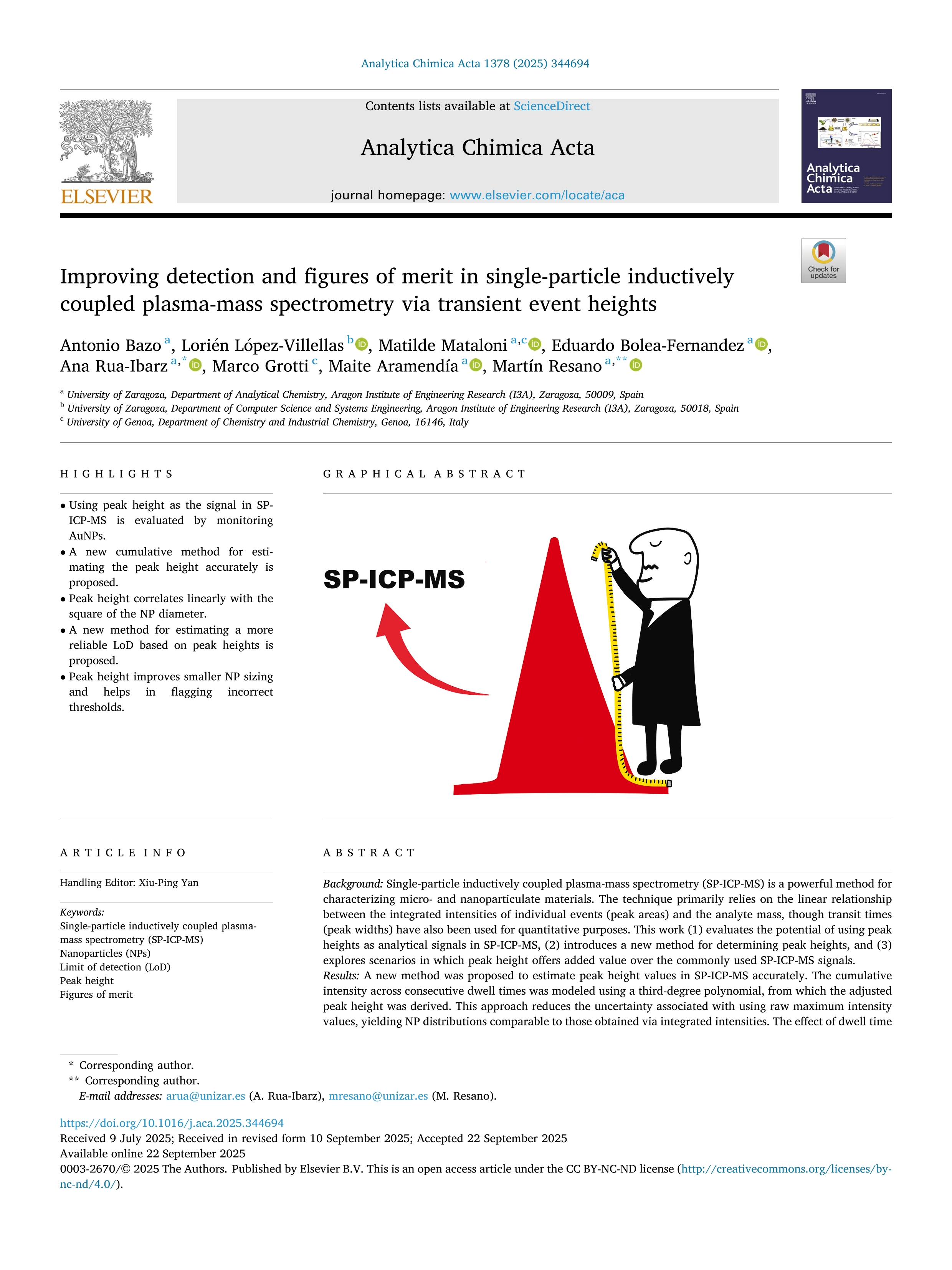

Resumen: Background: Single-particle inductively coupled plasma-mass spectrometry (SP-ICP-MS) is a powerful method for characterizing micro- and nanoparticulate materials. The technique primarily relies on the linear relationship between the integrated intensities of individual events (peak areas) and the analyte mass, though transit times (peak widths) have also been used for quantitative purposes. This work (1) evaluates the potential of using peak heights as analytical signals in SP-ICP-MS, (2) introduces a new method for determining peak heights, and (3) explores scenarios in which peak height offers added value over the commonly used SP-ICP-MS signals.
Results: A new method was proposed to estimate peak height values in SP-ICP-MS accurately. The cumulative intensity across consecutive dwell times was modeled using a third-degree polynomial, from which the adjusted peak height was derived. This approach reduces the uncertainty associated with using raw maximum intensity values, yielding NP distributions comparable to those obtained via integrated intensities. The effect of dwell time on peak height was also evaluated. An optimal range (50 μs–200 μs) was identified, where a linear relationship was observed between the peak height and the square of the NP diameter. Within this range, peak height showed the lowest bias when characterizing smaller NPs, indicating the potential to improve the limit of quantification (LoQ). Additionally, peak heights proved helpful in determining the limit of detection (LoD) and setting appropriate threshold values for data processing, thereby helping to flag incorrect resultsand addressing a challenge in SP-ICP-MS analysis.
Significance: This is the first study to evaluate peak height as an analytical signal in SP-ICP-MS. The results highlight its advantages in specific applications, such as sizing NPs near the LoD, and in supporting the more reliable use of other signals, such as peak areas, by helping to identify incorrect threshold selection that could lead to biased distributions. Finally, monitoring peak heights allows for a more realistic and assumption-free determination of the LoD.
Idioma: Inglés
DOI: 10.1016/j.aca.2025.344694
Año: 2025
Publicado en: Analytica Chimica Acta 1378 (2025), 344694 [10 pp.]
ISSN: 0003-2670
Financiación: info:eu-repo/grantAgreement/ES/DGA/E43-20R
Financiación: info:eu-repo/grantAgreement/ES/DGA/PROY_E17_24
Financiación: info:eu-repo/grantAgreement/ES/DGA/T58-23R
Financiación: info:eu-repo/grantAgreement/EC/H2020/101034288/EU/International Fellowship Programme for Talent Attraction to the Campus of International Excellence Campus Iberus/IberusExperience
Financiación: info:eu-repo/grantAgreement/ES/MICINN/PID2021-122455NB-I00
Financiación: info:eu-repo/grantAgreement/ES/MICINN/PID2022-136454NB-C22
Financiación: info:eu-repo/grantAgreement/ES/MICINN/RYC2021-031093-I
Tipo y forma: Article (Published version)
Área (Departamento): Área Química Analítica (Dpto. Química Analítica)
Área (Departamento): Área Arquit.Tecnología Comput. (Dpto. Informát.Ingenie.Sistms.)
Exportado de SIDERAL (2025-11-21-14:26:08)
Visitas y descargas
Results: A new method was proposed to estimate peak height values in SP-ICP-MS accurately. The cumulative intensity across consecutive dwell times was modeled using a third-degree polynomial, from which the adjusted peak height was derived. This approach reduces the uncertainty associated with using raw maximum intensity values, yielding NP distributions comparable to those obtained via integrated intensities. The effect of dwell time on peak height was also evaluated. An optimal range (50 μs–200 μs) was identified, where a linear relationship was observed between the peak height and the square of the NP diameter. Within this range, peak height showed the lowest bias when characterizing smaller NPs, indicating the potential to improve the limit of quantification (LoQ). Additionally, peak heights proved helpful in determining the limit of detection (LoD) and setting appropriate threshold values for data processing, thereby helping to flag incorrect resultsand addressing a challenge in SP-ICP-MS analysis.
Significance: This is the first study to evaluate peak height as an analytical signal in SP-ICP-MS. The results highlight its advantages in specific applications, such as sizing NPs near the LoD, and in supporting the more reliable use of other signals, such as peak areas, by helping to identify incorrect threshold selection that could lead to biased distributions. Finally, monitoring peak heights allows for a more realistic and assumption-free determination of the LoD.
Idioma: Inglés
DOI: 10.1016/j.aca.2025.344694
Año: 2025
Publicado en: Analytica Chimica Acta 1378 (2025), 344694 [10 pp.]
ISSN: 0003-2670
Financiación: info:eu-repo/grantAgreement/ES/DGA/E43-20R
Financiación: info:eu-repo/grantAgreement/ES/DGA/PROY_E17_24
Financiación: info:eu-repo/grantAgreement/ES/DGA/T58-23R
Financiación: info:eu-repo/grantAgreement/EC/H2020/101034288/EU/International Fellowship Programme for Talent Attraction to the Campus of International Excellence Campus Iberus/IberusExperience
Financiación: info:eu-repo/grantAgreement/ES/MICINN/PID2021-122455NB-I00
Financiación: info:eu-repo/grantAgreement/ES/MICINN/PID2022-136454NB-C22
Financiación: info:eu-repo/grantAgreement/ES/MICINN/RYC2021-031093-I
Tipo y forma: Article (Published version)
Área (Departamento): Área Química Analítica (Dpto. Química Analítica)
Área (Departamento): Área Arquit.Tecnología Comput. (Dpto. Informát.Ingenie.Sistms.)
Exportado de SIDERAL (2025-11-21-14:26:08)
Permalink:
Visitas y descargas
Este artículo se encuentra en las siguientes colecciones:
articulos > articulos-por-area > arquitectura_y_tecnologia_de_computadores
articulos > articulos-por-area > quimica_analitica
Notice créée le 2025-11-21, modifiée le 2025-11-21