PINGing Sunshine: A Review of the Evidence for Adding Non-Filtering Photoprotective Ingredients to Sunscreens
Krutmann, Jean ; Brown, Anthony ; Passeron, Thierry ; Granger, Corinne ; Gilaberte, Yolanda (Universidad de Zaragoza) ; Trullas, Carles ; Piquero-Casals, Jaime ; Leone, Giovanni ; Schalka, Sergio ; Lim, Henry W.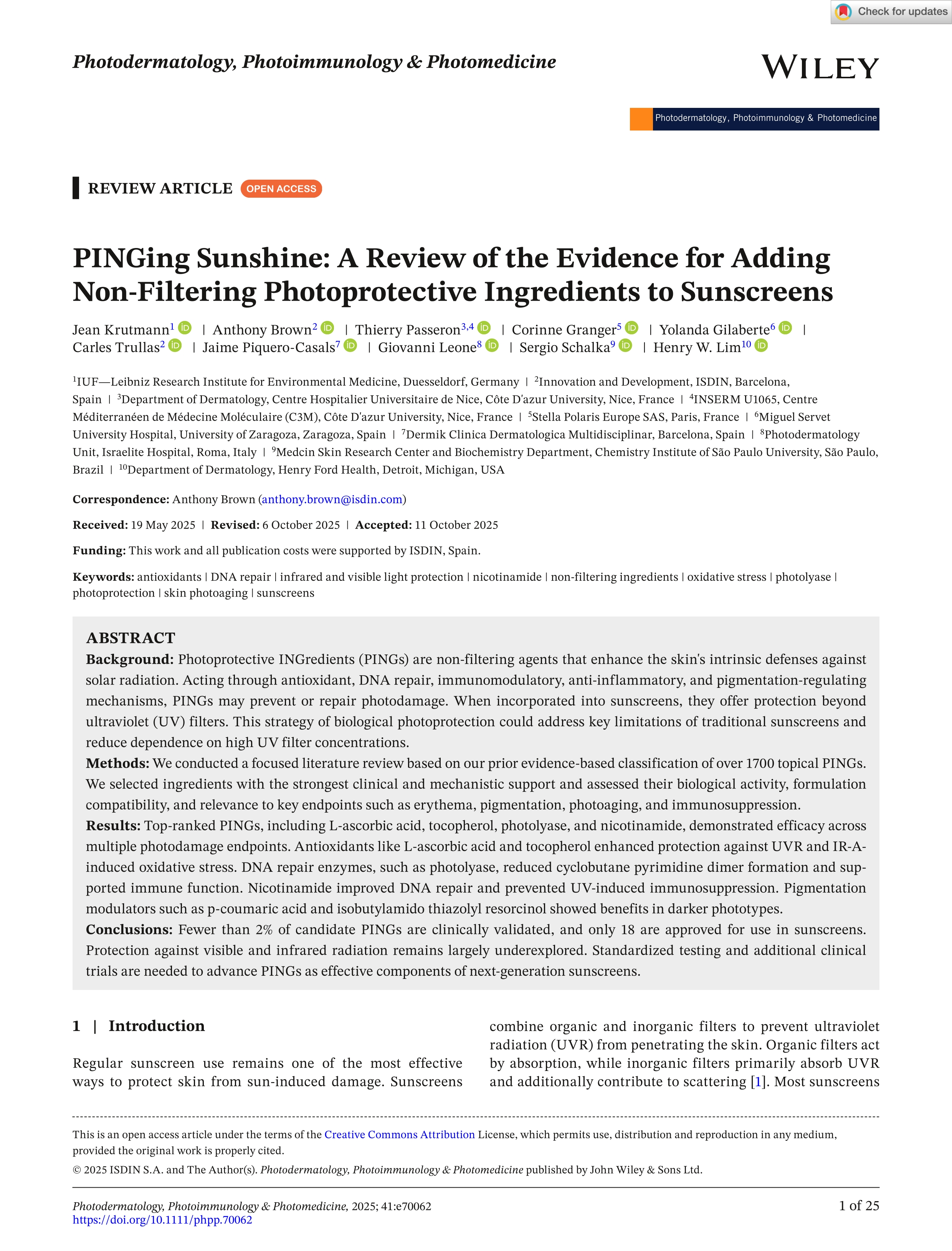
Resumen: Background: Photoprotective INGredients (PINGs) are non-filtering agents that enhance the skin's intrinsic defenses against solar radiation. Acting through antioxidant, DNA repair, immunomodulatory, anti-inflammatory, and pigmentation-regulating
mechanisms, PINGs may prevent or repair photodamage. When incorporated into sunscreens, they offer protection beyond ultraviolet (UV) filters. This strategy of biological photoprotection could address key limitations of traditional sunscreens and
reduce dependence on high UV filter concentrations.
Methods: We conducted a focused literature review based on our prior evidence-based classification of over 1700 topical PINGs. We selected ingredients with the strongest clinical and mechanistic support and assessed their biological activity, formulation compatibility, and relevance to key endpoints such as erythema, pigmentation, photoaging, and immunosuppression.
Results: Top-ranked PINGs, including L-ascorbic acid, tocopherol, photolyase, and nicotinamide, demonstrated efficacy across multiple photodamage endpoints. Antioxidants like L-ascorbic acid and tocopherol enhanced protection against UVR and IR-A-
induced oxidative stress. DNA repair enzymes, such as photolyase, reduced cyclobutane pyrimidine dimer formation and supported immune function. Nicotinamide improved DNA repair and prevented UV-induced immunosuppression. Pigmentation modulators such as p-coumaric acid and isobutylamido thiazolyl resorcinol showed benefits in darker phototypes.
Conclusions: Fewer than 2% of candidate PINGs are clinically validated, and only 18 are approved for use in sunscreens. Protection against visible and infrared radiation remains largely underexplored. Standardized testing and additional clinical
trials are needed to advance PINGs as effective components of next-generation sunscreens.
Idioma: Inglés
DOI: 10.1111/phpp.70062
Año: 2025
Publicado en: PHOTODERMATOLOGY PHOTOIMMUNOLOGY & PHOTOMEDICINE 41, 6 (2025), e70062 [25 pp.]
ISSN: 0905-4383
Tipo y forma: Article (Published version)
Área (Departamento): Área Dermatología (Dpto. Medicina, Psiqu. y Derm.)
 You must give appropriate credit, provide a link to the license, and indicate if changes were made. You may do so in any reasonable manner, but not in any way that suggests the licensor endorses you or your use.
Exportado de SIDERAL (2025-11-21-14:27:15)
Visitas y descargas
mechanisms, PINGs may prevent or repair photodamage. When incorporated into sunscreens, they offer protection beyond ultraviolet (UV) filters. This strategy of biological photoprotection could address key limitations of traditional sunscreens and
reduce dependence on high UV filter concentrations.
Methods: We conducted a focused literature review based on our prior evidence-based classification of over 1700 topical PINGs. We selected ingredients with the strongest clinical and mechanistic support and assessed their biological activity, formulation compatibility, and relevance to key endpoints such as erythema, pigmentation, photoaging, and immunosuppression.
Results: Top-ranked PINGs, including L-ascorbic acid, tocopherol, photolyase, and nicotinamide, demonstrated efficacy across multiple photodamage endpoints. Antioxidants like L-ascorbic acid and tocopherol enhanced protection against UVR and IR-A-
induced oxidative stress. DNA repair enzymes, such as photolyase, reduced cyclobutane pyrimidine dimer formation and supported immune function. Nicotinamide improved DNA repair and prevented UV-induced immunosuppression. Pigmentation modulators such as p-coumaric acid and isobutylamido thiazolyl resorcinol showed benefits in darker phototypes.
Conclusions: Fewer than 2% of candidate PINGs are clinically validated, and only 18 are approved for use in sunscreens. Protection against visible and infrared radiation remains largely underexplored. Standardized testing and additional clinical
trials are needed to advance PINGs as effective components of next-generation sunscreens.
Idioma: Inglés
DOI: 10.1111/phpp.70062
Año: 2025
Publicado en: PHOTODERMATOLOGY PHOTOIMMUNOLOGY & PHOTOMEDICINE 41, 6 (2025), e70062 [25 pp.]
ISSN: 0905-4383
Tipo y forma: Article (Published version)
Área (Departamento): Área Dermatología (Dpto. Medicina, Psiqu. y Derm.)
You must give appropriate credit, provide a link to the license, and indicate if changes were made. You may do so in any reasonable manner, but not in any way that suggests the licensor endorses you or your use. Exportado de SIDERAL (2025-11-21-14:27:15)
Permalink:
Visitas y descargas
Este artículo se encuentra en las siguientes colecciones:
Articles > Artículos por área > Dermatología
Record created 2025-11-21, last modified 2025-11-21