Serosurveillance of Leishmania infantum in Zoo‐Kept Animals in Spain
Barbero-Moyano, Jesús ; Marteles, Diana (Universidad de Zaragoza) ; Cano-Terriza, David ; Villanueva-Saz, Sergio (Universidad de Zaragoza) ; Gonzálvez, Moisés ; Quilez, Pablo (Universidad de Zaragoza) ; Beato-Benítez, Adrián ; Martínez, Javier ; Gargallo-Martín, Alfredo ; Soriano, Pilar ; Risalde, María A. ; García-Bocanegra, Ignacio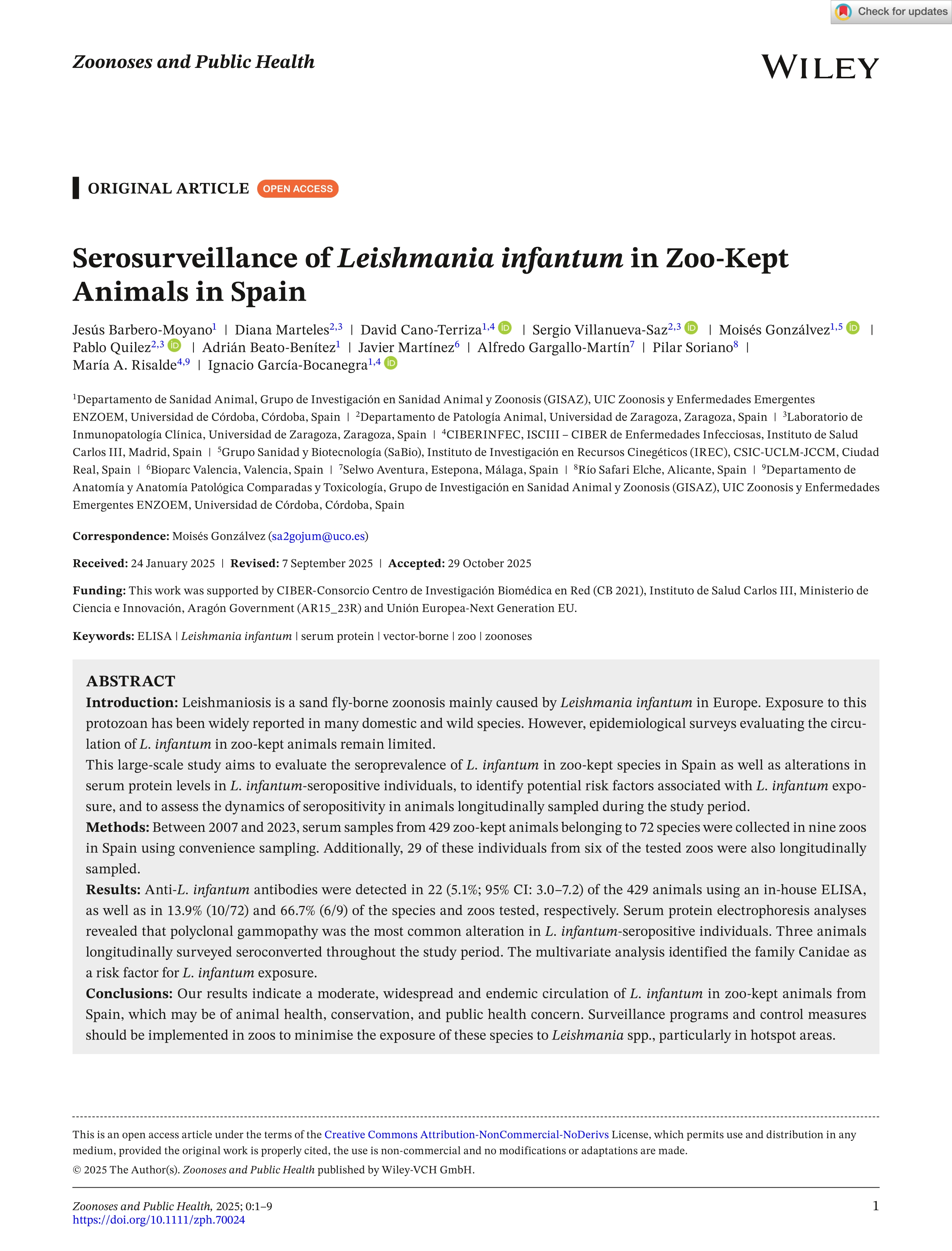
Resumen: Introduction: Leishmaniosis is a sand fly-borne zoonosis mainly caused by Leishmania infantum in Europe. Exposure to this protozoan has been widely reported in many domestic and wild species. However, epidemiological surveys evaluating the circulation of L. infantum in zoo-kept animals remain limited.
This large-scale study aims to evaluate the seroprevalence of L. infantum in zoo-kept species in Spain as well as alterations in serum protein levels in L. infantum-seropositive individuals, to identify potential risk factors associated with L. infantum exposure, and to assess the dynamics of seropositivity in animals longitudinally sampled during the study period.
Methods: Between 2007 and 2023, serum samples from 429 zoo-kept animals belonging to 72 species were collected in nine zoos in Spain using convenience sampling. Additionally, 29 of these individuals from six of the tested zoos were also longitudinally sampled.
Results: Anti-L. infantum antibodies were detected in 22 (5.1%; 95% CI: 3.0–7.2) of the 429 animals using an in-house ELISA, as well as in 13.9% (10/72) and 66.7% (6/9) of the species and zoos tested, respectively. Serum protein electrophoresis analyses revealed that polyclonal gammopathy was the most common alteration in L. infantum-seropositive individuals. Three animals longitudinally surveyed seroconverted throughout the study period. The multivariate analysis identified the family Canidae as a risk factor for L. infantum exposure.
Conclusions: Our results indicate a moderate, widespread and endemic circulation of L. infantum in zoo-kept animals from Spain, which may be of animal health, conservation, and public health concern. Surveillance programs and control measures should be implemented in zoos to minimise the exposure of these species to Leishmania spp., particularly in hotspot areas.
Idioma: Inglés
DOI: 10.1111/zph.70024
Año: 2026
Publicado en: Zoonoses and Public Health 73, 1 (2026), 65-73
ISSN: 1863-1959
Financiación: info:eu-repo/grantAgreement/ES/DGA/AR15-23R
Tipo y forma: Artículo (Versión definitiva)
Área (Departamento): Área Medicina y Cirugía Animal (Dpto. Patología Animal)
 Debe reconocer adecuadamente la autoría, proporcionar un enlace a la licencia e indicar si se han realizado cambios. Puede hacerlo de cualquier manera razonable, pero no de una manera que sugiera que tiene el apoyo del licenciador o lo recibe por el uso que hace. No puede utilizar el material para una finalidad comercial. Si remezcla, transforma o crea a partir del material, no puede difundir el material modificado.
Exportado de SIDERAL (2026-02-23-14:58:21)
Visitas y descargas
This large-scale study aims to evaluate the seroprevalence of L. infantum in zoo-kept species in Spain as well as alterations in serum protein levels in L. infantum-seropositive individuals, to identify potential risk factors associated with L. infantum exposure, and to assess the dynamics of seropositivity in animals longitudinally sampled during the study period.
Methods: Between 2007 and 2023, serum samples from 429 zoo-kept animals belonging to 72 species were collected in nine zoos in Spain using convenience sampling. Additionally, 29 of these individuals from six of the tested zoos were also longitudinally sampled.
Results: Anti-L. infantum antibodies were detected in 22 (5.1%; 95% CI: 3.0–7.2) of the 429 animals using an in-house ELISA, as well as in 13.9% (10/72) and 66.7% (6/9) of the species and zoos tested, respectively. Serum protein electrophoresis analyses revealed that polyclonal gammopathy was the most common alteration in L. infantum-seropositive individuals. Three animals longitudinally surveyed seroconverted throughout the study period. The multivariate analysis identified the family Canidae as a risk factor for L. infantum exposure.
Conclusions: Our results indicate a moderate, widespread and endemic circulation of L. infantum in zoo-kept animals from Spain, which may be of animal health, conservation, and public health concern. Surveillance programs and control measures should be implemented in zoos to minimise the exposure of these species to Leishmania spp., particularly in hotspot areas.
Idioma: Inglés
DOI: 10.1111/zph.70024
Año: 2026
Publicado en: Zoonoses and Public Health 73, 1 (2026), 65-73
ISSN: 1863-1959
Financiación: info:eu-repo/grantAgreement/ES/DGA/AR15-23R
Tipo y forma: Artículo (Versión definitiva)
Área (Departamento): Área Medicina y Cirugía Animal (Dpto. Patología Animal)
Debe reconocer adecuadamente la autoría, proporcionar un enlace a la licencia e indicar si se han realizado cambios. Puede hacerlo de cualquier manera razonable, pero no de una manera que sugiera que tiene el apoyo del licenciador o lo recibe por el uso que hace. No puede utilizar el material para una finalidad comercial. Si remezcla, transforma o crea a partir del material, no puede difundir el material modificado.Exportado de SIDERAL (2026-02-23-14:58:21)
Enlace permanente:
Visitas y descargas
Este artículo se encuentra en las siguientes colecciones:
Artículos > Artículos por área > Medicina y Cirugía Animal
Registro creado el 2025-11-27, última modificación el 2026-02-23