Ritual’s collective effervescence, awe, and social identity: psychosocial effects of the Pasto carnival
Rincón-Unigarro, Camilo ; da Costa-Dutra, Silvia (Universidad de Zaragoza) ; Cisneros-Rodríguez, María-José ; Díaz-Fuentes, Laura ; Giraldo-Castillo, Natalia ; Murcia-Infante, Angélica ; Páez, Darío ; Vargas-López, Mariana ; Vásquez-Velásquez, Santiago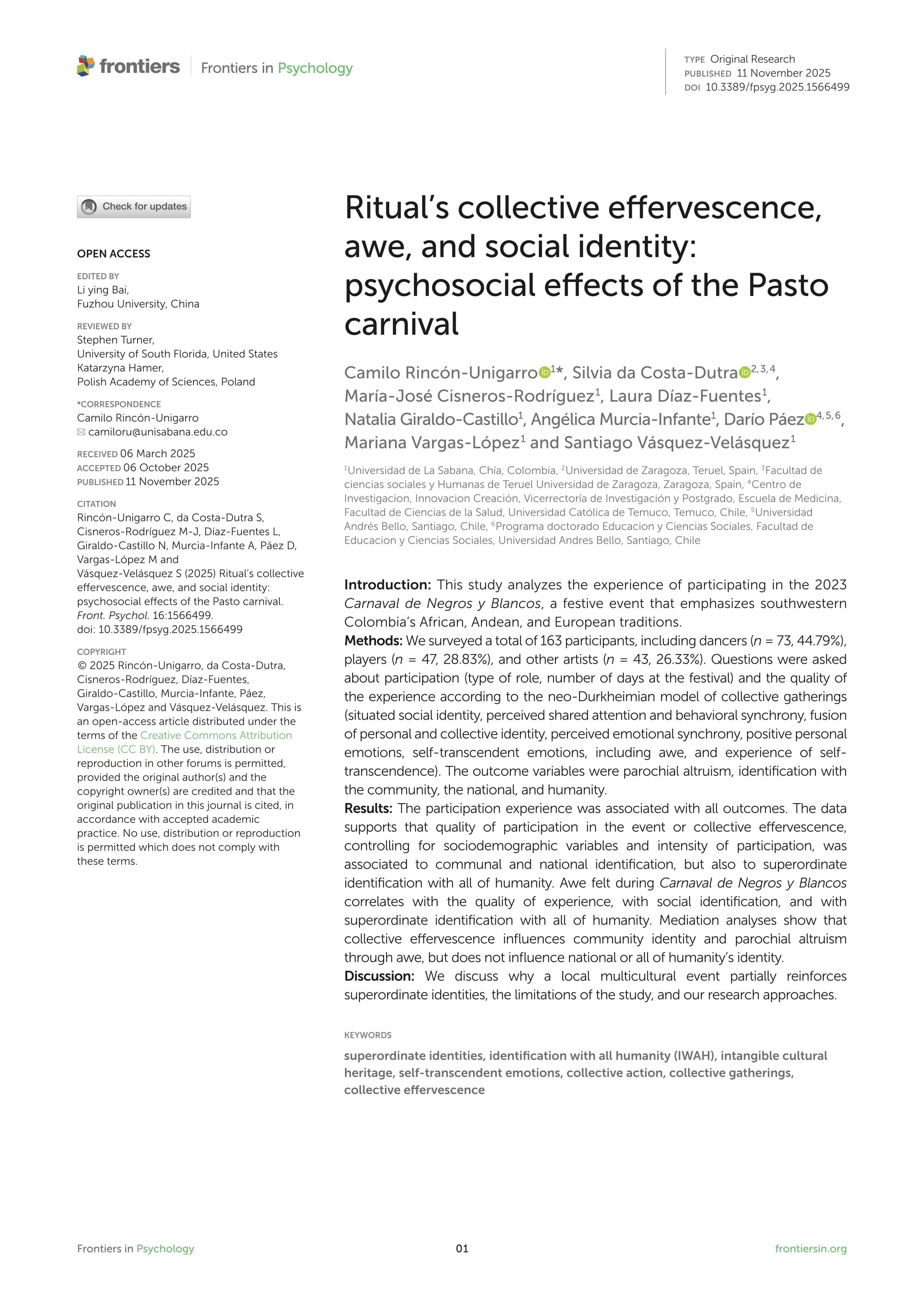
Resumen: Introduction: This study analyzes the experience of participating in the 2023 Carnaval de Negros y Blancos, a festive event that emphasizes southwestern Colombia’s African, Andean, and European traditions. Methods: We surveyed a total of 163 participants, including dancers (n = 73, 44.79%), players (n = 47, 28.83%), and other artists (n = 43, 26.33%). Questions were asked about participation (type of role, number of days at the festival) and the quality of the experience according to the neo-Durkheimian model of collective gatherings (situated social identity, perceived shared attention and behavioral synchrony, fusion of personal and collective identity, perceived emotional synchrony, positive personal emotions, self- ranscendent emotions, including awe, and experience of selftranscendence). The outcome variables were parochial altruism, identification with the community, the national, and humanity. Results: The participation experience was associated with all outcomes. The data supports that quality of participation in the event or collective effervescence, controlling for sociodemographic variables and intensity of participation, was associated to communal and national identification, but also to superordinate identification with all of humanity. Awe felt during Carnaval de Negros y Blancos correlates with the quality of experience, with social identification, and with superordinate identification with all of humanity. Mediation analyses show that collective effervescence influences community identity and parochial altruism through awe, but does not influence national or all of humanity’s identity. Discussion: We discuss why a local multicultural event partially reinforces superordinate identities, the limitations of the study, and our research approaches.
Idioma: Inglés
DOI: 10.3389/fpsyg.2025.1566499
Año: 2025
Publicado en: Frontiers in Psychology 16 (2025), 1566499 [18 pp.]
ISSN: 1664-1078
Tipo y forma: Artículo (Versión definitiva)
Área (Departamento): Área Psicología Social (Dpto. Psicología y Sociología)
 Debe reconocer adecuadamente la autoría, proporcionar un enlace a la licencia e indicar si se han realizado cambios. Puede hacerlo de cualquier manera razonable, pero no de una manera que sugiera que tiene el apoyo del licenciador o lo recibe por el uso que hace.
Exportado de SIDERAL (2025-12-12-14:42:41)
Visitas y descargas
Idioma: Inglés
DOI: 10.3389/fpsyg.2025.1566499
Año: 2025
Publicado en: Frontiers in Psychology 16 (2025), 1566499 [18 pp.]
ISSN: 1664-1078
Tipo y forma: Artículo (Versión definitiva)
Área (Departamento): Área Psicología Social (Dpto. Psicología y Sociología)
Debe reconocer adecuadamente la autoría, proporcionar un enlace a la licencia e indicar si se han realizado cambios. Puede hacerlo de cualquier manera razonable, pero no de una manera que sugiera que tiene el apoyo del licenciador o lo recibe por el uso que hace. Exportado de SIDERAL (2025-12-12-14:42:41)
Enlace permanente:
Visitas y descargas
Este artículo se encuentra en las siguientes colecciones:
Artículos > Artículos por área > Psicología Social
Registro creado el 2025-12-12, última modificación el 2025-12-12