Mini-Basketball for Preschool and School-Aged Children with Autism Spectrum Disorder: A Systematic Review of Randomized Controlled Trials
González-Devesa, Daniel ; Zhou, Rui ; Rico-González, Markel ; Gómez-Carmona, Carlos D. (Universidad de Zaragoza)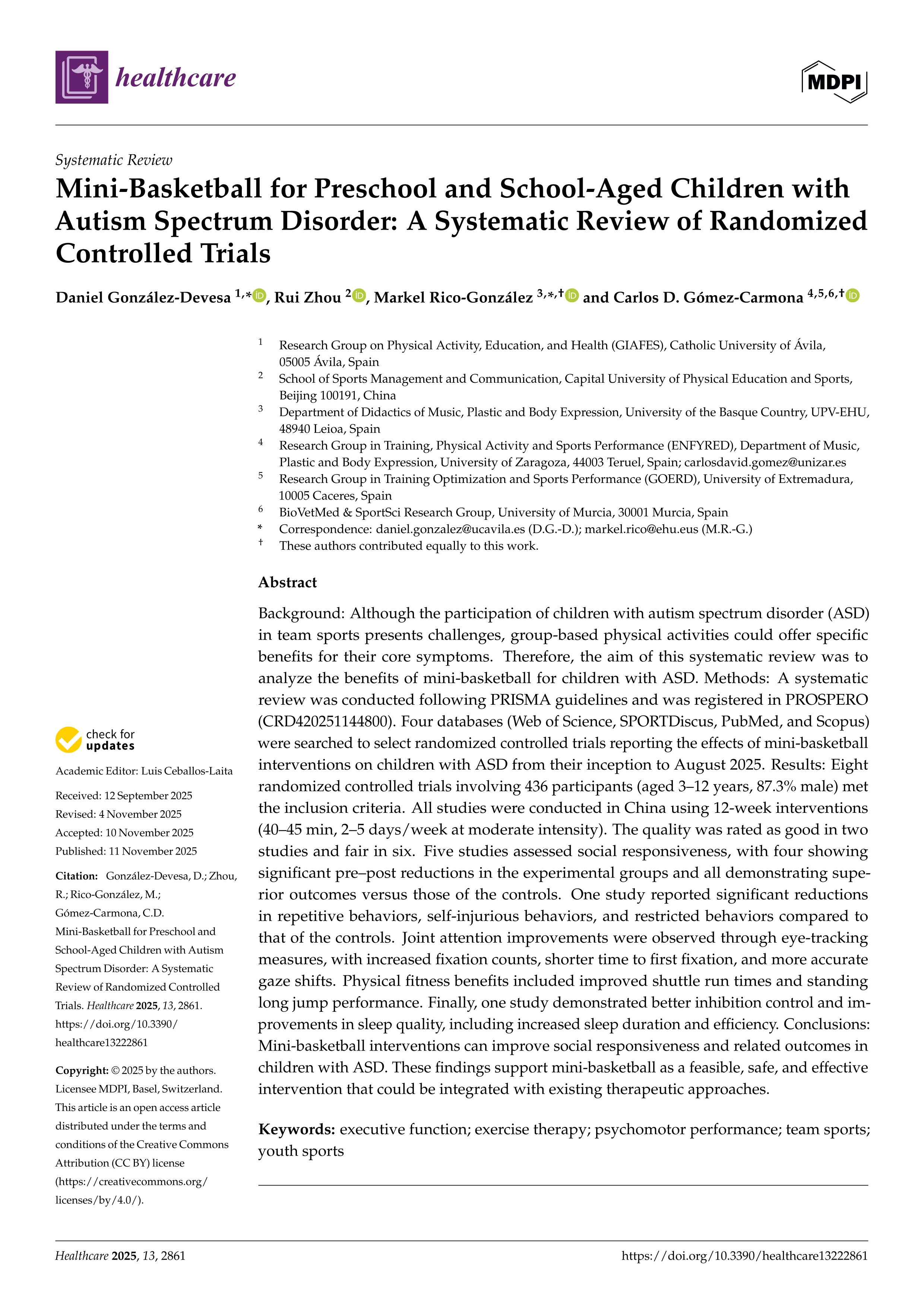
Resumen: Background: Although the participation of children with autism spectrum disorder (ASD) in team sports presents challenges, group-based physical activities could offer specific benefits for their core symptoms. Therefore, the aim of this systematic review was to analyze the benefits of mini-basketball for children with ASD. Methods: A systematic review was conducted following PRISMA guidelines and was registered in PROSPERO (CRD420251144800). Four databases (Web of Science, SPORTDiscus, PubMed, and Scopus) were searched to select randomized controlled trials reporting the effects of mini-basketball interventions on children with ASD from their inception to August 2025. Results: Eight randomized controlled trials involving 436 participants (aged 3–12 years, 87.3% male) met the inclusion criteria. All studies were conducted in China using 12-week interventions (40–45 min, 2–5 days/week at moderate intensity). The quality was rated as good in two studies and fair in six. Five studies assessed social responsiveness, with four showing significant pre–post reductions in the experimental groups and all demonstrating superior outcomes versus those of the controls. One study reported significant reductions in repetitive behaviors, self-injurious behaviors, and restricted behaviors compared to that of the controls. Joint attention improvements were observed through eye-tracking measures, with increased fixation counts, shorter time to first fixation, and more accurate gaze shifts. Physical fitness benefits included improved shuttle run times and standing long jump performance. Finally, one study demonstrated better inhibition control and improvements in sleep quality, including increased sleep duration and efficiency. Conclusions: Mini-basketball interventions can improve social responsiveness and related outcomes in children with ASD. These findings support mini-basketball as a feasible, safe, and effective intervention that could be integrated with existing therapeutic approaches.
Idioma: Inglés
DOI: 10.3390/healthcare13222861
Año: 2025
Publicado en: Healthcare (Switzerland) 13, 22 (2025), 2861 [15 pp.]
ISSN: 2227-9032
Financiación: info:eu-repo/grantAgreement/ES/AEI/AEI PID2019-106614GB-I00
Financiación: info:eu-repo/grantAgreement/ES/DGA/S53-23R
Tipo y forma: Artículo (Versión definitiva)
Área (Departamento): Área Didáctica Expres.Corporal (Dpto. Expres.Music.Plást.Corp.)
 Debe reconocer adecuadamente la autoría, proporcionar un enlace a la licencia e indicar si se han realizado cambios. Puede hacerlo de cualquier manera razonable, pero no de una manera que sugiera que tiene el apoyo del licenciador o lo recibe por el uso que hace.
Exportado de SIDERAL (2025-12-19-14:43:23)
Visitas y descargas
Idioma: Inglés
DOI: 10.3390/healthcare13222861
Año: 2025
Publicado en: Healthcare (Switzerland) 13, 22 (2025), 2861 [15 pp.]
ISSN: 2227-9032
Financiación: info:eu-repo/grantAgreement/ES/AEI/AEI PID2019-106614GB-I00
Financiación: info:eu-repo/grantAgreement/ES/DGA/S53-23R
Tipo y forma: Artículo (Versión definitiva)
Área (Departamento): Área Didáctica Expres.Corporal (Dpto. Expres.Music.Plást.Corp.)
Debe reconocer adecuadamente la autoría, proporcionar un enlace a la licencia e indicar si se han realizado cambios. Puede hacerlo de cualquier manera razonable, pero no de una manera que sugiera que tiene el apoyo del licenciador o lo recibe por el uso que hace. Exportado de SIDERAL (2025-12-19-14:43:23)
Enlace permanente:
Visitas y descargas
Este artículo se encuentra en las siguientes colecciones:
Artículos > Artículos por área > Didáctica de la Expresión Corporal
Registro creado el 2025-12-19, última modificación el 2025-12-19