Choroidal changes after antiVEGF in neovascular age-related macular degeneration with type 1 and 3 macular neovascularization
Bartol-Puyal, Francisco de Asís (Universidad de Zaragoza) ; Sánchez Monroy, Jorge (Universidad de Zaragoza) ; Puzo Bayod, Martín ; Mallén, Víctor (Universidad de Zaragoza) ; Méndez-Martínez, Silvia (Universidad de Zaragoza) ; Calvo, Pilar (Universidad de Zaragoza) ; Pablo, Luis (Universidad de Zaragoza)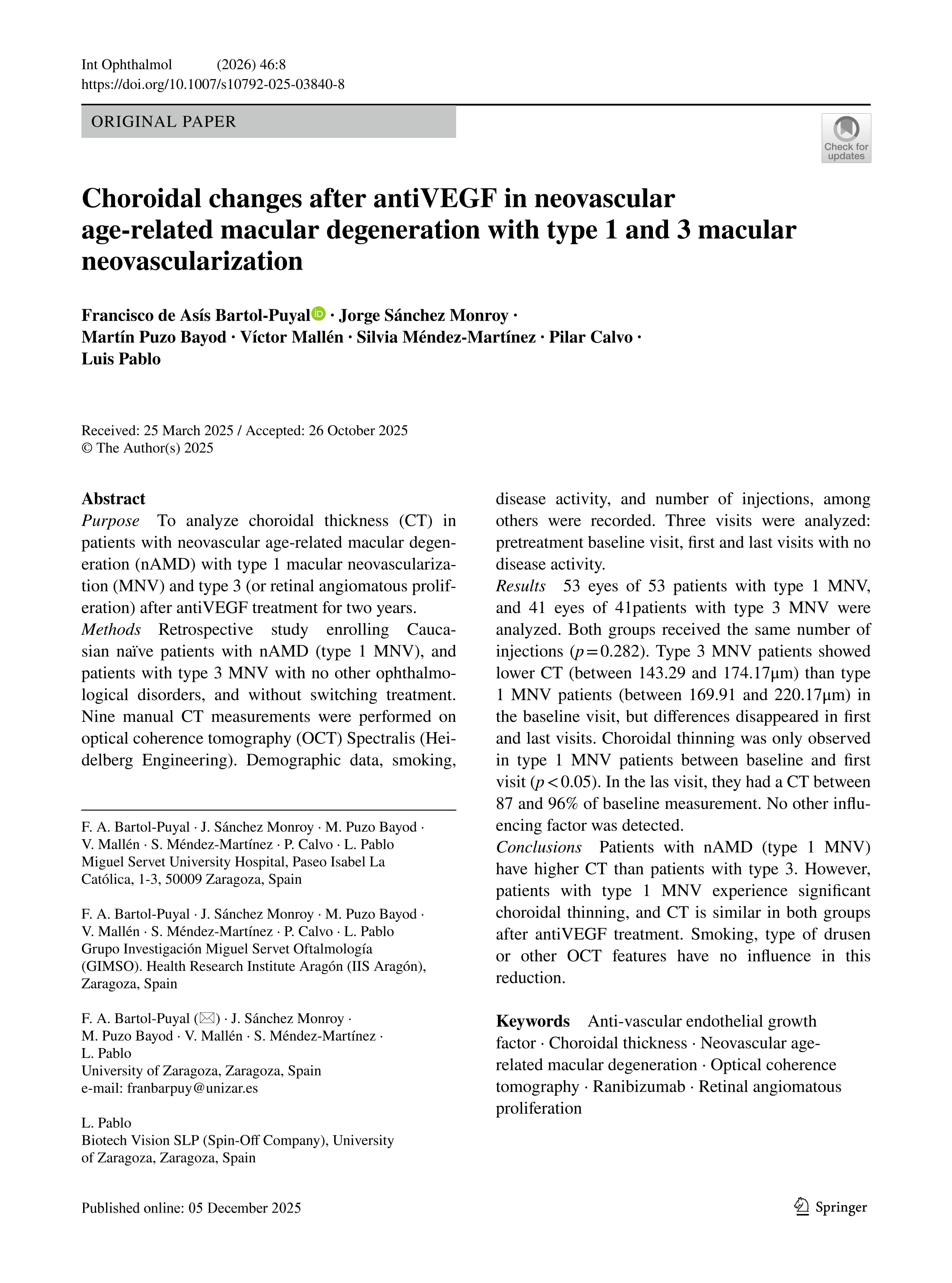
Resumen: Purpose: To analyze choroidal thickness (CT) in patients with neovascular age-related macular degeneration (nAMD) with type 1 macular neovascularization (MNV) and type 3 (or retinal angiomatous proliferation) after antiVEGF treatment for two years.
Methods: Retrospective study enrolling Caucasian naïve patients with nAMD (type 1 MNV), and patients with type 3 MNV with no other ophthalmological disorders, and without switching treatment. Nine manual CT measurements were performed on optical coherence tomography (OCT) Spectralis (Heidelberg Engineering). Demographic data, smoking, disease activity, and number of injections, among others were recorded. Three visits were analyzed: pretreatment baseline visit, first and last visits with no disease activity.
Results:53 eyes of 53 patients with type 1 MNV, and 41 eyes of 41patients with type 3 MNV were analyzed. Both groups received the same number of injections (p = 0.282). Type 3 MNV patients showed lower CT (between 143.29 and 174.17μm) than type 1 MNV patients (between 169.91 and 220.17μm) in the baseline visit, but differences disappeared in first and last visits. Choroidal thinning was only observed in type 1 MNV patients between baseline and first visit (p < 0.05). In the las visit, they had a CT between 87 and 96% of baseline measurement. No other influencing factor was detected.
Conclusions: Patients with nAMD (type 1 MNV) have higher CT than patients with type 3. However, patients with type 1 MNV experience significant choroidal thinning, and CT is similar in both groups after antiVEGF treatment. Smoking, type of drusen or other OCT features have no influence in this reduction
Idioma: Inglés
DOI: 10.1007/s10792-025-03840-8
Año: 2026
Publicado en: International Ophthalmology 46, 1 (2026), [8 pp.]
ISSN: 0165-5701
Tipo y forma: Artículo (Versión definitiva)
Área (Departamento): Área Oftalmología (Dpto. Cirugía)
Área (Departamento): Area Psiquiatría (Dpto. Medicina, Psiqu. y Derm.)
 Debe reconocer adecuadamente la autoría, proporcionar un enlace a la licencia e indicar si se han realizado cambios. Puede hacerlo de cualquier manera razonable, pero no de una manera que sugiera que tiene el apoyo del licenciador o lo recibe por el uso que hace.
Exportado de SIDERAL (2025-12-19-14:43:50)
Visitas y descargas
Methods: Retrospective study enrolling Caucasian naïve patients with nAMD (type 1 MNV), and patients with type 3 MNV with no other ophthalmological disorders, and without switching treatment. Nine manual CT measurements were performed on optical coherence tomography (OCT) Spectralis (Heidelberg Engineering). Demographic data, smoking, disease activity, and number of injections, among others were recorded. Three visits were analyzed: pretreatment baseline visit, first and last visits with no disease activity.
Results:53 eyes of 53 patients with type 1 MNV, and 41 eyes of 41patients with type 3 MNV were analyzed. Both groups received the same number of injections (p = 0.282). Type 3 MNV patients showed lower CT (between 143.29 and 174.17μm) than type 1 MNV patients (between 169.91 and 220.17μm) in the baseline visit, but differences disappeared in first and last visits. Choroidal thinning was only observed in type 1 MNV patients between baseline and first visit (p < 0.05). In the las visit, they had a CT between 87 and 96% of baseline measurement. No other influencing factor was detected.
Conclusions: Patients with nAMD (type 1 MNV) have higher CT than patients with type 3. However, patients with type 1 MNV experience significant choroidal thinning, and CT is similar in both groups after antiVEGF treatment. Smoking, type of drusen or other OCT features have no influence in this reduction
Idioma: Inglés
DOI: 10.1007/s10792-025-03840-8
Año: 2026
Publicado en: International Ophthalmology 46, 1 (2026), [8 pp.]
ISSN: 0165-5701
Tipo y forma: Artículo (Versión definitiva)
Área (Departamento): Área Oftalmología (Dpto. Cirugía)
Área (Departamento): Area Psiquiatría (Dpto. Medicina, Psiqu. y Derm.)
Debe reconocer adecuadamente la autoría, proporcionar un enlace a la licencia e indicar si se han realizado cambios. Puede hacerlo de cualquier manera razonable, pero no de una manera que sugiera que tiene el apoyo del licenciador o lo recibe por el uso que hace. Exportado de SIDERAL (2025-12-19-14:43:50)
Enlace permanente:
Visitas y descargas
Este artículo se encuentra en las siguientes colecciones:
Artículos > Artículos por área > Oftalmología
Artículos > Artículos por área > Psiquiatría
Registro creado el 2025-12-19, última modificación el 2025-12-19