Cardiac Magnetic Resonance-Guided Ventricular Tachycardia Substrate Ablation.
Soto-Iglesias D ; Penela D ; Jáuregui B ; Acosta J ; Fernández-Armenta J ; Linhart M ; Zucchelli G ; Syrovnev V ; Zaraket F ; Terés C ; Perea RJ ; Prat-González S ; Doltra A ; Ortiz-Pérez JT ; Bosch X ; Camara O ; Berruezo A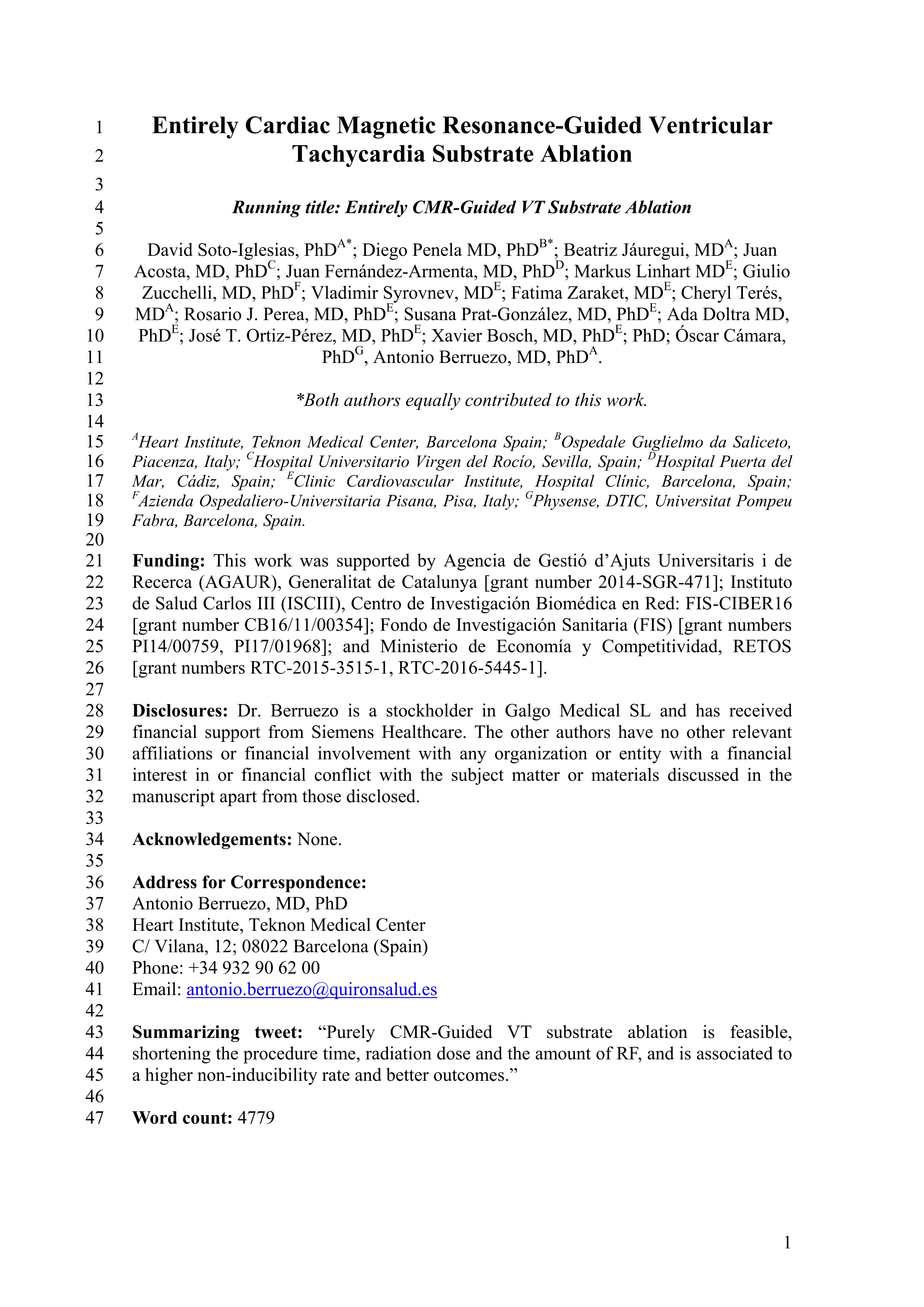
Resumen: Objectives
This study assessed the feasibility and potential benefit of performing ventricular tachycardia (VT) substrate ablation procedures guided by cardiac magnetic resonance (CMR)-derived pixel signal intensity (PSI) maps.
Background
CMR-aided VT ablation using PSI maps from late gadolinium enhancement-CMR (LGE-CMR), together with electroanatomical map (EAM) information, has been shown to improve outcomes of VT substrate ablation.
Methods
Eighty-four patients with scar-dependent monomorphic VT who underwent substrate ablation were included in the study. In the last 28 (33%) consecutive patients, the procedure was guided by CMR. Procedural data, as well as acute and follow-up outcomes, were compared between patients who underwent guided CMR and 2 control groups: 1) patients who had PSI maps were available but the EAM was acquired and used to select the ablation targets (CMR aided); and 2) patients with no CMR-derived PSI maps available (no CMR).
Results
Mean procedure duration was lower in CMR-guided substrate ablation compared with CMR-aided and no CMR (107 ± 59 min vs. 203 ± 68 min and 227 ± 52 min; p < 0.001 for both comparisons). CMR-guided ablation required less fluoroscopy time than CMR-aided ablation and no CMR (10 ± 4 min vs. 23 ± 11 min and 20 ± 9 min, respectively; p < 0.001 for both comparisons) and less radiofrequency time (15 ± 8 min vs. 20 ± 15 min and 26 ± 10 min; p = 0.16 and p < 0.001, respectively). After substrate ablation, VT inducibility was lower in CMR-guided ablation compared with CMR-aided ablation and no CMR (18% vs. 32% and 46%; p = 0.35 and p = 0.04, respectively), without significant differences in complications. After 12 months, VT recurrence was lower in those who underwent CMR-guided ablation compared with no CMR (log-rank: 0.019), with no differences with CMR-aided ablation.
Conclusions
CMR-guided VT ablation is feasible and safe, significantly reduces the procedural, fluoroscopy, and radiofrequency times, and is associated with a higher noninducibility rate and lower VT recurrence after substrate ablation.
Idioma: Inglés
DOI: 10.1016/j.jacep.2019.11.004
Año: 2020
Publicado en: JACC: Clinical Electrophysiology 6, 4 (2020), 436 - 447
ISSN: 2405-500X
Factor impacto JCR: 6.375 (2020)
Categ. JCR: CARDIAC & CARDIOVASCULAR SYSTEMS rank: 26 / 141 = 0.184 (2020) - Q1 - T1
Factor impacto SCIMAGO: 2.278 - Physiology (medical) (Q1) - Cardiology and Cardiovascular Medicine (Q1)
Financiación: info:eu-repo/grantAgreement/ES/MINECO/RTC-2015-3515-1
Financiación: info:eu-repo/grantAgreement/ES/MINECO/RTC-2016-5445-1
Tipo y forma: Article (PostPrint)
 You must give appropriate credit, provide a link to the license, and indicate if changes were made. You may do so in any reasonable manner, but not in any way that suggests the licensor endorses you or your use. You may not use the material for commercial purposes. If you remix, transform, or build upon the material, you may not distribute the modified material.
Exportado de SIDERAL (2026-01-07-18:53:05)
Visitas y descargas
This study assessed the feasibility and potential benefit of performing ventricular tachycardia (VT) substrate ablation procedures guided by cardiac magnetic resonance (CMR)-derived pixel signal intensity (PSI) maps.
Background
CMR-aided VT ablation using PSI maps from late gadolinium enhancement-CMR (LGE-CMR), together with electroanatomical map (EAM) information, has been shown to improve outcomes of VT substrate ablation.
Methods
Eighty-four patients with scar-dependent monomorphic VT who underwent substrate ablation were included in the study. In the last 28 (33%) consecutive patients, the procedure was guided by CMR. Procedural data, as well as acute and follow-up outcomes, were compared between patients who underwent guided CMR and 2 control groups: 1) patients who had PSI maps were available but the EAM was acquired and used to select the ablation targets (CMR aided); and 2) patients with no CMR-derived PSI maps available (no CMR).
Results
Mean procedure duration was lower in CMR-guided substrate ablation compared with CMR-aided and no CMR (107 ± 59 min vs. 203 ± 68 min and 227 ± 52 min; p < 0.001 for both comparisons). CMR-guided ablation required less fluoroscopy time than CMR-aided ablation and no CMR (10 ± 4 min vs. 23 ± 11 min and 20 ± 9 min, respectively; p < 0.001 for both comparisons) and less radiofrequency time (15 ± 8 min vs. 20 ± 15 min and 26 ± 10 min; p = 0.16 and p < 0.001, respectively). After substrate ablation, VT inducibility was lower in CMR-guided ablation compared with CMR-aided ablation and no CMR (18% vs. 32% and 46%; p = 0.35 and p = 0.04, respectively), without significant differences in complications. After 12 months, VT recurrence was lower in those who underwent CMR-guided ablation compared with no CMR (log-rank: 0.019), with no differences with CMR-aided ablation.
Conclusions
CMR-guided VT ablation is feasible and safe, significantly reduces the procedural, fluoroscopy, and radiofrequency times, and is associated with a higher noninducibility rate and lower VT recurrence after substrate ablation.
Idioma: Inglés
DOI: 10.1016/j.jacep.2019.11.004
Año: 2020
Publicado en: JACC: Clinical Electrophysiology 6, 4 (2020), 436 - 447
ISSN: 2405-500X
Factor impacto JCR: 6.375 (2020)
Categ. JCR: CARDIAC & CARDIOVASCULAR SYSTEMS rank: 26 / 141 = 0.184 (2020) - Q1 - T1
Factor impacto SCIMAGO: 2.278 - Physiology (medical) (Q1) - Cardiology and Cardiovascular Medicine (Q1)
Financiación: info:eu-repo/grantAgreement/ES/MINECO/RTC-2015-3515-1
Financiación: info:eu-repo/grantAgreement/ES/MINECO/RTC-2016-5445-1
Tipo y forma: Article (PostPrint)
You must give appropriate credit, provide a link to the license, and indicate if changes were made. You may do so in any reasonable manner, but not in any way that suggests the licensor endorses you or your use. You may not use the material for commercial purposes. If you remix, transform, or build upon the material, you may not distribute the modified material. Exportado de SIDERAL (2026-01-07-18:53:05)
Permalink:
Visitas y descargas
Este artículo se encuentra en las siguientes colecciones:
Articles
Record created 2026-01-07, last modified 2026-01-07