Liver dysfunction associated with artificial nutrition in critically ill patients
Grau, Teodoro ; Bonet,Alfonso ; Rubio, Mercedes ; Mateo, Dolores ; Farré, Mercé ; Acosta, José Antonio ; Blesa, Antonio ; Montejo, Juan Carlos ; García de Lorenzo, Abelardo ; Mesejo, Alfonso ; Serón Arbeloa, Carlos (Universidad de Zaragoza) ; and the Working Group on Nutrition and Metabolism of the Spanish Society of Critical Care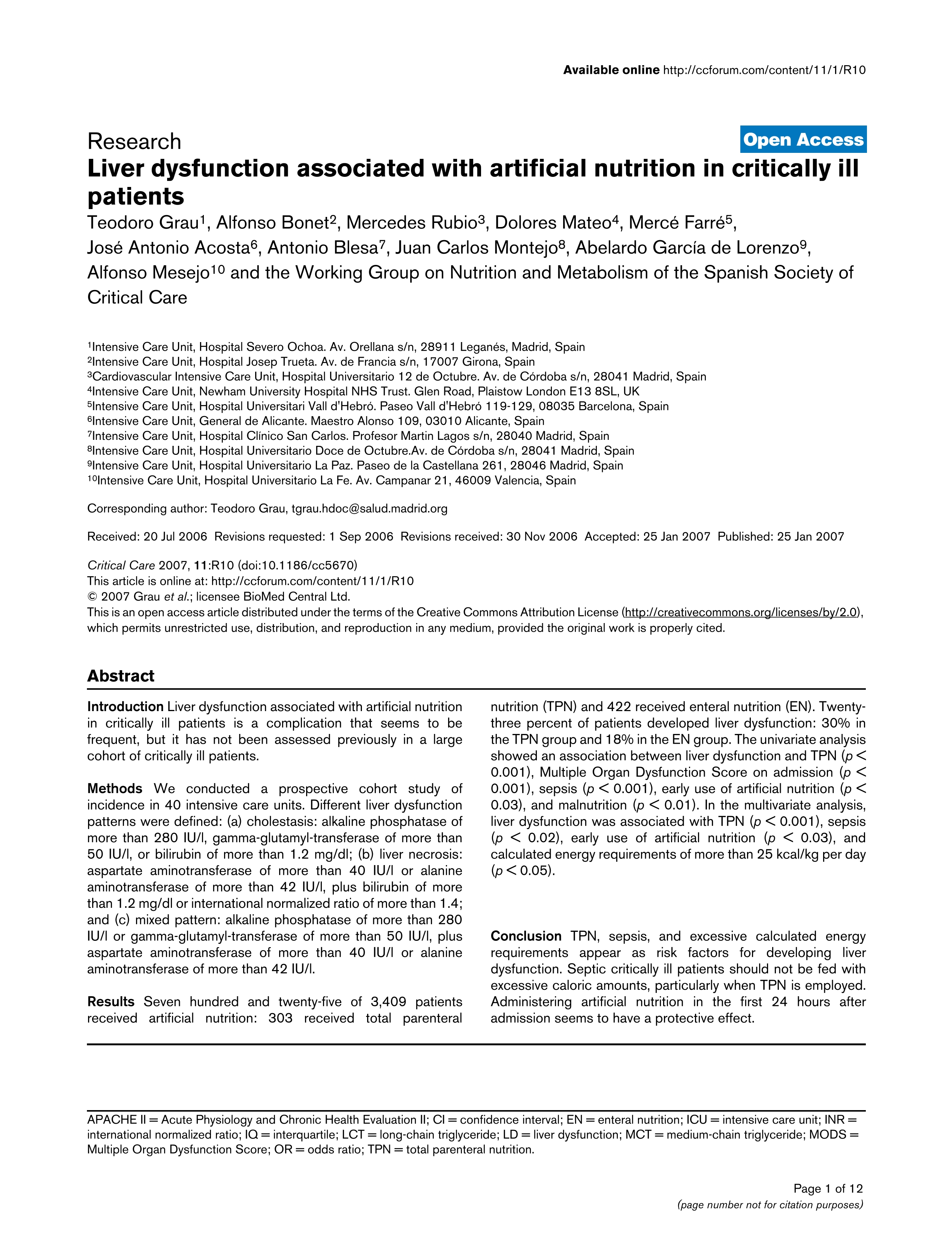
Resumen: Introduction: Liver dysfunction associated with artificial nutrition in critically ill patients is a complication that seems to be frequent, but it has not been assessed previously in a large cohort of critically ill patients.
Methods: We conducted a prospective cohort study of incidence in 40 intensive care units. Different liver dysfunction patterns were defined: (a) cholestasis: alkaline phosphatase of more than 280 IU/l, gamma-glutamyl-transferase of more than 50 IU/l, or bilirubin of more than 1.2 mg/dl; (b) liver necrosis: aspartate aminotransferase of more than 40 IU/l or alanine aminotransferase of more than 42 IU/l, plus bilirubin of more than 1.2 mg/dl or international normalized ratio of more than 1.4; and (c) mixed pattern: alkaline phosphatase of more than 280 IU/l or gamma-glutamyl-transferase of more than 50 IU/l, plus aspartate aminotransferase of more than 40 IU/l or alanine aminotransferase of more than 42 IU/l.
Results; Seven hundred and twenty-five of 3,409 patients received artificial nutrition: 303 received total parenteral nutrition (TPN) and 422 received enteral nutrition (EN). Twenty-three percent of patients developed liver dysfunction: 30% in the TPN group and 18% in the EN group. The univariate analysis showed an association between liver dysfunction and TPN (p < 0.001), Multiple Organ Dysfunction Score on admission (p < 0.001), sepsis (p < 0.001), early use of artificial nutrition (p < 0.03), and malnutrition (p < 0.01). In the multivariate analysis, liver dysfunction was associated with TPN (p < 0.001), sepsis (p < 0.02), early use of artificial nutrition (p < 0.03), and calculated energy requirements of more than 25 kcal/kg per day (p < 0.05).
Conclusion: TPN, sepsis, and excessive calculated energy requirements appear as risk factors for developing liver dysfunction. Septic critically ill patients should not be fed with excessive caloric amounts, particularly when TPN is employed. Administering artificial nutrition in the first 24 hours after admission seems to have a protective effect.
Idioma: Inglés
DOI: 10.1186/cc5670
Año: 2007
Publicado en: Critical care 11, 1 (2007), [12 pp.]
ISSN: 1364-8535
Factor impacto JCR: 3.834 (2007)
Categ. JCR: CRITICAL CARE MEDICINE rank: 4 / 19 = 0.211 (2007) - Q1 - T1
Tipo y forma: Artículo (Versión definitiva)
Área (Departamento): Area Medicina (Dpto. Medicina, Psiqu. y Derm.)
 Debe reconocer adecuadamente la autoría, proporcionar un enlace a la licencia e indicar si se han realizado cambios. Puede hacerlo de cualquier manera razonable, pero no de una manera que sugiera que tiene el apoyo del licenciador o lo recibe por el uso que hace.
Exportado de SIDERAL (2026-01-08-14:10:31)
Visitas y descargas
Methods: We conducted a prospective cohort study of incidence in 40 intensive care units. Different liver dysfunction patterns were defined: (a) cholestasis: alkaline phosphatase of more than 280 IU/l, gamma-glutamyl-transferase of more than 50 IU/l, or bilirubin of more than 1.2 mg/dl; (b) liver necrosis: aspartate aminotransferase of more than 40 IU/l or alanine aminotransferase of more than 42 IU/l, plus bilirubin of more than 1.2 mg/dl or international normalized ratio of more than 1.4; and (c) mixed pattern: alkaline phosphatase of more than 280 IU/l or gamma-glutamyl-transferase of more than 50 IU/l, plus aspartate aminotransferase of more than 40 IU/l or alanine aminotransferase of more than 42 IU/l.
Results; Seven hundred and twenty-five of 3,409 patients received artificial nutrition: 303 received total parenteral nutrition (TPN) and 422 received enteral nutrition (EN). Twenty-three percent of patients developed liver dysfunction: 30% in the TPN group and 18% in the EN group. The univariate analysis showed an association between liver dysfunction and TPN (p < 0.001), Multiple Organ Dysfunction Score on admission (p < 0.001), sepsis (p < 0.001), early use of artificial nutrition (p < 0.03), and malnutrition (p < 0.01). In the multivariate analysis, liver dysfunction was associated with TPN (p < 0.001), sepsis (p < 0.02), early use of artificial nutrition (p < 0.03), and calculated energy requirements of more than 25 kcal/kg per day (p < 0.05).
Conclusion: TPN, sepsis, and excessive calculated energy requirements appear as risk factors for developing liver dysfunction. Septic critically ill patients should not be fed with excessive caloric amounts, particularly when TPN is employed. Administering artificial nutrition in the first 24 hours after admission seems to have a protective effect.
Idioma: Inglés
DOI: 10.1186/cc5670
Año: 2007
Publicado en: Critical care 11, 1 (2007), [12 pp.]
ISSN: 1364-8535
Factor impacto JCR: 3.834 (2007)
Categ. JCR: CRITICAL CARE MEDICINE rank: 4 / 19 = 0.211 (2007) - Q1 - T1
Tipo y forma: Artículo (Versión definitiva)
Área (Departamento): Area Medicina (Dpto. Medicina, Psiqu. y Derm.)
Debe reconocer adecuadamente la autoría, proporcionar un enlace a la licencia e indicar si se han realizado cambios. Puede hacerlo de cualquier manera razonable, pero no de una manera que sugiera que tiene el apoyo del licenciador o lo recibe por el uso que hace. Exportado de SIDERAL (2026-01-08-14:10:31)
Enlace permanente:
Visitas y descargas
Este artículo se encuentra en las siguientes colecciones:
Artículos > Artículos por área > Medicina
Registro creado el 2026-01-08, última modificación el 2026-01-08