Fluorescence Transduction of Liquid Crystal Ordering Transitions for Biosensing
Vera-Arévalo, Mauricio (Universidad de Zaragoza) ; Concellón, Alberto (Universidad de Zaragoza)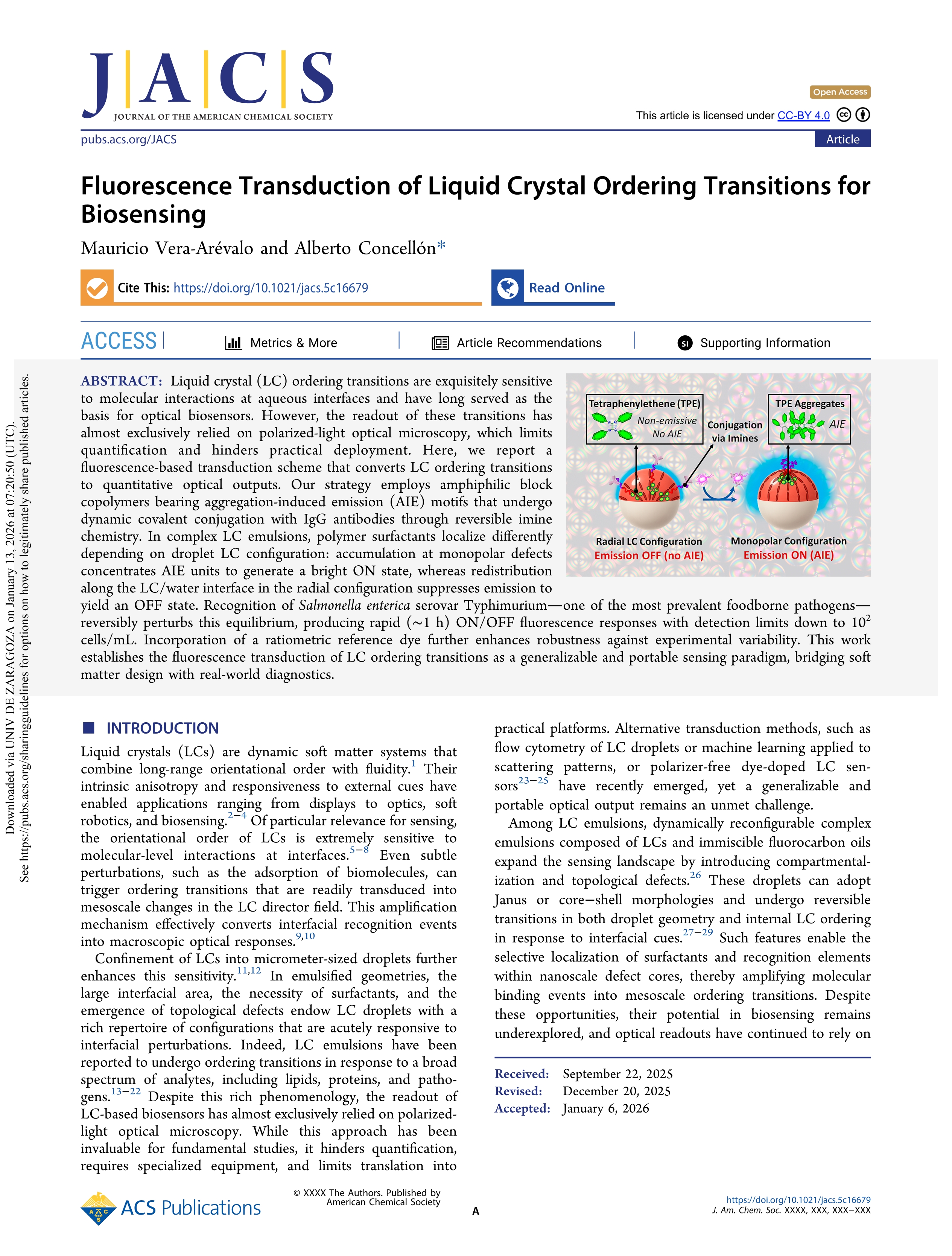
Resumen: Liquid crystal (LC) ordering transitions are exquisitely sensitive to molecular interactions at aqueous interfaces and have long served as the basis for optical biosensors. However, the readout of these transitions has almost exclusively relied on polarized-light optical microscopy, which limits quantification and hinders practical deployment. Here, we report a fluorescence-based transduction scheme that converts LC ordering transitions to quantitative optical outputs. Our strategy employs amphiphilic block copolymers bearing aggregation-induced emission (AIE) motifs that undergo dynamic covalent conjugation with IgG antibodies through reversible imine chemistry. In complex LC emulsions, polymer surfactants localize differently depending on droplet LC configuration: accumulation at monopolar defects concentrates AIE units to generate a bright ON state, whereas redistribution along the LC/water interface in the radial configuration suppresses emission to yield an OFF state. Recognition of Salmonella enterica serovar Typhimurium─one of the most prevalent foodborne pathogens─reversibly perturbs this equilibrium, producing rapid (∼1 h) ON/OFF fluorescence responses with detection limits down to 102 cells/mL. Incorporation of a ratiometric reference dye further enhances robustness against experimental variability. This work establishes the fluorescence transduction of LC ordering transitions as a generalizable and portable sensing paradigm, bridging soft matter design with real-world diagnostics.
Idioma: Inglés
DOI: 10.1021/jacs.5c16679
Año: 2026
Publicado en: Journal of the American Chemical Society
ISSN: 0002-7863
Financiación: info:eu-repo/grantAgreement/ES/MICIU/CEX2023-001286-S
Tipo y forma: Article (Published version)
Área (Departamento): Área Química Orgánica (Dpto. Química Orgánica)
 You must give appropriate credit, provide a link to the license, and indicate if changes were made. You may do so in any reasonable manner, but not in any way that suggests the licensor endorses you or your use.
Exportado de SIDERAL (2026-01-28-15:42:25)
Visitas y descargas
Idioma: Inglés
DOI: 10.1021/jacs.5c16679
Año: 2026
Publicado en: Journal of the American Chemical Society
ISSN: 0002-7863
Financiación: info:eu-repo/grantAgreement/ES/MICIU/CEX2023-001286-S
Tipo y forma: Article (Published version)
Área (Departamento): Área Química Orgánica (Dpto. Química Orgánica)
You must give appropriate credit, provide a link to the license, and indicate if changes were made. You may do so in any reasonable manner, but not in any way that suggests the licensor endorses you or your use. Exportado de SIDERAL (2026-01-28-15:42:25)
Permalink:
Visitas y descargas
Este artículo se encuentra en las siguientes colecciones:
Articles > Artículos por área > Química Orgánica
Record created 2026-01-15, last modified 2026-01-28